
Hiwa Kai Hawaiian Black Lava Sea Salt with activated coconut charcoal (Molokai, Hawaii)
In brief — Hiwa Kai is Pacific sea salt blended with activated coconut-shell charcoal, which is what makes it glossy black, not a volcanic mineral. The salinity is round and clean with a faint smoke, and the charcoal adds a soft velvety trace. You buy it for the contrast: jet-black crystals on pale tuna, scallops or panna cotta. The catch: heat bleeds the color out, so it is a finishing salt, full stop. A small jar runs about $8 to $14. Its aromatic profile develops notes of round clean salinity, faint smoke, marine mineral, extended by volcanic stone and toasted nut, for an intensity of 6/10. In the kitchen, it's best added as a finishing touch, raw, off the heat and it pairs with seared rare tuna, raw scallops and crudo, deviled and soft-boiled eggs. Recommended dosage: a pinch scattered at the end, on a pale surface; the look does as much work as the flavor. Expect from $5.00 to $11.00 per 100g (median $8.00).
Origin : Molokai, Hawaiian archipelago (Pacific solar-evaporated sea salt), United States
« You are buying the look, and it delivers: jet-black crystals on pale crudo are striking. The flavor is a clean, faintly smoky sea salt, pleasant but not remarkable. Honest finishing salt, not a flavor upgrade. Skip the detox marketing. »
Hiwa Kai is Pacific sea salt blended with activated coconut-shell charcoal, which is what makes it glossy black, not a volcanic mineral. The salinity is round and clean with a faint smoke, and the charcoal adds a soft velvety trace. You buy it for the contrast: jet-black crystals on pale tuna, scallops or panna cotta. The catch: heat bleeds the color out, so it is a finishing salt, full stop. A small jar runs about $8 to $14.
Salt · Seasoned salt
Hawaiian Black Lava Salt (Hiwa Kai)
Molokai, Hawaiian archipelago (Pacific solar-evaporated sea salt), United States
round clean salinity · faint smoke · marine mineral
Aromatic profile
| Family | Halite + activated vegetable charcoal |
|---|---|
| Intensity | ●●●○○ (6/10) |
| Main notes | round clean salinity · faint smoke · marine mineral |
| Secondary notes | volcanic stone · toasted nut |
| Mouthfeel | glossy black crystals with a firm crack, then a fast clean melt and a soft velvety trace from the charcoal |
| Finish length | medium, an earthy mineral finish with no bitterness |
Culinary use
- When to add : finishing, raw, off the heat
- Dosage : a pinch scattered at the end, on a pale surface; the look does as much work as the flavor
- Ideal pairings : seared rare tuna, raw scallops and crudo, deviled and soft-boiled eggs, hummus and white bean dips, sushi and poke, white panna cotta and salted caramel
- Avoid with : long braises and slow cooking (the color bleeds out and is wasted), very dark dishes (you lose the whole point, the contrast), high-acid preparations that dull the crystal
The grain in detail
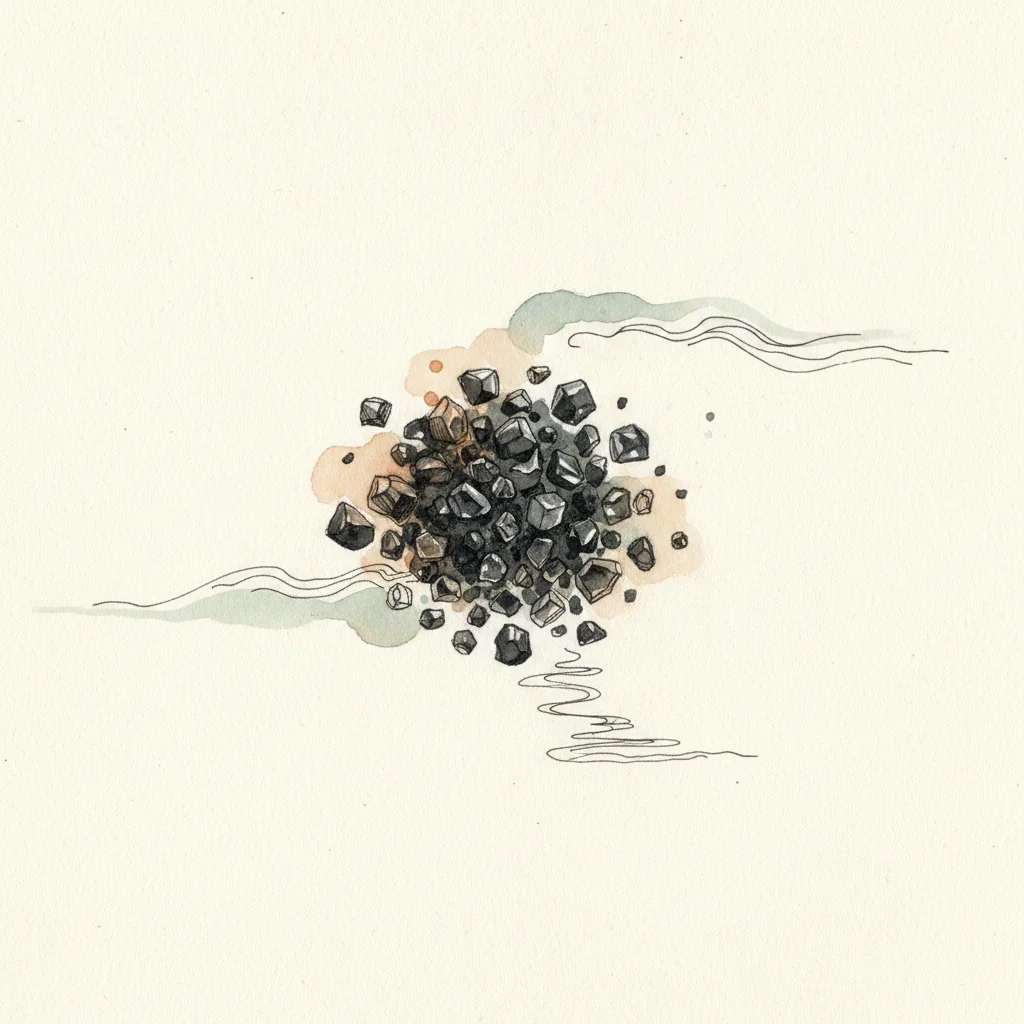
Hiwa Kai (Hawaiian for black sea salt) is solar-evaporated Pacific sea salt that has been blended with activated charcoal made from roasted coconut shells. Production centers on the island of Molokai, where the seawater is concentrated in shallow solar ponds, then the charcoal is folded in during crystallization to coat the grains. Here is the first thing to get straight: the black is the charcoal, not lava and not a volcanic mineral, despite the name. The charcoal is inert and odorless on its own, so its job is mostly visual, turning the crystals a deep glossy black, with a light textural role, that soft velvety trace on the tongue. The salt underneath is the round, clean, faintly sweet Pacific sea salt Hawaii is known for, carrying a whisper of smoke and a mineral note that reads like volcanic stone. In the mouth the crystals crack, melt fast, and finish earthy with no bitterness. Culinarily the look does as much work as the flavor, and that is the honest reason to own it: jet-black crystals scattered over seared rare tuna, white raw scallops, soft-boiled eggs, hummus, sushi, poke, a white panna cotta or fresh mozzarella read as dramatic. It also lands well on salted-caramel cookies and pate de fruits. Two things to know before you buy. First, watch the imitations, a lot of cheap product sold as Hawaiian black salt is Chinese sea salt dyed with charcoal, so look for a Molokai or genuinely Hawaiian source. Second, the activated-charcoal detox marketing is just that, marketing; the charcoal is nutritionally inert and has no proven detox effect at these doses. Treat it as a finishing salt you reach for when the plate is pale and you want contrast.
History & origin
Native Hawaiians have dried Pacific sea salt in the sun since at least the 12th century, using it in cooking and in ritual. Blending the salt with coconut-shell charcoal is far more recent, popularized in the 1990s by Pacific Rim cuisine and modern Hawaiian chefs who wanted the visual drama of a black finishing crystal. The supply stays small and is heavily counterfeited on international markets, where charcoal-dyed sea salt from elsewhere is routinely passed off as the Molokai original.
Provenance & authenticity
What sets the real thing apart — appellation, species and verification cues.
- Grade / standard
- Sea salt blended with activated coconut charcoal
How to verify the real one
- black colour = added activated charcoal (flavouring), not natural
- often blended/finished outside Hawaii
Indicative price
Reference format : 100g — from $5.00 to $11.00 (median : $8.00).
Storage
Airtight jar away from humidity. Keeps for years, the charcoal is stable and does not fade.
Where to buy?
Where to buy it
Links checked on
| Merchant | Price | Action |
|---|---|---|
| Amazon US | — | Amazon US |
| SaltWorks (seasalt.com) | — | SaltWorks (seasalt.com) |
Prices may vary depending on current promotions on the merchant site.
Alternatives if unavailable
Tags
- Hawaii
- United States
- activated charcoal
- black salt
- finishing salt
- visual
Frequently asked questions
- How do you store Hawaiian Black Lava Salt (Hiwa Kai)?
- Airtight jar away from humidity. Keeps for years, the charcoal is stable and does not fade.
- What dosage for Hawaiian Black Lava Salt (Hiwa Kai)?
- a pinch scattered at the end, on a pale surface; the look does as much work as the flavor
- When should you add Hawaiian Black Lava Salt (Hiwa Kai) in cooking?
- It's best used finishing, raw, off the heat.
- What should you avoid pairing Hawaiian Black Lava Salt (Hiwa Kai) with?
- Avoid with: long braises and slow cooking (the color bleeds out and is wasted), very dark dishes (you lose the whole point, the contrast), high-acid preparations that dull the crystal.
Go further
The dishes where this hawaiian black lava salt (hiwa kai) shines
Also a recommended alternative for
As a complementary pairing with
See every dish where this product is mentioned →
Other salts to discover
Featured in these gift sets
Page prepared according to our methodology. Purchase links marked sponsored and liable to earn a commission — details on our Affiliations page.