
Comparison
Manuka vs acacia honey — which to choose?
These two barely belong on the same shelf. Manuka is a dense, bitter, lab-certified medicinal honey you buy by the MGO number, around $38 a jar. Acacia is the mildest, palest honey there is, about $16, made to sweeten without flavor. For a sore throat, Manuka. For a drizzle, acacia, every time.

Honey · Medicinal honey
Manuka Honey (UMF)
North and South Island, coastal and forest scrubland, New Zealand (UMF)
cooked honey · eucalyptus · licorice
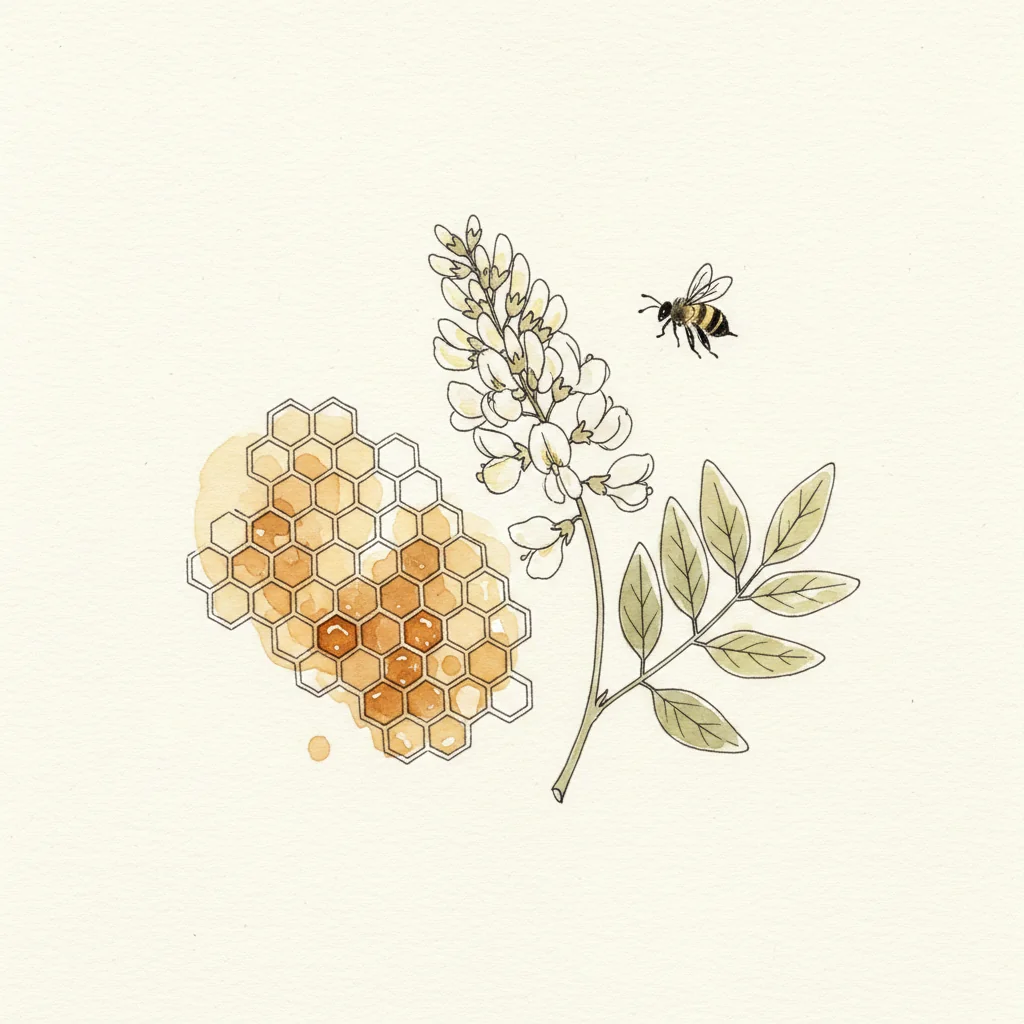
Honey · Monofloral honey
Acacia Honey
Great Hungarian Plain and the wider Carpathian Basin (also Romania, Bulgaria, Serbia), Hungary
soft floral sweetness · vanilla · clean sugar
Our verdict
Acacia for everyday sweetening; Manuka for its certified medicinal punch, not for taste.
At a glance
| Criterion | Manuka Honey (UMF) | Acacia Honey |
|---|---|---|
| Origin | New Zealand, North & South Island scrubland | Hungary & the Carpathian Basin |
| Botanical | Leptospermum scoparium | Robinia pseudoacacia (black locust) |
| Certification | UMF / MGO lab-tested (the whole point) | None |
| Intensity | 8/10 — thick, bitter, medicinal | 3/10 — soft, floral, clean |
| Main notes | Cooked honey, eucalyptus, licorice, noble bitterness | Vanilla, soft florals, clean sugar |
| Best use | Raw by the spoon, throat & immune support, warm tea | Raw drizzle, goat cheese, green tea, vinaigrettes |
| Median price | ~$38 / 250g jar (UMF 10+) | ~$16 / 450g jar |
| Value verdict | Worth it only if you want the MGO | Imbattable everyday sweetener |
When to choose Manuka Honey (UMF)
Reach for Manuka when you're buying the certificate, not the flavor. The UMF or MGO number on the jar is a real, lab-tested measure of antibacterial strength, and it's the only reason to pay three times the price of an ordinary honey. Keep a jar for the spoon-by-spoon stuff: a teaspoon raw at the first scratch of a sore throat, stirred into warm (never boiling) tea, smeared on salted-butter toast when you're run down. Here's the mechanism that decides everything: the MGO that justifies the premium breaks down above 104°F / 104°F (40°C), so the second you cook with Manuka you've paid medicinal-honey money for what is now just an expensive, slightly bitter sweetener. Spoon it onto Greek yogurt, fresh cheeses or a honey-lemon marinade for salmon — raw, cold, off the heat. Buy by grade: UMF 10+ / MGO 263+ is the honest entry point; below that you're paying for the name. And don't chase the freshest jar — the MGO climbs slowly over the first 12 to 24 months, so an older jar can be the stronger one. What Manuka is not is a flavor honey. Its dense, eucalyptus-and-licorice bitterness is an acquired taste, and on a cheese board or in a dessert a French chestnut honey gives you more character for a fifth of the price. If your goal is taste rather than throat, skip the upgrade. The one place acacia can't follow Manuka is the medicine cabinet — that's Manuka's lane, and it owns it.
When to choose Acacia Honey
Acacia takes nearly everything else. This is the honey you use when you want sweetness and nothing else: no bitterness, no strong floral signature, no fight with the dish. It pours thin and glass-clear, and thanks to its high fructose it stays runny for years and almost never crystallizes — which is exactly why it dissolves invisibly into tea, vinaigrettes and cocktails where a bolder honey would muddy things. At about $16 a 450g jar it costs a fraction of Manuka, so you can pour it freely. Four jobs it owns. First, fresh cheeses — drizzle it raw over goat cheese or burrata and it sweetens without burying the milk. Second, green and herbal teas — it sweetens the cup without dragging in eucalyptus or molasses notes. Third, breakfast — Greek yogurt and granola, warm biscuits, pancakes and waffles, where you want gloss and sweetness, not a statement. Fourth, a neutral sweetener in a vinaigrette or a sour cocktail. The rule: if you don't want to taste the honey, reach for acacia. Add it raw, off the heat — its delicate aromatics cook off, so don't waste it in a long braise or a hot bake. And know its limit: against a sharp blue cheese it simply disappears, where a chestnut or buckwheat honey would hold its ground. Acacia is the one honey that does almost no harm to your budget and almost no harm to the dish — the safe, generous default. What it can't do is heal a throat, and you shouldn't ask it to.
Where to buy?
Manuka Honey (UMF)
Links checked on
| Merchant | Price | Action |
|---|---|---|
| Amazon US | — | Amazon US |
| Sous Chef UK | — | Sous Chef UK |
Prices may vary depending on current promotions on the merchant site.
Acacia Honey
Links checked on
| Merchant | Price | Action |
|---|---|---|
| Amazon US | — | Amazon US |
| Sous Chef UK | — | Sous Chef UK |
Prices may vary depending on current promotions on the merchant site.
Frequently asked questions
- Is Manuka honey actually better than acacia?
- Not for cooking or flavor — they do different jobs. Manuka is a certified medicinal honey you buy by the MGO number; acacia is a mild everyday sweetener. For taste and value, acacia wins; for throat and immune support, Manuka.
- Can I cook with Manuka honey?
- You can, but you shouldn't if you're paying for the MGO. The active compound breaks down above 104°F / 104°F (40°C), so cooking turns a $38 jar into an ordinary bitter sweetener. Use it raw.
- Which is better value?
- Acacia, easily, for everyday use — about $16 a jar versus $38 for entry-grade Manuka. Manuka is only worth its premium if you specifically want the lab-certified MGO.
- Does either one crystallize?
- Acacia almost never does, thanks to its high fructose. Manuka can thicken and set over time; a brief warm-water bath under 104°F restores it without harming the MGO.
The best pairings
With Manuka Honey (UMF)
With Acacia Honey
Comparison prepared according to our methodology. Sponsored purchase links — see our affiliations.