
Comparison
Tellicherry black vs Penja white pepper: when to use each?
Same species, opposite uses. Tellicherry black brings cocoa, leather and broad heat for steak, curry and braises. Penja white PGI from Cameroon brings musky warmth and menthol for cream sauces, white fish and pale dishes where black specks would look wrong. Own both; they don't overlap.
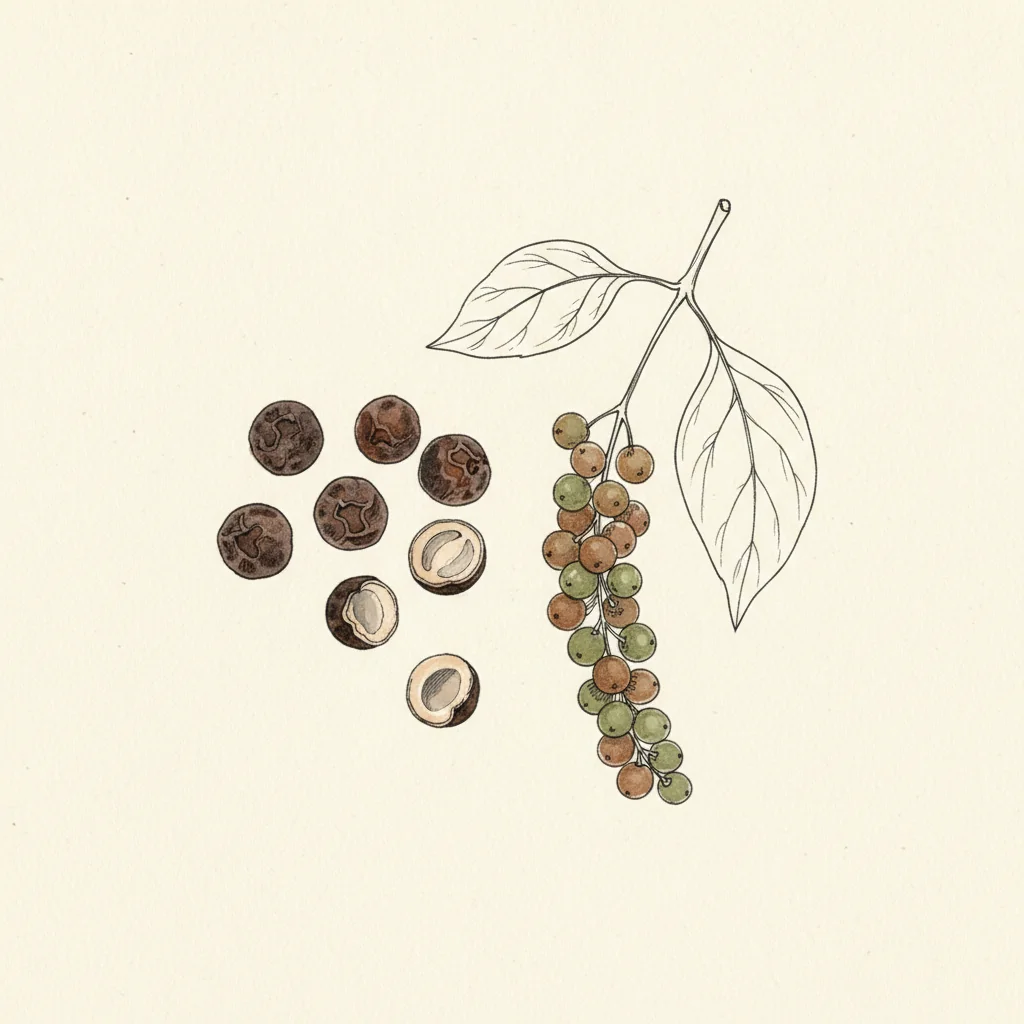
Pepper · Black pepper
Tellicherry Black Pepper
Malabar Coast, Kannur district (Kerala), India
dark cocoa · worn leather · candied citrus
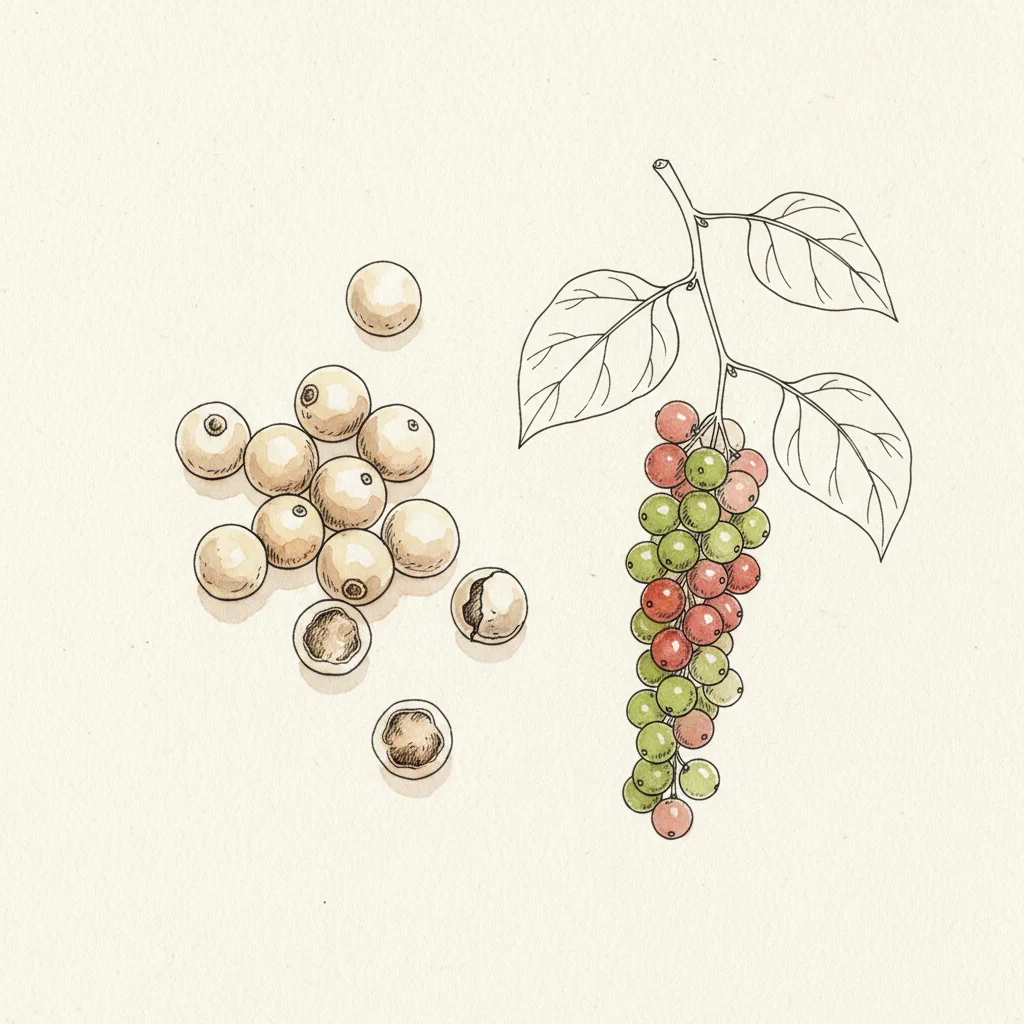
Pepper · White pepper
Penja White Pepper
Penja Valley, Littoral region, Cameroon (PGI)
musky animal warmth · fresh menthol · damp forest floor
Our verdict
Tellicherry for red meat and braises; Penja white for cream, fish and pale sauces.
At a glance
| Criterion | Tellicherry Black Pepper | Penja White Pepper |
|---|---|---|
| Botanical name | Piper nigrum (black) | Piper nigrum (white) |
| Origin | Malabar Coast, Kerala, India | Penja Valley, Cameroon |
| Appellation | None (TGSEB grade) | PGI since 2013 |
| Intensity | 8/10 — broad, slow heat | 7/10 — round, spreading warmth |
| Main notes | Dark cocoa, worn leather, candied citrus | Musky animal warmth, menthol, forest floor |
| Best use | Steak, curry, braises, dark chocolate | Cream sauces, white fish, scallops, carpaccio |
| Median price | ~$10 / 8 oz | ~$16 / 2.5 oz |
When to choose Tellicherry Black Pepper
Reach for Tellicherry on anything dark and robust. Its TGSEB berries carry dark cocoa, worn leather and candied citrus over a broad, slow-building heat that stands up to beef fat and char. That's the pepper for a seared ribeye, BBQ brisket, garam masala and a long braise — crack it coarse and late so it doesn't scorch on the sear. It survives cooking better than most peppers, so it works tied in a cloth for a stock or added late to a bourguignon. Use it on baked eggs, carbonara, aged cheddar and 70% dark chocolate. The one thing it can't do is disappear: those black specks read as dirt in a beurre blanc, a celeriac purée or a white fish in cream, and the cocoa-leather weight overpowers anything delicate. That's where Penja takes over. So think of Tellicherry as the dark-dish pepper — red meat, braises, spice blends, chocolate — and reach for it whenever color and heat are welcome rather than a problem. About $10 a half-pound jar, two or three coarse turns per plate. It's the everyday default in a black-pepper kitchen; the only reason to set it down is a pale plate where you want warmth without visible pepper, and then it's the Cameroonian white you want, not this.
When to choose Penja White Pepper
Reach for Penja white when the dish is pale and delicate. It's a rare grain worth grinding fresh: ripe berries soaked in the spring water of Cameroon's volcanic Penja Valley, then sun-dried to an ivory bead, PGI-protected since 2013 so the provenance is real. The nose is musky, almost animal, with a clean menthol lift; the heat is round and spreading, not biting. That profile is built for exactly the dishes Tellicherry ruins: delicate white fish, seared scallops, cream sauces and beurre blanc, poached chicken, fresh cheeses and carpaccio. On all of them, white pepper seasons without leaving black specks and without the cocoa-leather weight that would bury a subtle sauce. One or two turns of the mill per plate, ground fresh just before serving — the volatile menthol fades fast, so it's a finishing move, not a base. The catch: it's not a workhorse. Heavily spiced dishes drown the menthol, long marinades cook off the aromatics, and rustic tomato sauces flatten it — none of that is where you spend Penja money. And it is a splurge: about $16 for a 2.5 oz jar, far pricier per gram than Tellicherry. Buy it for the pale, refined plates where black pepper would look and taste wrong, and let Tellicherry handle everything dark. The two don't compete; they cover opposite halves of the kitchen.
Where to buy?
Tellicherry Black Pepper
Links checked on
| Merchant | Price | Action |
|---|---|---|
| Amazon US | — | Amazon US |
| Spicewalla | — | Spicewalla |
| Steenbergs UK | — | Steenbergs UK |
Prices may vary depending on current promotions on the merchant site.
Penja White Pepper
Links checked on
| Merchant | Price | Action |
|---|---|---|
| Amazon US | — | Amazon US |
| La Boite | — | La Boite |
| Sous Chef UK | — | Sous Chef UK |
Prices may vary depending on current promotions on the merchant site.
Frequently asked questions
- What's the difference between black and white pepper?
- Same plant. Black pepper is the whole berry dried with its skin; white pepper is the ripe berry soaked and the skin removed, leaving the ivory core. White is milder, mustier and leaves no black specks — built for pale sauces and fish.
- Can I use white pepper instead of black?
- In pale, delicate dishes, yes — Penja white is the upgrade there. But it can't replace Tellicherry's cocoa depth on a steak or in a curry. They cover opposite ends of the kitchen rather than substituting.
- Why is Penja white more expensive?
- It's PGI-protected, processed by hand (berries soaked and skins removed), and grown in a small volcanic valley in Cameroon. About $16 for 2.5 oz versus $10 for half a pound of Tellicherry. You pay for refinement, not range.
- Does white pepper go in early or late?
- Late. Penja's menthol top notes are volatile and cook off, so grind it fresh at the finish. Tellicherry, by contrast, is dense enough to add earlier and even survive a braise.
The best pairings
With Tellicherry Black Pepper
With Penja White Pepper
Comparison prepared according to our methodology. Sponsored purchase links — see our affiliations.