
Mahleb, Ground Cherry-Stone Spice (St. Lucy Cherry Kernel)
In brief — Mahleb is the ground kernel inside the pit of the St. Lucy cherry, and it tastes like bitter almond crossed with sour cherry and marzipan. It's the secret in Greek tsoureki and Middle Eastern ma'amoul, where a teaspoon turns a plain enriched dough fragrant. Buy it whole and grind fresh: ready-ground goes flat fast. About $9 to $13 a jar. Its aromatic profile develops notes of bitter almond, sour cherry, marzipan, extended by rosewater hint and faint vanilla warmth, for an intensity of 6/10. In the kitchen, it's best added for baking and it pairs with Greek tsoureki Easter bread, Middle Eastern ma'amoul cookies, kahk and date pastries. Recommended dosage: about 1/2 to 1 teaspoon of freshly ground kernels per loaf of enriched dough; more than that and the bitterness takes over. Expect from $8.00 to $13.00 per 3 to 5 oz jar, ground (median $10.50).
Origin : Eastern Mediterranean and Anatolia (Syria, Lebanon, Greece, Turkey, Iran), Levant and Greece
Prunus mahaleb
« Indispensable for tsoureki and ma'amoul, baffling anywhere else. Buy the whole kernels and grind fresh, because ground mahleb fades fast. One teaspoon per loaf, never more, or the bitterness wins. »
Mahleb is the ground kernel inside the pit of the St. Lucy cherry, and it tastes like bitter almond crossed with sour cherry and marzipan. It's the secret in Greek tsoureki and Middle Eastern ma'amoul, where a teaspoon turns a plain enriched dough fragrant. Buy it whole and grind fresh: ready-ground goes flat fast. About $9 to $13 a jar.
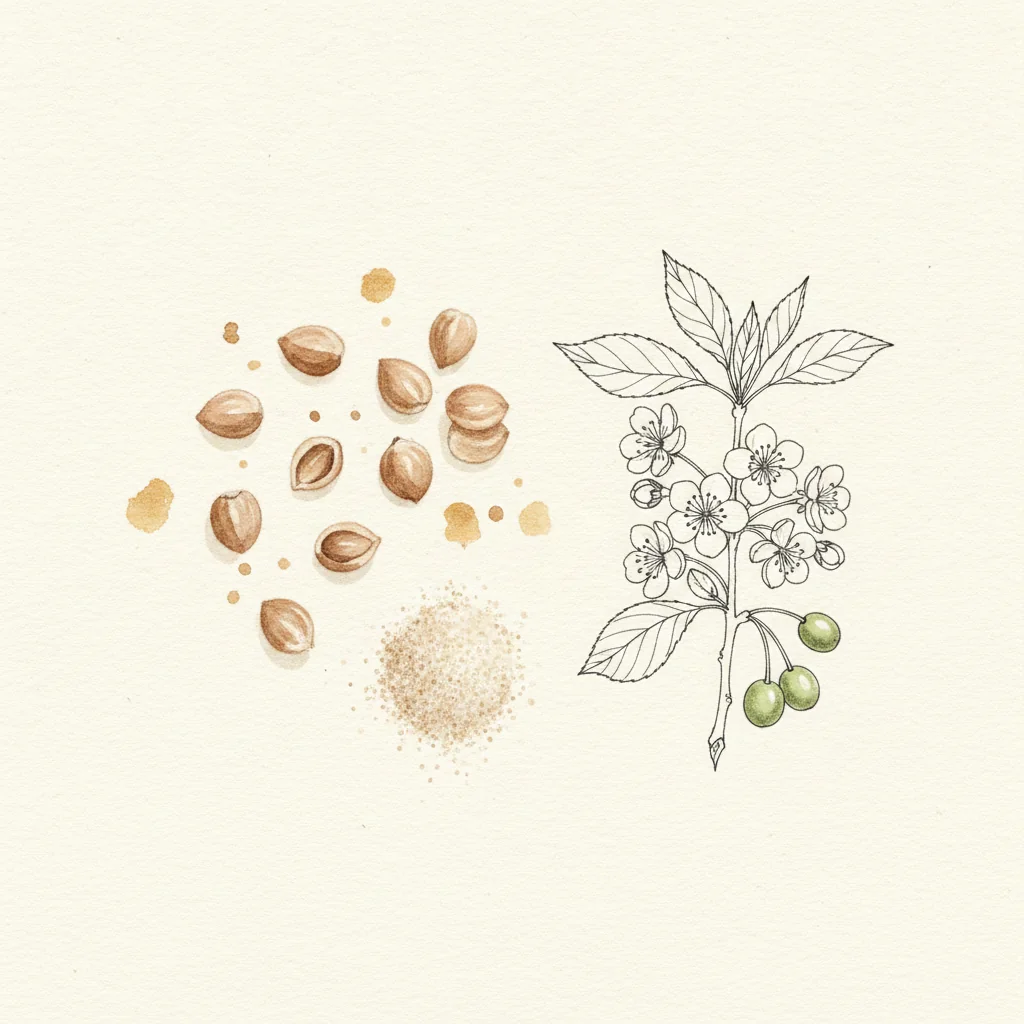
Spice · Ground stone-fruit kernel
Mahleb
Eastern Mediterranean and Anatolia (Syria, Lebanon, Greece, Turkey, Iran), Levant and Greece
bitter almond · sour cherry · marzipan
Aromatic profile
| Family | Stone-fruit kernel (cherry pit) |
|---|---|
| Intensity | ●●●○○ (6/10) |
| Main notes | bitter almond · sour cherry · marzipan |
| Secondary notes | rosewater hint · faint vanilla warmth |
| Mouthfeel | fine pale powder that blooms with heat, leaving a soft bitter-almond warmth and a clean cherry-skin tang |
| Finish length | medium, a nutty bitterness that lingers without turning harsh when dosed lightly |
Culinary use
- When to add : baking
- Dosage : about 1/2 to 1 teaspoon of freshly ground kernels per loaf of enriched dough; more than that and the bitterness takes over
- Ideal pairings : Greek tsoureki Easter bread, Middle Eastern ma'amoul cookies, kahk and date pastries, Armenian and Cypriot festival breads, rice pudding and custards, shortbread and almond doughs
- Avoid with : savory meat rubs (it reads sweet and out of place), long simmers (the aroma flattens and the bitterness sharpens), anything where you'd want clean vanilla, not almond
The grain in detail
Mahleb is made from the small kernel found inside the stone of the St. Lucy cherry (Prunus mahaleb), a wild Mediterranean cherry grown for its seed, not its fruit. You crack the pit, take out the soft kernel, and grind it to a pale cream powder. The flavor is the whole reason it exists: bitter almond up front, then sour cherry and marzipan, with a faint floral lift some people read as rosewater. It carries the same family of compounds that give bitter almonds and apricot kernels their scent, which is why a little goes a long way and too much turns medicinal. This is a baking spice, full stop. It defines Greek tsoureki, the braided Easter bread, and shows up across the Levant in ma'amoul, kahk, and date-filled pastries, plus Armenian and Cypriot festival breads. A half-teaspoon to a teaspoon per loaf is the working dose, kneaded into enriched, butter-and-egg doughs where it blooms with the heat of the oven. The catch with mahleb is freshness. Ground mahleb oxidizes and loses its perfume within months, going dull and faintly rancid, so the kernels are worth buying whole and grinding just before you bake. It is genuinely niche outside Greek and Middle Eastern kitchens, which is why even good supermarkets rarely stock it and you'll usually order it online.
History & origin
Mahleb has been used in Eastern Mediterranean baking for well over a thousand years, named in medieval Arabic and Byzantine texts and tied to religious festival breads across Orthodox and Levantine traditions. The St. Lucy cherry is native to the region from the Mediterranean to Central Asia, long grown as a rootstock and for its aromatic kernel rather than its small bitter fruit. It carries no PDO or PGI protection; it remains a traditional household and bakery spice rather than a branded specialty, sold through Greek, Armenian, and Middle Eastern grocers.
Provenance & authenticity
What sets the real thing apart — appellation, species and verification cues.
- Species
- Prunus mahaleb
Indicative price
Reference format : 3 to 5 oz jar, ground — from $8.00 to $13.00 (median : $10.50).
Storage
Best stored as whole kernels in an airtight jar, away from light and heat; grind only what you need. Whole kernels keep their aroma a year or more, ground mahleb fades within a few months.
Where to buy?
Where to buy it
Links checked on
| Merchant | Price | Action |
|---|---|---|
| Amazon US | — | Amazon US |
| NY Spice Shop | — | NY Spice Shop |
| Sous Chef UK | — | Sous Chef UK |
Prices may vary depending on current promotions on the merchant site.
Tags
- Levant
- Greece
- baking spice
- cherry kernel
- bitter almond
- tsoureki
- rare
Frequently asked questions
- How do you store Mahleb?
- Best stored as whole kernels in an airtight jar, away from light and heat; grind only what you need. Whole kernels keep their aroma a year or more, ground mahleb fades within a few months.
- What dosage for Mahleb?
- about 1/2 to 1 teaspoon of freshly ground kernels per loaf of enriched dough; more than that and the bitterness takes over
- When should you add Mahleb in cooking?
- It's best used baking.
- What should you avoid pairing Mahleb with?
- Avoid with: savory meat rubs (it reads sweet and out of place), long simmers (the aroma flattens and the bitterness sharpens), anything where you'd want clean vanilla, not almond.
Go further
The dishes where this mahleb shines
See every dish where this product is mentioned →
Other spices to discover
Page prepared according to our methodology. Purchase links marked sponsored and liable to earn a commission — details on our Affiliations page.