
Ground Sumac, dried crushed berries of Rhus coriaria (Aleppo and the Syrian coastal mountains)
In brief — Sumac is dried red berry crushed to a coarse, wine-red powder, and it does one thing better than anything in your rack: it makes food sour without making it wet. The best lots come off the hills around Aleppo and the Syrian coast, where cooks have used it instead of lemon for two thousand years. Look for deep burgundy, not brown, color is the freshness tell. About $9 for a 4 oz bag. Its aromatic profile develops notes of tart lemon, dried red berry, light tannin, extended by ripe raspberry and green apple, for an intensity of 6/10. In the kitchen, it's best added as a finishing touch only, off the heat, dusted straight onto the plate and it pairs with fattoush and chopped salads, hummus and labneh, grilled lamb and chicken skewers. Recommended dosage: one to two teaspoons over a dish for four, scattered at the table. Expect from $7.00 to $12.00 per 4 oz bag (median $9.00).
Origin : Aleppo and the coastal mountains, plus neighboring Lebanon, Syria
Rhus coriaria
« When you find a true Levantine lot, deep burgundy and barely salted, the tart raspberry profile is unbeatable. The catch: much shelf sumac is cut with salt or dulled brown. Taste before you trust the label. »
Sumac is dried red berry crushed to a coarse, wine-red powder, and it does one thing better than anything in your rack: it makes food sour without making it wet. The best lots come off the hills around Aleppo and the Syrian coast, where cooks have used it instead of lemon for two thousand years. Look for deep burgundy, not brown, color is the freshness tell. About $9 for a 4 oz bag.
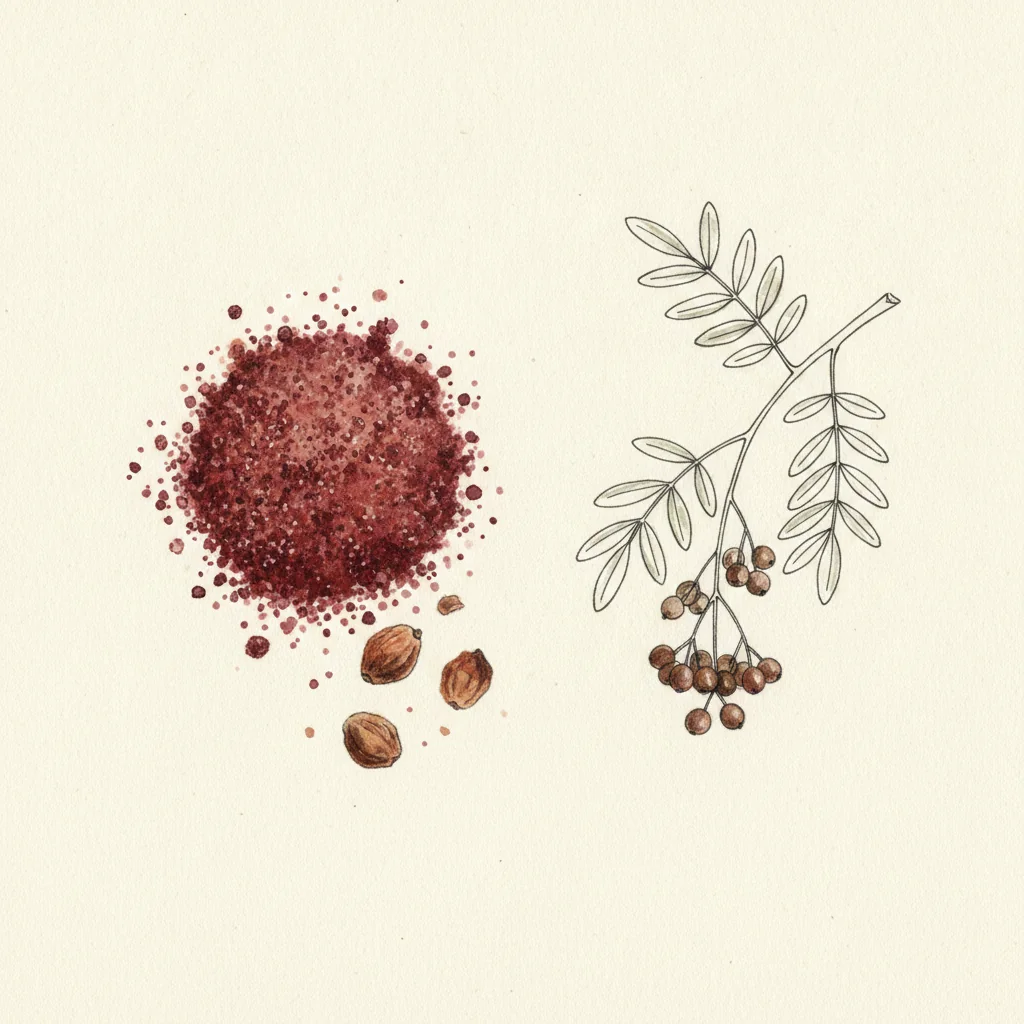
Spice · Spice berry
Sumac
Aleppo and the coastal mountains, plus neighboring Lebanon, Syria
tart lemon · dried red berry · light tannin
Aromatic profile
| Family | Rhus coriaria |
|---|---|
| Intensity | ●●●○○ (6/10) |
| Main notes | tart lemon · dried red berry · light tannin |
| Secondary notes | ripe raspberry · green apple · soft vinegar |
| Mouthfeel | a clean, almost astringent sourness that grips without any added liquid |
| Finish length | medium, fading on a fruity, slightly puckering finish |
Culinary use
- When to add : finishing only, off the heat, dusted straight onto the plate
- Dosage : one to two teaspoons over a dish for four, scattered at the table
- Ideal pairings : fattoush and chopped salads, hummus and labneh, grilled lamb and chicken skewers, raw red onions for kebabs, ripe tomatoes and smashed avocado, za'atar blends
- Avoid with : dishes already heavily acidic from lemon or vinegar, long dry roasting (the color dulls and the tartness flattens)
The grain in detail
Sumac is the ground berry of Rhus coriaria, the only one of the genus you cook with, and it is the answer whenever you want sour but can't afford the water a lemon would add. The crushed berries throw a clean, fruity tartness, malic and tartaric acid up front, a whisper of tannin behind, with notes of dried raspberry, prune and green apple. The plant grows wild on dry limestone hillsides all around the eastern Mediterranean, but the cooks' benchmark is the Levant: the slopes around Aleppo and the Syrian coastal mountains, plus neighboring Lebanon, where the grind is finest and the berries ripen sweetest. Berries are picked dead ripe in late summer, sun-dried, then milled, traditionally with a pinch of salt to lock the color and the acid. That color is your single best quality check. A real sumac is deep burgundy to garnet; if it has drifted toward dull brown it has oxidized, been dried too long, or been cut with lesser fruit. Here is the catch worth knowing: a lot of supermarket sumac is mostly salt, so taste before you trust the label. In the Levant it is a true acidulant, not a garnish, replacing lemon when you want to keep a dish dry-textured. It is one of the three pillars of za'atar alongside thyme and sesame, it goes over fattoush and grilled lamb, it cuts the richness of hummus, and it sharpens the raw onions that ride alongside a kebab. At a US table it earns its keep on ripe tomatoes, smashed avocado, hard-boiled eggs and roast chicken. One thing it will not do: survive heat. Cook it down and the fruit goes flat. Dust it on at the very end, off the flame, and it stays bright. A note on the supply chain, since it shapes what you'll actually find: years of war disrupted the Syrian trade, so much of what sells in the US is now labeled Turkish, often the wild-harvested cured sumac from around Gaziantep, which is excellent in its own right. The Aleppo-and-coast benchmark is the flavor standard; the jar in front of you may carry a different stamp.
History & origin
Mediterranean cooks were souring food with sumac long before lemons reached the region: the Greeks and Romans used it as their acid of choice, and the Levant has cooked with it continuously for two millennia. It is one of the three spices in Levantine za'atar. Its arrival in Western kitchens is recent, carried in on the wave of Lebanese and Israeli cooking in the 2010s. Today the Syrian coast and Aleppo set the quality bar, though Turkish wild-harvested lots fill most US shelves.
Provenance & authenticity
What sets the real thing apart — appellation, species and verification cues.
- Species
- Rhus coriaria
How to verify the real one
- Rhus coriaria (NOT toxic Toxicodendron sumac)
- Aleppo/coastal Syria-Lebanon origin
- deep brick-red, tart; bright red can mean added salt/dye
Indicative price
Reference format : 4 oz bag — from $7.00 to $12.00 (median : $9.00).
Storage
Airtight jar away from light and damp. Color is the indicator: when the red drifts toward brown, the spice is oxidizing. Keeps 12 to 18 months.
Where to buy?
Where to buy it
Links checked on
| Merchant | Price | Action |
|---|---|---|
| Amazon US | — | Amazon US |
| Burlap & Barrel | — | Burlap & Barrel |
| Spicewalla | — | Spicewalla |
| Sous Chef UK | — | Sous Chef UK |
Prices may vary depending on current promotions on the merchant site.
Tags
- sumac
- Syria
- Aleppo
- Levant
- Rhus coriaria
- acidulant
- za'atar
Frequently asked questions
- How do you store Sumac?
- Airtight jar away from light and damp. Color is the indicator: when the red drifts toward brown, the spice is oxidizing. Keeps 12 to 18 months.
- What dosage for Sumac?
- one to two teaspoons over a dish for four, scattered at the table
- When should you add Sumac in cooking?
- It's best used finishing only, off the heat, dusted straight onto the plate.
- What should you avoid pairing Sumac with?
- Avoid with: dishes already heavily acidic from lemon or vinegar, long dry roasting (the color dulls and the tartness flattens).
Go further
The dishes where this sumac shines
Also a recommended alternative for
As a complementary pairing with
See every dish where this product is mentioned →
Other spices to discover
Page prepared according to our methodology. Purchase links marked sponsored and liable to earn a commission — details on our Affiliations page.