
Himalayan Pink Salt (Khewra mine, Punjab, Pakistan)
In brief — Pink Himalayan salt comes from the Khewra mine in Pakistan, not India and not the Himalayas proper, and its color is just fossilized iron oxide. The salinity is rounder than a sea salt, the minerality warmer. It's a commodity rock salt: fine grain runs about $5 to $6 a pound, and the wellness halo is marketing. Buy it for the warm crunch and the salt block, not the mineral myth. Its aromatic profile develops notes of round salinity, warm mineral, faint trace-element edge, extended by warm stone and pink earth, for an intensity of 6/10. In the kitchen, it's best added raw or finishing and it pairs with steak seared on a hot salt block, carpaccio, tomato salad. Recommended dosage: 1 to 2 g, ground or crushed into crystals over the finished plate. Expect from $8.00 to $14.00 per 2 lb fine-grain bag (median $11.00).
Origin : Khewra Salt Mine, Salt Range, Punjab province, Pakistan
« Honest verdict: a pretty commodity rock salt with a warm, round salinity and a faint metallic finish. The mineral health story is marketing. Worth buying for the salt block, not the myth. »
Pink Himalayan salt comes from the Khewra mine in Pakistan, not India and not the Himalayas proper, and its color is just fossilized iron oxide. The salinity is rounder than a sea salt, the minerality warmer. It's a commodity rock salt: fine grain runs about $5 to $6 a pound, and the wellness halo is marketing. Buy it for the warm crunch and the salt block, not the mineral myth.
Salt · Rock salt
Himalayan Pink Salt
Khewra Salt Mine, Salt Range, Punjab province, Pakistan
round salinity · warm mineral · faint trace-element edge
Aromatic profile
| Family | Halite (fossil sodium chloride) |
|---|---|
| Intensity | ●●●○○ (6/10) |
| Main notes | round salinity · warm mineral · faint trace-element edge |
| Secondary notes | warm stone · pink earth |
| Mouthfeel | hard, slow-dissolving crystals; the salinity is rounder and less aggressive than a sea salt |
| Finish length | medium, with a slightly metallic finish from the iron |
Culinary use
- When to add : raw or finishing
- Dosage : 1 to 2 g, ground or crushed into crystals over the finished plate
- Ideal pairings : steak seared on a hot salt block, carpaccio, tomato salad, hard-boiled eggs, fresh cheeses, a margarita rim
- Avoid with : long braises (no real payoff, any salt works), stocks and broths, anywhere you want a clean shattering crunch (this isn't a flaky salt)
The grain in detail
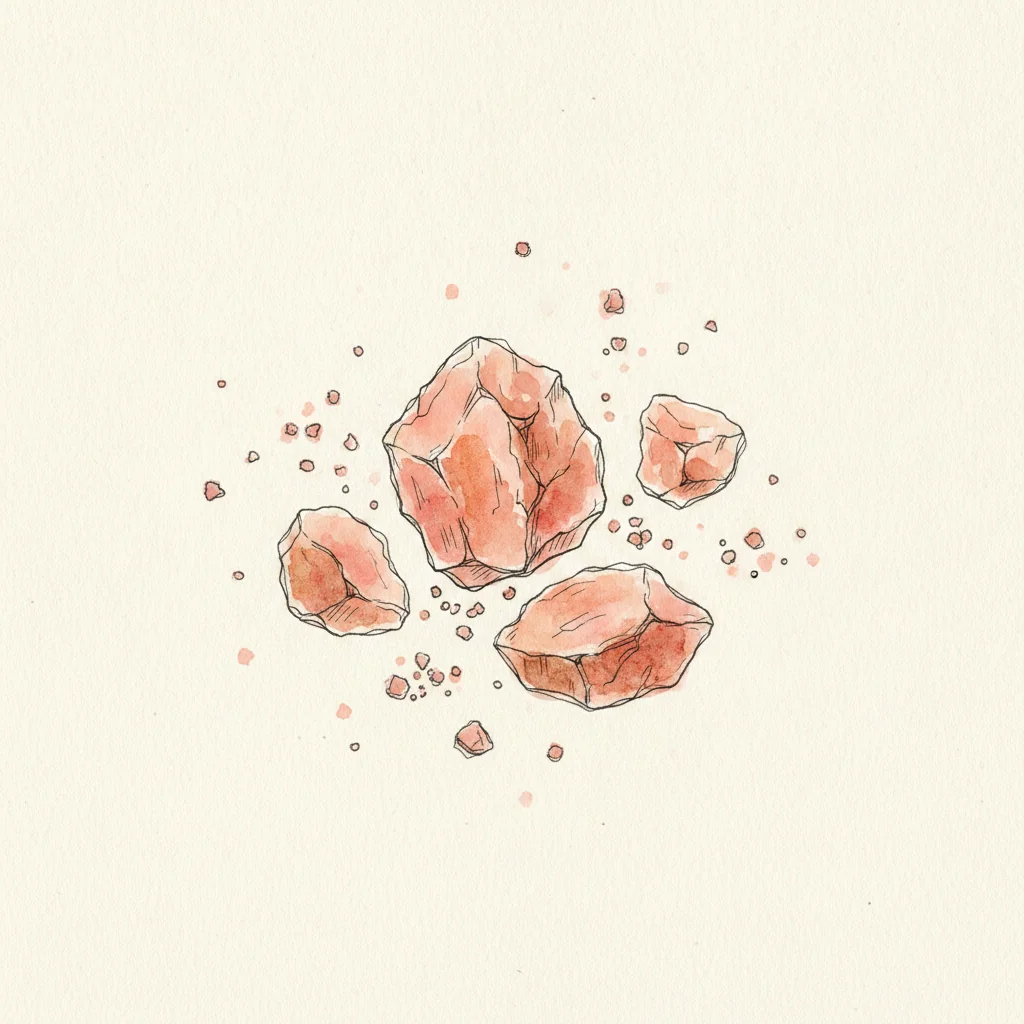
Pink Himalayan salt has only a loose geographic tie to the Himalayas: it's mined at Khewra in Pakistan's Salt Range, roughly 300 km from the mountains the name borrows. The Khewra mine, worked since the 1500s and one of the oldest and deepest in the world, sits on a salt bed that formed 250 to 500 million years ago when an ancient sea evaporated and got trapped. The pink color, from pale blush to salmon, comes from iron oxide in the rock, present in varying amounts. The crystals are large, hard and translucent, sometimes flecked with color. The mineral profile is different from a sea salt: it's 95 to 98 percent sodium chloride, with a trace-element signature, iron, magnesium, potassium, calcium, that lends a light metallic note on the finish. The salinity is round, less aggressive than a dry industrial salt, and it melts slowly on the tongue. Two real uses in the kitchen. First, crushed or grated as a finishing crystal over seared meats, carpaccio, tomato salads, hard-boiled eggs. Second, and this is where it earns its keep, the salt block: a thick slab cut from the rock, heated slowly, then used to sear fish, meat and vegetables, which season themselves by contact. Cold, the same block plates sushi or chills desserts. Here's the part the label won't tell you: the trace minerals everyone sells you on are present in quantities far too small to do anything nutritional. It's a salt, a good-looking one, and that's the honest pitch.
History & origin
Khewra produces around 350,000 tonnes a year, one of the largest non-marine salt outputs in the world, managed by the Pakistan Mineral Development Corporation since 1872. For most of its history it was sold as a basic industrial salt. A wave of US and European wellness marketing in the 2000s repositioned it as a premium 'Himalayan' product and demand exploded. The naming stays contested: the salt is pulled more than 300 km from the actual range.
Provenance & authenticity
What sets the real thing apart — appellation, species and verification cues.
- Grade / standard
- Rock/halite mineral salt
How to verify the real one
- Khewra mine, Punjab Pakistan (NOT Himalaya proper)
- pink hue from iron oxide traces
- fossil sea, mined not evaporated
Indicative price
Reference format : 2 lb fine-grain bag — from $8.00 to $14.00 (median : $11.00).
Storage
Airtight jar away from humidity. Keeps indefinitely, it's a fossil salt.
Where to buy?
Where to buy it
Links checked on
| Merchant | Price | Action |
|---|---|---|
| Amazon US | — | Amazon US |
| Spicewalla | — | Spicewalla |
| Sous Chef UK | — | Sous Chef UK |
Prices may vary depending on current promotions on the merchant site.
Alternatives if unavailable
Tags
- Pakistan
- Khewra
- rock salt
- fossil salt
- mineral
- pink
- salt block
Frequently asked questions
- How do you store Himalayan Pink Salt?
- Airtight jar away from humidity. Keeps indefinitely, it's a fossil salt.
- What dosage for Himalayan Pink Salt?
- 1 to 2 g, ground or crushed into crystals over the finished plate
- When should you add Himalayan Pink Salt in cooking?
- It's best used raw or finishing.
- What should you avoid pairing Himalayan Pink Salt with?
- Avoid with: long braises (no real payoff, any salt works), stocks and broths, anywhere you want a clean shattering crunch (this isn't a flaky salt).
Go further
The dishes where this himalayan pink salt shines
See every dish where this product is mentioned →
Other salts to discover
Featured in these gift sets
Page prepared according to our methodology. Purchase links marked sponsored and liable to earn a commission — details on our Affiliations page.