
Baharat, the all-purpose warm spice blend of the Levant and the Gulf
In brief — Baharat is Arabic for "spices" — the everyday warm blend that does in the Levant and the Gulf what garam masala does in India: the all-purpose backbone of savory cooking. There's no fixed recipe, but the core runs black pepper, allspice, cumin, coriander, cassia, clove, cardamom and paprika. Gulf versions lean on dried lime and a darker clove; Turkish ones push mint and chili. Buy from a serious house, not a supermarket sachet, and bloom it in fat — never dust it on raw. In the kitchen, it's best added rubbed onto meat before cooking or bloomed in the fat at the start, not dusted raw over the finished plate and it pairs with lamb and beef kofta, shawarma and kebab rubs, kibbeh. Recommended dosage: about a tablespoon per pound of ground meat for kofta, or a teaspoon to season a pot of soup or pilaf for four. Expect from $4.00 to $12.00 per 50-75 g jar (median $7.00).
Origin : Made across the Arab world, with distinct house recipes in Lebanon, Syria, Turkey and the Gulf states, Levant & Gulf
« A blend, not a spice, so it's only as good as the house that ground it — a fresh named jar sings on kofta and pilaf; the stale supermarket one is salt and dust pretending to be eight spices. Worth the upgrade. Bloom it in fat, never raw. »
Baharat is Arabic for "spices" — the everyday warm blend that does in the Levant and the Gulf what garam masala does in India: the all-purpose backbone of savory cooking. There's no fixed recipe, but the core runs black pepper, allspice, cumin, coriander, cassia, clove, cardamom and paprika. Gulf versions lean on dried lime and a darker clove; Turkish ones push mint and chili. Buy from a serious house, not a supermarket sachet, and bloom it in fat — never dust it on raw.
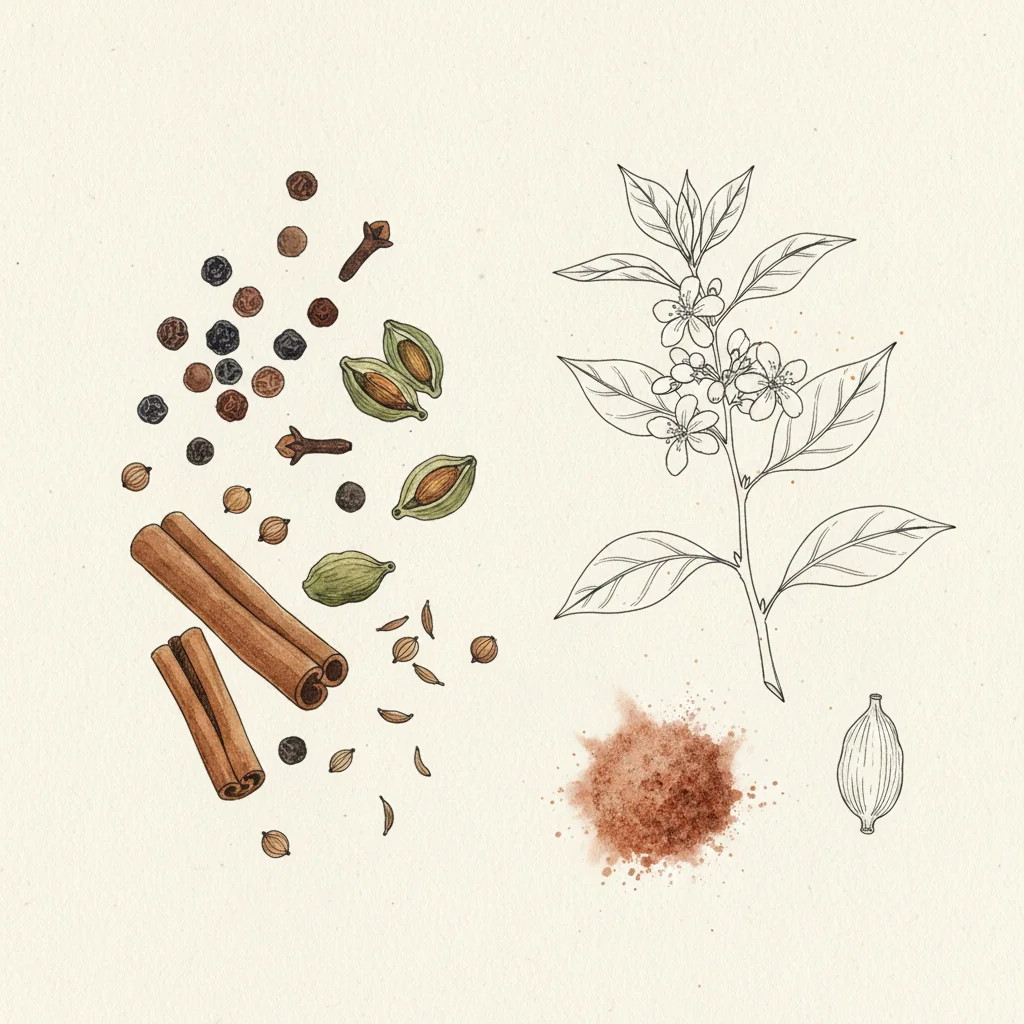
Spice · Blend
Baharat
Made across the Arab world, with distinct house recipes in Lebanon, Syria, Turkey and the Gulf states, Levant & Gulf
warm allspice and clove · black pepper bite · toasted cumin and coriander
Aromatic profile
| Family | composed blend |
|---|---|
| Intensity | ●●●○○ (6/10) |
| Main notes | warm allspice and clove · black pepper bite · toasted cumin and coriander |
| Secondary notes | sweet cassia · floral cardamom · smoky paprika |
| Mouthfeel | rounded and warming, peppery up front, with a sweet baking-spice tail and no single dominant heat |
| Finish length | medium-long, a clove-and-pepper fade that lingers in savory dishes |
Culinary use
- When to add : rubbed onto meat before cooking or bloomed in the fat at the start, not dusted raw over the finished plate
- Dosage : about a tablespoon per pound of ground meat for kofta, or a teaspoon to season a pot of soup or pilaf for four
- Ideal pairings : lamb and beef kofta, shawarma and kebab rubs, kibbeh, rice and freekeh pilaf, roast chicken and turkey, lentil soup and stews
- Avoid with : delicate white fish, raw preparations like tartare or ceviche, clean vinaigrettes and bright salads
The grain in detail
Baharat (Arabic بهارات, simply "spices") is the workhorse blend of Arab cooking — the warm, savory mix a cook reaches for the way an Indian kitchen reaches for garam masala or a French one for quatre-épices. There is no single recipe, only as many versions as there are houses and regions. The constant core is black pepper, allspice, cumin, coriander, cassia or cinnamon, clove, cardamom and paprika; from there it diverges. Lebanese and Syrian baharat stays balanced and aromatic, built for kibbeh and kofta. Gulf baharat (sometimes called bzar) is darker and deeper, folding in dried black lime (loomi), more clove and sometimes dried rosebud. Turkish baharat leans warmer still, with mint and a chili lift for kebabs. The spices are toasted whole, ground, and blended in proportions each cook keeps to themselves. This is foundation seasoning, not a finishing flourish: it goes onto the meat as a rub or into the fat at the start of the pot, so the oils bloom and carry through the dish — shawarma and kofta, rice and freekeh pilaf, lentil soup, roast chicken, slow-braised lamb. Dust it raw over a finished plate and it tastes dusty and flat, the cumin and coriander never waking up. The sourcing catch is the same as every blend: supermarket baharat is often four or five tired spices padded with salt, ground months ago and stale on the shelf. Aim for a named house — in the US, small-batch blenders like The Spice Way or Burlap & Barrel (whose Turkish Kebab blend is a köfte baharat); in the UK, Steenbergs' organic version or the Greenfields jar at Sous Chef. The nose should hit you the second the jar opens — peppery, warm, alive — and the color should read deep brick-brown, never a flat gray. A blend with no smell is old; buy small and finish it inside a year.
History & origin
Baharat takes its name straight from the Arabic plural of bahar, "spice" — the word for the blend is simply the word for spices, a sign of how central it is to the cooking. The mix grew out of the medieval Arab spice trade that funneled pepper, cinnamon, clove and cardamom from India and the Spice Islands through the ports of the Gulf and the Levant. As those routes matured, every region settled into its own house ratio: the Levant balanced and aromatic, the Gulf darker with dried lime, Anatolia warmer and chili-tinged. Like ras el hanout, baharat carries no protected designation by its very nature — it is a category defined by being non-standard, a cook's or merchant's signature rather than a fixed formula.
Indicative price
Reference format : 50-75 g jar — from $4.00 to $12.00 (median : $7.00).
Storage
Airtight, opaque jar away from light and heat. The volatile oils in the pepper, cumin and clove hold for about 12 months; past that the blend goes dusty and flat. Buy small.
Where to buy?
Where to buy it
Links checked on
| Merchant | Price | Action |
|---|---|---|
| The Spice Way (Amazon US) | — | The Spice Way (Amazon US) |
| Burlap & Barrel | — | Burlap & Barrel |
| Steenbergs UK | — | Steenbergs UK |
Prices may vary depending on current promotions on the merchant site.
Alternatives if unavailable
Tags
- Levant
- Gulf
- blend
- kofta
- shawarma
- all-purpose
- bzar
Frequently asked questions
- How do you store Baharat?
- Airtight, opaque jar away from light and heat. The volatile oils in the pepper, cumin and clove hold for about 12 months; past that the blend goes dusty and flat. Buy small.
- What dosage for Baharat?
- about a tablespoon per pound of ground meat for kofta, or a teaspoon to season a pot of soup or pilaf for four
- When should you add Baharat in cooking?
- It's best used rubbed onto meat before cooking or bloomed in the fat at the start, not dusted raw over the finished plate.
- What should you avoid pairing Baharat with?
- Avoid with: delicate white fish, raw preparations like tartare or ceviche, clean vinaigrettes and bright salads.
Go further
The dishes where this baharat shines
Also a recommended alternative for
As a complementary pairing with
See every dish where this product is mentioned →
Other spices to discover
Featured in these gift sets
Page prepared according to our methodology. Purchase links marked sponsored and liable to earn a commission — details on our Affiliations page.