
Ras el Hanout, Moroccan attar blend (15 to 30 spices)
In brief — Ras el hanout means "head of the shop" — the best blend a Moroccan spice merchant can build from his own stock. There is no fixed recipe: 15 to 30 spices, swung toward dried rose in Fès, warmer ginger and cubeb in Marrakech, more cardamom in Tétouan. It is a merchant's signature, not a single spice. Buy it from a real attar or a serious house, not a supermarket sachet, and bloom it in fat — never dust it on raw. Its aromatic profile develops notes of warm baking spice, dried rose, spiced wood, extended by candied citrus and light musk, for an intensity of 6/10. In the kitchen, it's best added bloomed early in the fat, never dusted raw over the finished plate and it pairs with lamb tagine with prunes and almonds, royal couscous, kefta meatballs. Recommended dosage: about a tablespoon per tagine for four, or 30 g per kilo of meat for couscous. Expect from $7.00 to $22.00 per 50-60 g jar (median $11.00).
Origin : Made across the country, with signature recipes in Fès, Marrakech and Tétouan, Morocco
« A blend, not a spice, so quality is the merchant's signature — buy from a named house and it sings; buy the supermarket jar and it is five spices pretending to be thirty. Worth the upgrade. Bloom it in fat, always. »
Ras el hanout means "head of the shop" — the best blend a Moroccan spice merchant can build from his own stock. There is no fixed recipe: 15 to 30 spices, swung toward dried rose in Fès, warmer ginger and cubeb in Marrakech, more cardamom in Tétouan. It is a merchant's signature, not a single spice. Buy it from a real attar or a serious house, not a supermarket sachet, and bloom it in fat — never dust it on raw.
Spice · Blend
Ras el Hanout
Made across the country, with signature recipes in Fès, Marrakech and Tétouan, Morocco
warm baking spice · dried rose · spiced wood
Aromatic profile
| Family | composed blend |
|---|---|
| Intensity | ●●●○○ (6/10) |
| Main notes | warm baking spice · dried rose · spiced wood |
| Secondary notes | candied citrus · light musk · floral cardamom |
| Mouthfeel | complex and warming, no single dominant heat, building slowly across the palate |
| Finish length | long, a lingering spice-and-floral fade |
Culinary use
- When to add : bloomed early in the fat, never dusted raw over the finished plate
- Dosage : about a tablespoon per tagine for four, or 30 g per kilo of meat for couscous
- Ideal pairings : lamb tagine with prunes and almonds, royal couscous, kefta meatballs, honey-roasted carrots and squash, pilaf rice, roasted chicken
- Avoid with : delicate white fish, raw preparations like tartare, clean vinaigrettes
The grain in detail
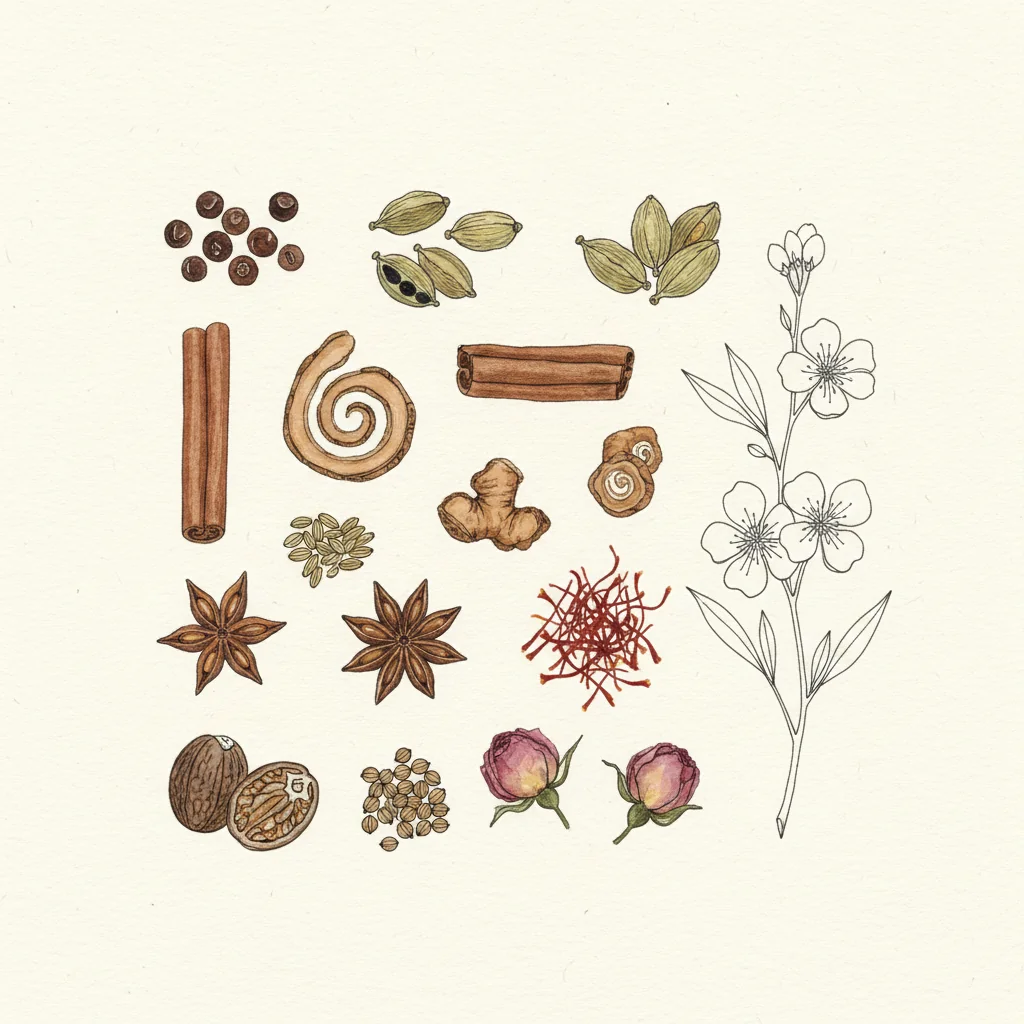
Ras el hanout (Arabic رأس الحانوت, "head of the shop") is the most prized blend a Moroccan attar — the traditional spice merchant and herbalist — can assemble from his shelves. There is no single recipe, only as many versions as there are houses: Fès leans on dried rose and lavender, Marrakech pushes the warm notes (ginger, cubeb pepper, grains of paradise), Tétouan folds in more cardamom and nutmeg. Classic blends run 15 to 30 ingredients, the most constant being green cardamom, Ceylon cinnamon, clove, cubeb, galangal, ginger, grains of paradise, nutmeg, long pepper, black pepper, dried Damask rose and turmeric. The spices are toasted separately, ground by hand, then assembled in proportions the merchant keeps to himself. This is the backbone of festive Moroccan cooking: lamb or veal tagine with prunes and almonds, royal couscous, pigeon pastilla, Tangier kefta, méchoui marinades. The blend always goes in at the start, bloomed in warm fat so the essential oils release into the sauce. Dust it on raw at the end and it stays powdery, tasting of nothing it should. Here is the catch on sourcing: most supermarket "ras el hanout" is five or six basic spices in a jar, and it shows. Aim for a named house — Mustapha Blaoui or the Bab Doukkala herbalist in Marrakech, or in the US the small-batch blenders like Spicewalla and Burlap & Barrel, in the UK Steenbergs or the Terre Exotique blend at Sous Chef. The honest color is ochre-rose, never flat uniform brown, and the nose should hit you the second the jar opens — bright, layered, alive. A flat or dusty blend is old; buy small and use it within a year.
History & origin
Ras el hanout grew out of the spice trade linking the Ottoman world, Muslim Andalusia and the Maghreb from the 12th century on. The attar — part grocer, part herbalist, part apothecary — was a codified trade in Fès by the 14th century, centered on the Attarine souk. Each merchant built his own recipe and passed it down by word of mouth, as a commercial signature. The oldest written mention of a "raïs el hanout" appears in 17th-century Andalusian manuscripts. By its very nature it carries no protected designation: it is a blend defined by being non-standard.
Provenance & authenticity
What sets the real thing apart — appellation, species and verification cues.
- Grade / standard
- Spice blend (15-30 spices)
How to verify the real one
- blend - provenance is the blender/maison, not a single GI
- freshly ground, named spice list
Indicative price
Reference format : 50-60 g jar — from $7.00 to $22.00 (median : $11.00).
Storage
Airtight, opaque jar away from light and heat. The essential oils hold for about 12 months; past that the blend goes powdery and flat. Buy small.
Where to buy?
Where to buy it
Links checked on
| Merchant | Price | Action |
|---|---|---|
| Amazon US | — | Amazon US |
| Sous Chef UK | — | Sous Chef UK |
Prices may vary depending on current promotions on the merchant site.
Alternatives if unavailable
Tags
- Morocco
- Maghreb
- blend
- tagine
- couscous
- attar
Frequently asked questions
- How do you store Ras el Hanout?
- Airtight, opaque jar away from light and heat. The essential oils hold for about 12 months; past that the blend goes powdery and flat. Buy small.
- What dosage for Ras el Hanout?
- about a tablespoon per tagine for four, or 30 g per kilo of meat for couscous
- When should you add Ras el Hanout in cooking?
- It's best used bloomed early in the fat, never dusted raw over the finished plate.
- What should you avoid pairing Ras el Hanout with?
- Avoid with: delicate white fish, raw preparations like tartare, clean vinaigrettes.
Go further
The dishes where this ras el hanout shines
Also a recommended alternative for
See every dish where this product is mentioned →
Other spices to discover
Featured in these gift sets
Page prepared according to our methodology. Purchase links marked sponsored and liable to earn a commission — details on our Affiliations page.