
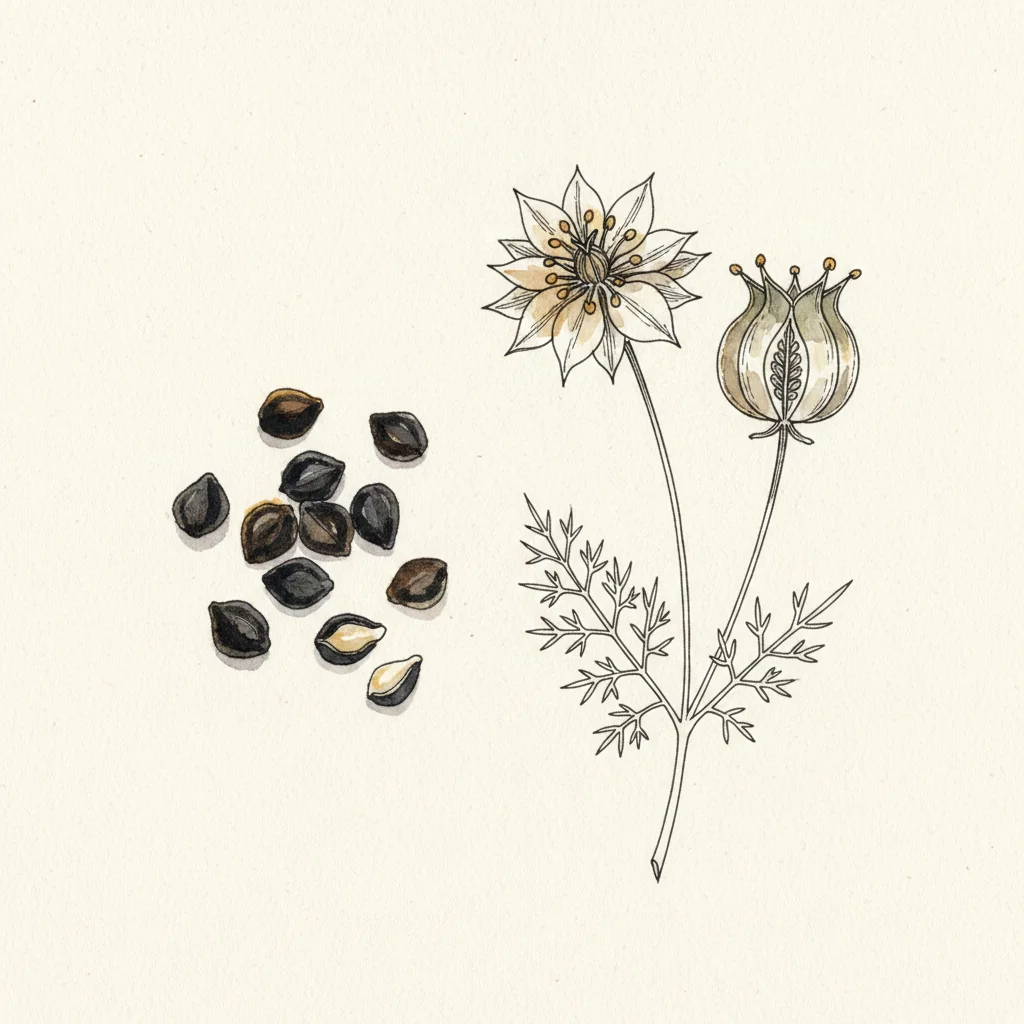
Nigella sativa whole seeds, sun-dried (sold as black cumin, kalonji, or black seed)
In brief — The name is a lie: nigella isn't cumin and never was. These are the small black, angular seeds of Nigella sativa, a buttercup-family plant, and they taste of toasted onion, hazelnut and a mild pepper warmth with a whisper of oregano. You know them already from the tops of naan and pita. Egypt's Nile Valley grows the most aromatic lots, and a jar runs about $7. Its aromatic profile develops notes of toasted onion, hazelnut, mild pepper, extended by dried oregano and faint bitterness, for an intensity of 6/10. In the kitchen, it's best added scattered raw on dough before baking, or sprinkled as a finish on the plate and it pairs with naan and pita, fresh cheeses like labneh and ricotta, cucumber and tomato salads. Recommended dosage: a rounded teaspoon over one flatbread or a salad for four, toasted dry for ten seconds first. Expect from $5.00 to $11.00 per 3.5 oz (100g) jar (median $7.00).
Origin : Nile Valley, Upper Egypt, Egypt
Nigella sativa
« A cheap spice that punches above its price once you toast it. The toasted-onion lift on flatbread and labneh is genuinely distinctive. Buy a single-origin Egyptian lot, skip the dusty supermarket jar. »
The name is a lie: nigella isn't cumin and never was. These are the small black, angular seeds of Nigella sativa, a buttercup-family plant, and they taste of toasted onion, hazelnut and a mild pepper warmth with a whisper of oregano. You know them already from the tops of naan and pita. Egypt's Nile Valley grows the most aromatic lots, and a jar runs about $7.
Spice · Spice seed
Nigella Seeds (Black Cumin)
Nile Valley, Upper Egypt, Egypt
toasted onion · hazelnut · mild pepper
Aromatic profile
| Family | Nigella sativa |
|---|---|
| Intensity | ●●●○○ (6/10) |
| Main notes | toasted onion · hazelnut · mild pepper |
| Secondary notes | dried oregano · faint bitterness · pine resin |
| Mouthfeel | a clean little crunch up front, then a soft peppery prickle that fades fast |
| Finish length | medium, closing on a warm hazelnut note |
Culinary use
- When to add : scattered raw on dough before baking, or sprinkled as a finish on the plate
- Dosage : a rounded teaspoon over one flatbread or a salad for four, toasted dry for ten seconds first
- Ideal pairings : naan and pita, fresh cheeses like labneh and ricotta, cucumber and tomato salads, roasted squash and sweet potato, lentil dal and gentle vegetable curries
- Avoid with : delicate raw fish (the onion note flattens it), an overload of fresh dill (the two muddy each other)
The grain in detail
Nigella, sold almost everywhere as black cumin, is one of the most mislabeled spices on the shelf. Botanically it's Nigella sativa, an annual in the buttercup family (Ranunculaceae), with no relation to true cumin (Cuminum cyminum) or to caraway, two other names it gets stuck with. The seeds are matte black, three-sided and roughly 3 mm across, with a finely ridged skin. They ripen inside papery capsules that dry on the plant before harvest. Most of the world's crop comes from Egypt, India and Turkey, and the Nile Valley lots out of Upper Egypt are the ones cooks reach for when they want clean aroma over volume. The smell is more layered than the size suggests: thymoquinone, a phenolic compound, carries the faint bitter, resinous edge, while p-cymene and alpha-pinene push the hazelnut and pine. Warm them gently, especially on a baking flatbread, and they bloom into a toasted-onion note that's the unmistakable signature of an Indian naan or a Levantine man'oushe. The seeds have a long medicinal history too, turning up in ancient Egyptian texts and in the Islamic prophetic tradition as a near-universal remedy. Modern research is curious about thymoquinone's anti-inflammatory behavior, but no therapeutic claim is settled, and in the kitchen this is a flavor, not a supplement. Here's where they earn their place: against fresh cheese (labneh, ricotta), on lacto-fermented vegetables, folded through a soft squash or sweet-potato curry, and of course pressed into flatbread dough before the oven. In some Indian cooking they ride in panch phoron, the five-seed blend with fenugreek, fennel, mustard and real cumin. To wake them up, toast them dry for about ten seconds, just to the point of fragrance, and pull them before they blacken and turn acrid.
History & origin
Cultivated for at least three thousand years, nigella seeds were found in Tutankhamun's tomb and named in the writings attributed to Hippocrates. Egyptian and Levantine cooks have scattered them over bread for centuries. In the English-speaking kitchen they stayed niche until the rise of Indian and Middle Eastern cooking in the 1980s and 90s made them a recognizable signal, the black flecks on a naan or a za'atar swirl. Today's traceable lots come largely from family farms in Egypt's Fayoum and Nile Valley, with cooperative and single-origin importers handling the better grades.
Provenance & authenticity
What sets the real thing apart — appellation, species and verification cues.
- Species
- Nigella sativa
How to verify the real one
- Nigella sativa - NOT cumin (misnamed)
- angular black seeds
- Nile Valley, Egypt origin
Indicative price
Reference format : 3.5 oz (100g) jar — from $5.00 to $11.00 (median : $7.00).
Storage
Airtight opaque jar at room temperature, away from light. Keeps about 24 months whole, the hard shell protects the oils inside. Toast only the pinch you're about to use.
Where to buy?
Where to buy it
Links checked on
| Merchant | Price | Action |
|---|---|---|
| Amazon US | — | Amazon US |
| Burlap & Barrel | — | Burlap & Barrel |
| Sous Chef UK | — | Sous Chef UK |
Prices may vary depending on current promotions on the merchant site.
Tags
- nigella
- black-cumin
- nigella-sativa
- kalonji
- egypt
- flatbread
- epice-graine
Frequently asked questions
- How do you store Nigella Seeds (Black Cumin)?
- Airtight opaque jar at room temperature, away from light. Keeps about 24 months whole, the hard shell protects the oils inside. Toast only the pinch you're about to use.
- What dosage for Nigella Seeds (Black Cumin)?
- a rounded teaspoon over one flatbread or a salad for four, toasted dry for ten seconds first
- When should you add Nigella Seeds (Black Cumin) in cooking?
- It's best used scattered raw on dough before baking, or sprinkled as a finish on the plate.
- What should you avoid pairing Nigella Seeds (Black Cumin) with?
- Avoid with: delicate raw fish (the onion note flattens it), an overload of fresh dill (the two muddy each other).
Go further
The dishes where this nigella seeds (black cumin) shines
See every dish where this product is mentioned →
Other spices to discover
Featured in these gift sets
Page prepared according to our methodology. Purchase links marked sponsored and liable to earn a commission — details on our Affiliations page.