
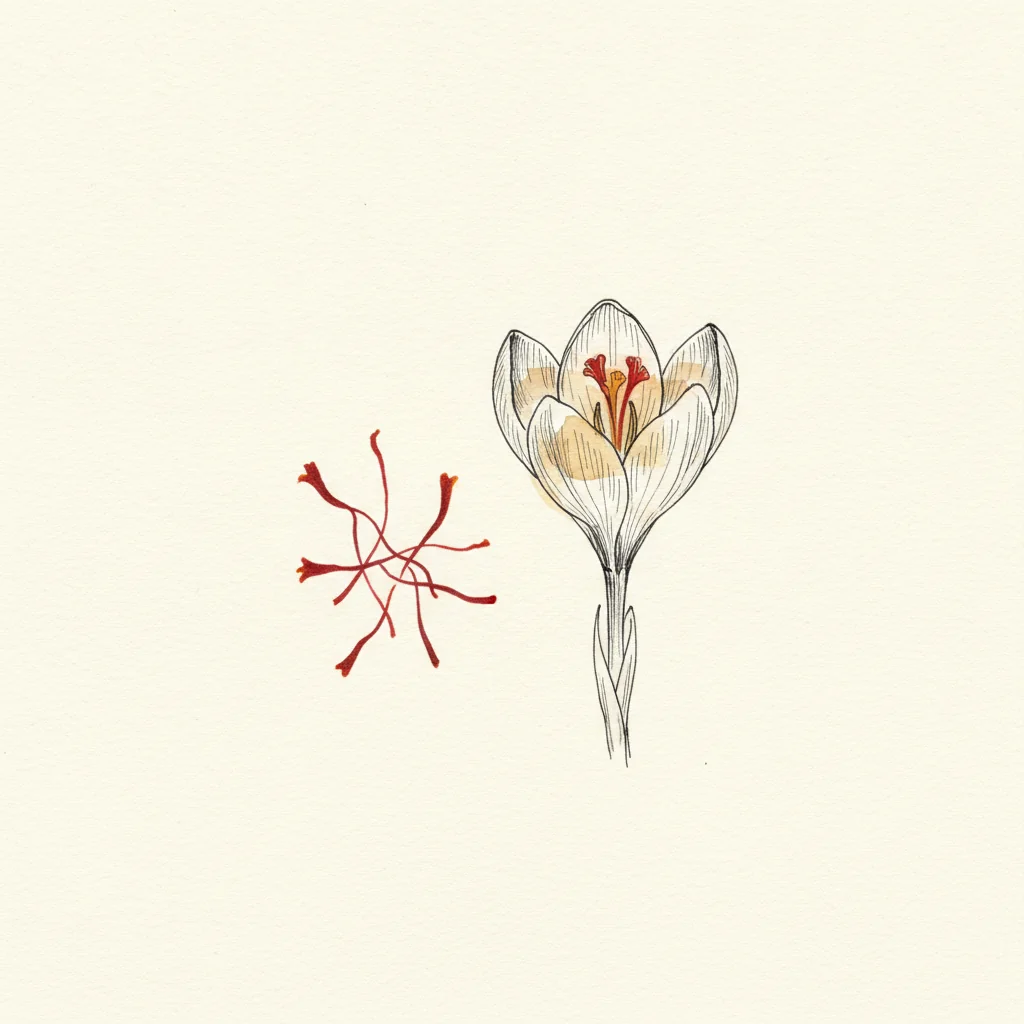
Iranian Sargol Saffron, pure red stigma tips with no yellow style (Khorasan, Iran)
In brief — Sargol means the red stigma tips only, with none of the yellow style. It's the purest, most concentrated cut, where the three ISO quality markers, crocin, picrocrocin and safranal, peak. Iran grows close to 90 percent of the world's saffron, mostly in Khorasan, where the dry climate gives an intensity European saffrons rarely touch. Around $10 to $13 a gram for the real thing. Steep it first, and a pinch carries a whole pan. Its aromatic profile develops notes of dry honey, warm hay, sea iodine, extended by leather and blond tobacco, for an intensity of 9/10. In the kitchen, it's best added steeped first — bloom the threads in a little warm liquid for 20 to 30 minutes before you cook with them and it pairs with paella, risotto alla milanese, tagines and biryani. Recommended dosage: 0.1 to 0.2 g, about 15 to 25 threads, for four servings. Expect from $8.00 to $15.00 per 1g (median $11.00).
Origin : Khorasan, around Torbat-e Heydarieh, Ghaen and Birjand, Iran
Crocus sativus
« The benchmark. Drier and more iodine-driven than Spanish, with a hay-and-tobacco finish that holds. Sargol earns the premium: pure red tips, no yellow filler. The panel's only worry is the flood of fakes, so buy whole threads. »
Sargol means the red stigma tips only, with none of the yellow style. It's the purest, most concentrated cut, where the three ISO quality markers, crocin, picrocrocin and safranal, peak. Iran grows close to 90 percent of the world's saffron, mostly in Khorasan, where the dry climate gives an intensity European saffrons rarely touch. Around $10 to $13 a gram for the real thing. Steep it first, and a pinch carries a whole pan.
Spice · Saffron
Iranian Saffron (Sargol)
Khorasan, around Torbat-e Heydarieh, Ghaen and Birjand, Iran
dry honey · warm hay · sea iodine
Aromatic profile
| Family | Crocus sativus |
|---|---|
| Intensity | ●●●●● (9/10) |
| Main notes | dry honey · warm hay · sea iodine |
| Secondary notes | leather · blond tobacco · noble bitterness |
| Mouthfeel | dry and elegantly bitter, with a slow warmth that builds rather than bites |
| Finish length | very long, an earthy and iodine-tinged finish that lingers |
Culinary use
- When to add : steep first: bloom the threads in a little warm liquid for 20 to 30 minutes before you cook with them
- Dosage : 0.1 to 0.2 g, about 15 to 25 threads, for four servings
- Ideal pairings : paella, risotto alla milanese, tagines and biryani, bouillabaisse, saffron ice cream and sweet infusions
- Avoid with : already heavily spiced dishes that bury it, aggressive raw garlic that fights the perfume, dry heat with no soak first, which scorches the threads and wastes them
The grain in detail
Iranian saffron is graded against the ISO 3632 standard, which measures three compounds: crocin for coloring power, picrocrocin for bitterness, and safranal for aroma. Sargol, literally the top of the flower, keeps only the upper red section of the stigma, exactly where those three molecules concentrate. A good Sargol runs past 250 on the coloring scale, against roughly 200 for a Pushal cut and 120 for a Negin. The best plots sit in Khorasan-e Razavi, around Torbat-e Heydarieh and Ghaen, at 1,200 to 1,700 meters. The continental climate, cold winters, dry summers and short autumns, is exactly what Crocus sativus needs to build its aromatics. Harvest is at dawn in October and November, by hand, flower by flower. Each flower gives only three stigmas, so it takes about 150,000 flowers to make one kilo of dried saffron, which is why it's the most expensive spice on earth by weight. Here's why Sargol earns the premium over a cheaper cut: with no yellow style padding the weight, you're paying for pure flavor, not filler. The Iranian profile is drier, more iodine-driven and more bitter than Spanish or European saffron, with a warm finish close to hay and blond tobacco, which is what makes it so effective in tiny doses in long-simmered dishes, paella, tagine, bouillabaisse and biryani. The catch worth its own line: fakes are everywhere. Powder cut with turmeric, dyed safflower threads sold as saffron, Sargol bulked out with other parts of the flower. Buy whole threads, a deep even red, with only the faintest orange right at the base, and always bloom them in warm liquid first so the color and aroma fully release.
History & origin
Saffron has been cultivated in Persia for at least 3,000 years, and Assyrian tablets already name the spice. Khorasan, crossed by the Silk Road, is its historic cradle. Cultivation spread to the Mediterranean with the Arab conquests of the eighth century, then into Europe by way of Al-Andalus. Today, despite international sanctions, Iran supplies roughly 90 percent of the world's saffron, much of it re-exported through Spain or the UAE, which is one reason a label saying Spanish saffron may still hold Iranian threads.
Provenance & authenticity
What sets the real thing apart — appellation, species and verification cues.
- Species
- Crocus sativus
- Grade / standard
- ISO 3632 Category I; Sargol cut (red stigmas only, no yellow style)
How to verify the real one
- ISO 3632 Cat. I lab certificate (crocin >190 E1%)
- Sargol = pure red stigmas, no yellow
- water test: releases colour slowly, threads stay red
- trumpet-shaped stigma under magnification
Indicative price
Reference format : 1g — from $8.00 to $15.00 (median : $11.00).
Storage
An opaque glass jar or a tin, kept dark, dry and cool. It holds 2 to 3 years with no real loss, and the aroma actually keeps developing for the first six months after drying.
Where to buy?
Where to buy it
Links checked on
| Merchant | Price | Action |
|---|---|---|
| Amazon US | — | Amazon US |
| Slofoodgroup | — | Slofoodgroup |
| Sous Chef UK | — | Sous Chef UK |
Prices may vary depending on current promotions on the merchant site.
Tags
- saffron
- Iran
- Sargol
- Khorasan
- Crocus sativus
- ISO-3632
- premium
Frequently asked questions
- How do you store Iranian Saffron (Sargol)?
- An opaque glass jar or a tin, kept dark, dry and cool. It holds 2 to 3 years with no real loss, and the aroma actually keeps developing for the first six months after drying.
- What dosage for Iranian Saffron (Sargol)?
- 0.1 to 0.2 g, about 15 to 25 threads, for four servings
- When should you add Iranian Saffron (Sargol) in cooking?
- It's best used steep first: bloom the threads in a little warm liquid for 20 to 30 minutes before you cook with them.
- What should you avoid pairing Iranian Saffron (Sargol) with?
- Avoid with: already heavily spiced dishes that bury it, aggressive raw garlic that fights the perfume, dry heat with no soak first, which scorches the threads and wastes them.
Go further
The dishes where this iranian saffron (sargol) shines
Also a recommended alternative for
As a complementary pairing with
See every dish where this product is mentioned →
Other spices to discover
Page prepared according to our methodology. Purchase links marked sponsored and liable to earn a commission — details on our Affiliations page.