
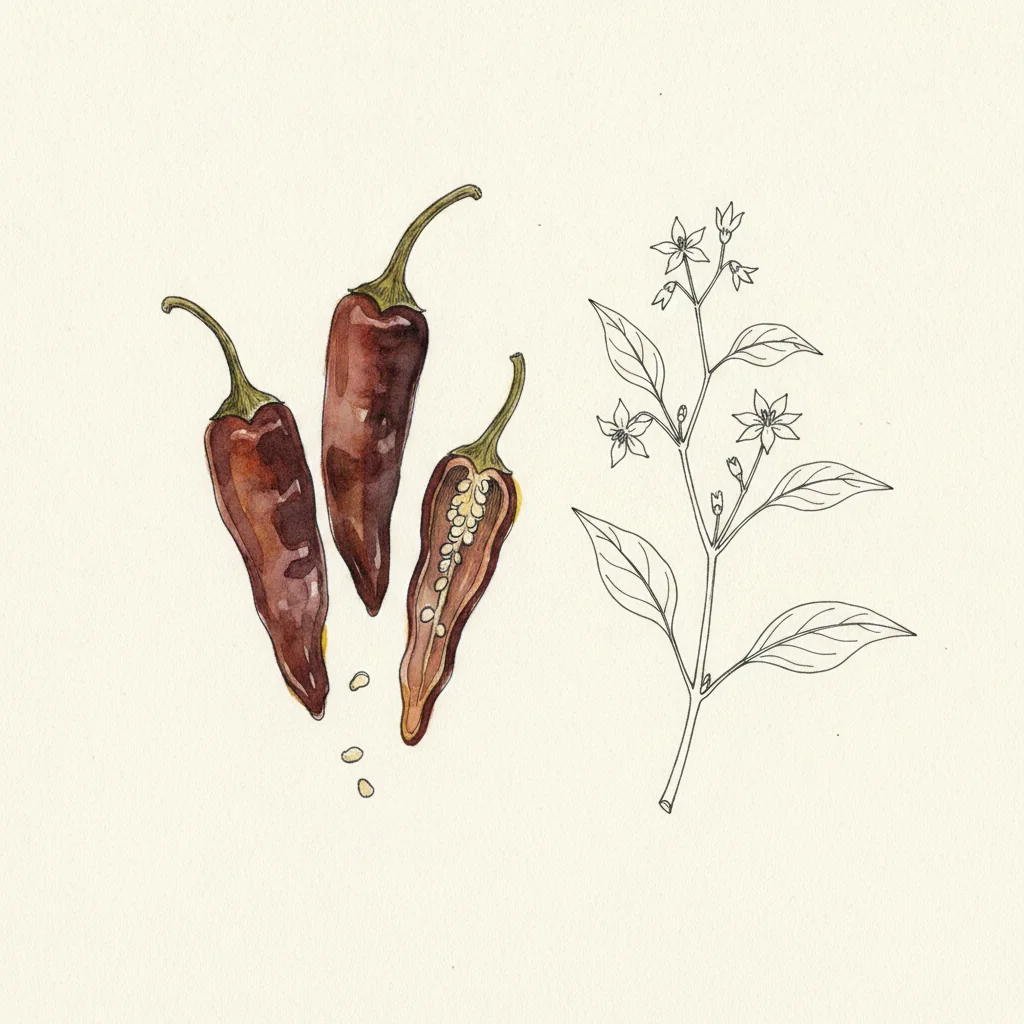
Guajillo Chile — sun-dried mirasol pods, Capsicum annuum
In brief — The workhorse red chile of Mexican cooking — long, smooth, deep-burgundy mirasol pods sun-dried across the highlands of Zacatecas and Durango. Heat sits low, around 3 out of 10; the point is the flavor: bright berry-tart, dried cranberry, a green-tea tannin. This is the chile that gives birria, red enchilada sauce and pozole their color and their backbone, not their burn. Its aromatic profile develops notes of bright berry-tart, dried cranberry, green tea, extended by tomato leaf and tobacco, for an intensity of 3/10. In the kitchen, it's best added rehydrated and blended into the base of a sauce, or toasted dry then ground; never a raw finish and it pairs with birria and barbacoa, red enchilada sauce and adobo, pozole rojo. Recommended dosage: 3 to 4 pods for a sauce serving four, stemmed and seeded, about 15 g of dried pods. Expect from $8.00 to $13.00 per 8 oz (225 g) bag of whole dried pods (median $10.00).
Origin : Zacatecas and Durango (the dry highland Bajío-to-north belt where mirasol is grown), Mexico
Capsicum annuum (mirasol cultivar)
« The dried chile to learn first: bright berry-tart fruit, real color, mild enough to use freely, and cheap. It only misses the top mark because the skin scorches bitter in seconds if you over-toast it, so it punishes carelessness. »
The workhorse red chile of Mexican cooking — long, smooth, deep-burgundy mirasol pods sun-dried across the highlands of Zacatecas and Durango. Heat sits low, around 3 out of 10; the point is the flavor: bright berry-tart, dried cranberry, a green-tea tannin. This is the chile that gives birria, red enchilada sauce and pozole their color and their backbone, not their burn.
Spice · Chile
Guajillo Chile
Zacatecas and Durango (the dry highland Bajío-to-north belt where mirasol is grown), Mexico
bright berry-tart · dried cranberry · green tea
Aromatic profile
| Family | Capsicum annuum |
|---|---|
| Intensity | ●●○○○ (3/10) |
| Main notes | bright berry-tart · dried cranberry · green tea |
| Secondary notes | tomato leaf · tobacco · a faint pine resin |
| Mouthfeel | a clean, tangy warmth that lands on the front of the tongue and fades fast; tart before it's hot |
| Finish length | medium, finishing dry and berry-sour rather than burning |
Culinary use
- When to add : rehydrated and blended into the base of a sauce, or toasted dry then ground; never a raw finish
- Dosage : 3 to 4 pods for a sauce serving four, stemmed and seeded, about 15 g of dried pods
- Ideal pairings : birria and barbacoa, red enchilada sauce and adobo, pozole rojo, salsa roja for tacos, marinades for grilled skirt steak, mole bases (alongside ancho and pasilla)
- Avoid with : raw plating or last-second sprinkling, dishes that need real heat (guajillo is mild), long scorching that turns the skin acrid and bitter
The grain in detail
Guajillo is the dried form of the mirasol pepper, a Capsicum annuum cultivar grown across Mexico's dry central and northern highlands — Zacatecas and Durango are the heartland, with Aguascalientes and San Luis Potosí close behind. The fresh pod grows pointing up (mirasol means "looking at the sun"), and after harvest it's sun-dried on tarps and patios until the skin turns a glossy, leathery burgundy. Good guajillo stays pliable and faintly translucent against the light; if a pod snaps like a chip, it's stale and most of the flavor has gone with the moisture. The heat is genuinely mild — roughly 2,500 to 5,000 Scoville, a notch above a poblano and well below a jalapeño — which is exactly why it's the most-used dried chile in the country. You're buying it for the flavor, not the fire: a clean berry-tartness, dried cranberry and tomato leaf, a green-tea astringency from the skin, and a whisper of pine and tobacco underneath. It's the indispensable base note of the holy trinity of Mexican dried chiles — guajillo for brightness and color, ancho for sweetness and body, pasilla for dark raisin depth — and almost every red sauce worth making leans on it. The technique that matters: toast the stemmed, seeded pods in a dry pan for ten to fifteen seconds a side until they smell nutty and just start to puff, then soak them in hot water for twenty minutes before blending. Toast too long and the skin scorches into something acrid and bitter that no amount of sugar fixes — guajillo's flaw is that the very skin you want goes harsh in seconds. There's no protected designation of origin for it; the market sorts itself by grade and pliability rather than appellation, and the bagged pods you find in any Latin grocery are usually the honest buy. Whole pods keep their aroma far longer than the pre-ground powder, which oxidizes fast.
History & origin
Guajillo is one of the oldest cultivated chiles of central Mexico, descended from mirasol landraces grown long before the Spanish arrived and central to the country's mole and salsa traditions ever since. Production today concentrates in the semi-arid highlands of Zacatecas, Durango, Aguascalientes and San Luis Potosí, where the dry autumn lets the pods sun-dry on open patios. It is by volume the most-produced and most-consumed dried chile in Mexico. No protected designation of origin (such as the Mexican Marca Colectiva or DOP system) covers guajillo to date; quality is judged on color, pliability and aroma rather than certification.
Provenance & authenticity
What sets the real thing apart — appellation, species and verification cues.
- Species
- Capsicum annuum (mirasol cultivar)
Indicative price
Reference format : 8 oz (225 g) bag of whole dried pods — from $8.00 to $13.00 (median : $10.00).
Storage
Airtight, away from light. Pliability is your freshness gauge: a guajillo that still bends and feels leathery is alive; one that snaps dry and looks dull has oxidized and lost its aroma. Whole pods keep about 12 months; buy pods, not powder, and grind as needed.
Where to buy?
Where to buy it
Links checked on
| Merchant | Price | Action |
|---|---|---|
| Amazon US (whole dried pods) | — | Amazon US (whole dried pods) |
| Sous Chef UK (Cool Chile Co) | — | Sous Chef UK (Cool Chile Co) |
Prices may vary depending on current promotions on the merchant site.
Alternatives if unavailable
Tags
- Mexico
- Zacatecas
- Durango
- mirasol
- Capsicum annuum
- dried chile
- birria
- mole
Frequently asked questions
- How do you store Guajillo Chile?
- Airtight, away from light. Pliability is your freshness gauge: a guajillo that still bends and feels leathery is alive; one that snaps dry and looks dull has oxidized and lost its aroma. Whole pods keep about 12 months; buy pods, not powder, and grind as needed.
- What dosage for Guajillo Chile?
- 3 to 4 pods for a sauce serving four, stemmed and seeded, about 15 g of dried pods
- When should you add Guajillo Chile in cooking?
- It's best used rehydrated and blended into the base of a sauce, or toasted dry then ground; never a raw finish.
- What should you avoid pairing Guajillo Chile with?
- Avoid with: raw plating or last-second sprinkling, dishes that need real heat (guajillo is mild), long scorching that turns the skin acrid and bitter.
Go further
The dishes where this guajillo chile shines
Also a recommended alternative for
As a complementary pairing with
See every dish where this product is mentioned →
Other spices to discover
Featured in these gift sets
Page prepared according to our methodology. Purchase links marked sponsored and liable to earn a commission — details on our Affiliations page.