
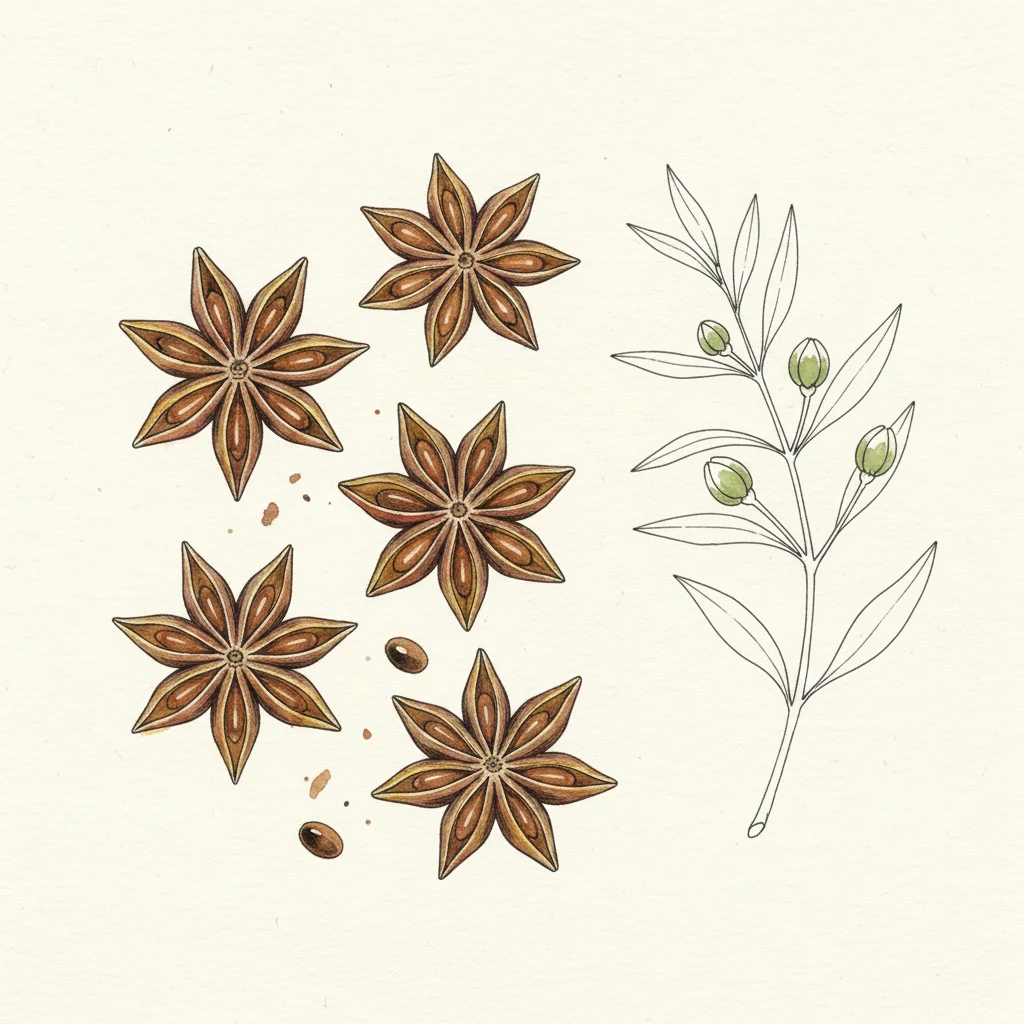
Star Anise (badian) from Lang Son, northern Vietnam, whole stars
In brief — The eight-pointed dried fruit of a small Asian evergreen, star anise is packed with anethole — the same molecule that scents anise seed and fennel, but at a far higher, more heat-stable concentration. That stability is why it's the spice for long-simmered broth, not a finishing sprinkle. Lang Son in northern Vietnam grows some of the best-formed, most fragrant stars. The backbone of pho and Chinese five-spice. About $10 to $13 for a 100g bag of whole Vietnamese stars — cheap for what it does, and a bag lasts a year. In the kitchen, it's best added infused early in a long simmer (broth, mulled wine) or at the start of a braise — never tossed in at the finish and it pairs with Vietnamese pho broth, Chinese five-spice and red-braised pork belly, poached pears and apple compote. Recommended dosage: one to two whole stars per 2 liters of broth — overdo it and the licorice turns soapy and cold. Expect from $7.00 to $13.00 per 100g whole stars (median $10.00).
Origin : Lang Son province, on the Chinese border, Vietnam
Illicium verum
« A workhorse, not a splurge: heat-stable anethole that carries a broth for hours where ground spice quits. Cheap, traceable Vietnamese stars are the move. Mind the toxic Japanese look-alike, and never overdose — past two stars it turns soapy and cold. »
The eight-pointed dried fruit of a small Asian evergreen, star anise is packed with anethole — the same molecule that scents anise seed and fennel, but at a far higher, more heat-stable concentration. That stability is why it's the spice for long-simmered broth, not a finishing sprinkle. Lang Son in northern Vietnam grows some of the best-formed, most fragrant stars. The backbone of pho and Chinese five-spice. About $10 to $13 for a 100g bag of whole Vietnamese stars — cheap for what it does, and a bag lasts a year.
Spice · Whole spice
Star Anise
Lang Son province, on the Chinese border, Vietnam
anise · licorice · fennel
Aromatic profile
| Family | Illicium verum |
|---|---|
| Intensity | ●●●●○ (8/10) |
| Main notes | anise · licorice · fennel |
| Secondary notes | sweet wood · faint vanilla · warm resin |
| Mouthfeel | round, lightly sweet, lingering — it coats the back of the palate |
| Finish length | very long, a tenacious anise trail that holds through a long simmer |
Culinary use
- When to add : infused early in a long simmer (broth, mulled wine) or at the start of a braise — never tossed in at the finish
- Dosage : one to two whole stars per 2 liters of broth — overdo it and the licorice turns soapy and cold
- Ideal pairings : Vietnamese pho broth, Chinese five-spice and red-braised pork belly, poached pears and apple compote, mulled wine and cider, braised short ribs and duck stocks
- Avoid with : dishes already loaded with raw fennel, a glug of pastis or absinthe, which doubles the anise and tips it medicinal, delicate white fish, where it bulldozes everything
The grain in detail
Star anise is the dried fruit of Illicium verum, a small evergreen native to southwest China and northern Vietnam. The eight-pointed star — sometimes six points, sometimes ten — holds a single shiny red-brown seed in each woody follicle, but most of the aroma lives in the pod itself. The flavor is driven by trans-anethole, which can make up as much as 90 percent of the volatile compounds. That's the same molecule behind anise seed and fennel, but star anise carries far more of it, and crucially it holds up under heat. That heat stability is the whole reason to reach for it: where ground spices fade in a long cook, star anise keeps giving, which is exactly what a pot of pho needs as it simmers for hours alongside charred ginger, cinnamon, clove and coriander seed in beef broth. Lang Son province, on the Vietnam-China border, is one of the oldest growing regions, worked mostly by smallholders on small forest plots. The fruit is picked green between August and October, then sun-dried until it takes on its russet-brown color. A good star is whole, firm, and sharply fragrant the moment you snap it. One real warning on sourcing: some cheap commercial lots have been cut with Illicium religiosum, the Japanese star anise, which is toxic and looks similar. Traceable Vietnamese and Chinese supply chains rule that risk out — buy from a named source, not a bulk bin. Beyond pho, the pod is one of the five spices in Chinese five-spice, scents red-braised pork belly and lacquered duck, lifts poached pears and apple compote, and gives mulled wine its warm anise spine. Use it whole and fish it out; ground star anise loses its punch fast and turns dusty.
History & origin
Known in China for at least three thousand years, star anise reached Europe in the seventeenth century by way of English and Dutch sailors, and European distillers seized on it — gin, anisette, ouzo and sambuca all lean on it for a cleaner anethole yield than anise seed gives. The Vietnamese trade organized around Lang Son in the nineteenth century, exporting north into China and west to Europe. In the 2000s the spice briefly made headlines for a non-culinary reason: pharma firms extract shikimic acid from the pods to make oseltamivir (Tamiflu), and flu-pandemic demand spiked world prices.
Provenance & authenticity
What sets the real thing apart — appellation, species and verification cues.
- Species
- Illicium verum
How to verify the real one
- Illicium verum (edible star anise)
- Lang Son, N. Vietnam origin
- fraud risk: toxic Illicium anisatum (Japanese star anise) substitution - buy whole, intact 8-point stars
Indicative price
Reference format : 100g whole stars — from $7.00 to $13.00 (median : $10.00).
Storage
Airtight jar, away from light. Whole stars hold their aroma 24 to 36 months; ground star anise fades fast, so grind only what you need.
Where to buy?
Where to buy it
Links checked on
| Merchant | Price | Action |
|---|---|---|
| Amazon US | — | Amazon US |
| Burlap & Barrel | — | Burlap & Barrel |
| Steenbergs | — | Steenbergs |
Prices may vary depending on current promotions on the merchant site.
Tags
- star anise
- badian
- Vietnam
- Illicium verum
- Lang Son
- pho
- five-spice
Frequently asked questions
- How do you store Star Anise?
- Airtight jar, away from light. Whole stars hold their aroma 24 to 36 months; ground star anise fades fast, so grind only what you need.
- What dosage for Star Anise?
- one to two whole stars per 2 liters of broth — overdo it and the licorice turns soapy and cold
- When should you add Star Anise in cooking?
- It's best used infused early in a long simmer (broth, mulled wine) or at the start of a braise — never tossed in at the finish.
- What should you avoid pairing Star Anise with?
- Avoid with: dishes already loaded with raw fennel, a glug of pastis or absinthe, which doubles the anise and tips it medicinal, delicate white fish, where it bulldozes everything.
Go further
The dishes where this star anise shines
Also a recommended alternative for
As a complementary pairing with
See every dish where this product is mentioned →
Other spices to discover
Featured in these gift sets
Page prepared according to our methodology. Purchase links marked sponsored and liable to earn a commission — details on our Affiliations page.