
Piment d'Espelette AOP, the Gorria chili of the French Basque Country — sun-dried, milled Capsicum annuum
In brief — The Basque Country's own chili, milled from the deep-red Gorria pepper grown in ten communes around the village of Espelette and PDO-protected since 2002. The heat is gentle — about 4,000 Scoville, paprika-soft — and the point is the flavor: sun-dried tomato, warm red fruit, a faint smoke. This is a finishing pepper for eggs, fish and chicken, not a chili you fear. If the jar doesn't say AOP, it's just chili powder with a Basque name. In the kitchen, it's best added as a finishing touch, dusted over the plated dish, or stirred in near the end of cooking and it pairs with scrambled and fried eggs, seared scallops and white fish, roast chicken and Basque chicken (poulet basquaise). Recommended dosage: a half to one teaspoon for four people as a finish, roughly 1 g a portion; it's a seasoning, not a knockout. Expect from $12.00 to $18.00 per 1.4 oz (40 g) jar of AOP powder (median $14.00).
Origin : Basque Country, ten communes around Espelette in the Pyrénées-Atlantiques, France (PDO (AOP) since 2002, AOC since 2000)
Capsicum annuum
« Basque paprika with a pulse — about 4,000 Scoville, all fruit and toasted tomato, barely any burn. Brilliant on eggs, scallops and dark chocolate. Buy the AOP jar or you're paying for plain chili powder. »
The Basque Country's own chili, milled from the deep-red Gorria pepper grown in ten communes around the village of Espelette and PDO-protected since 2002. The heat is gentle — about 4,000 Scoville, paprika-soft — and the point is the flavor: sun-dried tomato, warm red fruit, a faint smoke. This is a finishing pepper for eggs, fish and chicken, not a chili you fear. If the jar doesn't say AOP, it's just chili powder with a Basque name.
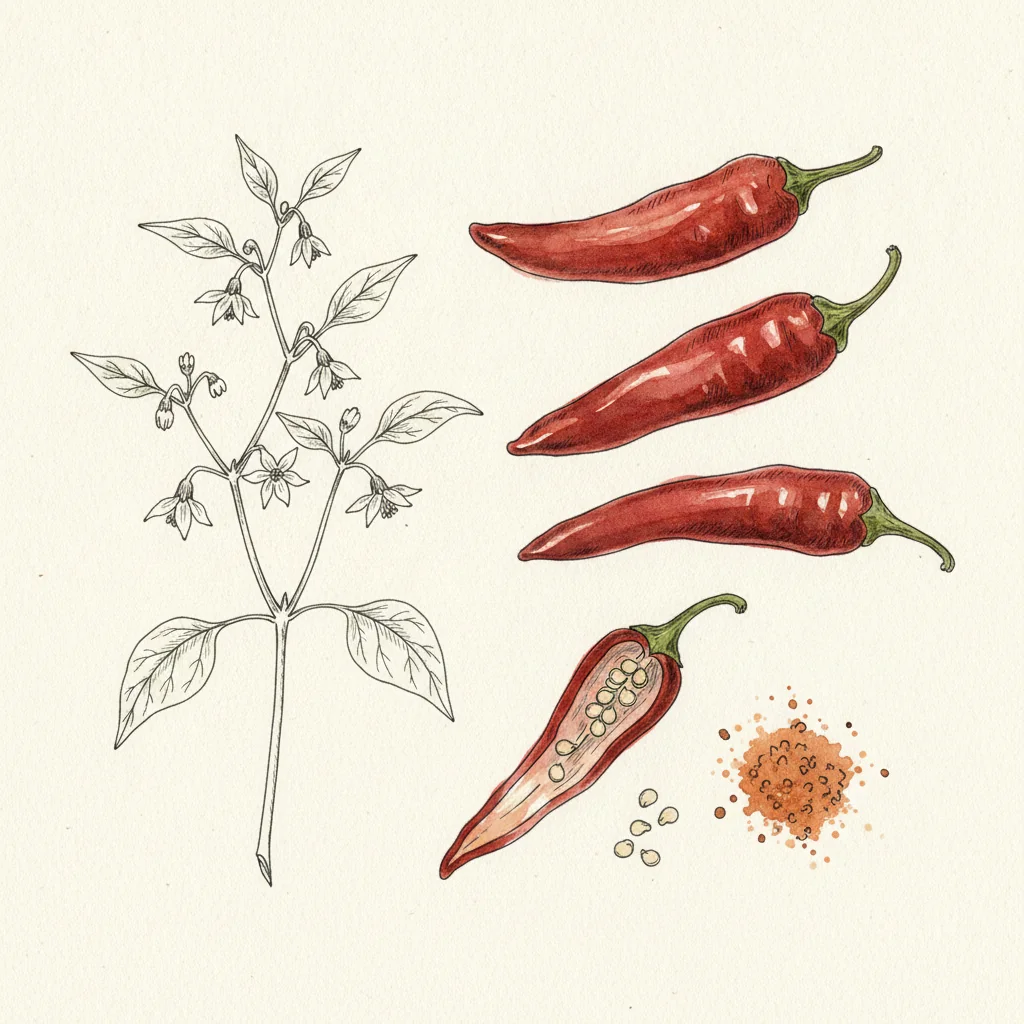
Spice · Chile
Piment d'Espelette AOP
Basque Country, ten communes around Espelette in the Pyrénées-Atlantiques, France (PDO (AOP) since 2002, AOC since 2000)
sun-dried tomato · warm red fruit · toasted pepper
Aromatic profile
| Family | Capsicum annuum |
|---|---|
| Intensity | ●●○○○ (4/10) |
| Main notes | sun-dried tomato · warm red fruit · toasted pepper |
| Secondary notes | faint smoke · dried hay · a clean salt-and-pepper edge |
| Mouthfeel | a rounded, slow heat that arrives late and fades fast, fruity before it's hot, around 4,000 on the Scoville scale — closer to a sweet paprika with a pulse than to a true chili |
| Finish length | medium, finishing on a warm tomato-and-toast note rather than a burn |
Culinary use
- When to add : finishing, dusted over the plated dish, or stirred in near the end of cooking
- Dosage : a half to one teaspoon for four people as a finish, roughly 1 g a portion; it's a seasoning, not a knockout
- Ideal pairings : scrambled and fried eggs, seared scallops and white fish, roast chicken and Basque chicken (poulet basquaise), cured ham and charcuterie, tomato and pepper stews (piperade), dark chocolate and chocolate desserts
- Avoid with : long hard-boiled sauces that scorch the powder bitter, dishes that need real heat — this isn't the chili for that, anything where you'd never notice 4,000 Scoville
The grain in detail
Piment d'Espelette is the milled powder of the Gorria cultivar of Capsicum annuum, a chili local farmers selected over centuries to suit the damp, mild Basque terroir along the foothills of the western Pyrenees. Chili cultivation around Espelette traces back to about 1650, brought up from the New World through the Atlantic ports; the pepper slowly replaced black peppercorns as the everyday seasoning of the region. A growers' cooperative formalized production in 1983, the appellation was recognized as an AOC on 1 June 2000, and confirmed as a European PDO (AOP) on 22 August 2002. Only ten communes around the village of Espelette in the Pyrénées-Atlantiques may grow it, and only the registered Gorria variety counts — that's the whole difference between the real thing and the generic powder sold under the same name. The traditional method is unhurried: the pods are hand-picked in late summer, strung into the garlands you see hanging from Basque house fronts to dry, then oven-finished and stone-milled to a coarse brick-red powder. The heat sits around 4,000 on the Scoville scale, roughly four out of ten, which puts it just above a sweet paprika and well below a serious chili. That mildness is the point: this is a seasoning you reach for daily, not a heat you respect from a distance. The flavor reads of sun-dried tomato, warm red fruit and toasted pepper, with a whisper of smoke from the drying. It is the backbone of Basque cooking — piperade, poulet basquaise, axoa, cured Bayonne ham — and it's the classic French stand-in for black pepper at the table. Heat dulls the fruit and long cooking can turn the powder bitter, so treat it like a finish: stir it in near the end or dust it over the plate, where the aromatics actually survive. The one hard rule when you buy: read the label. If it doesn't carry the AOP/PDO mark and the Gorria pedigree, you're paying chili-prices for ordinary ground pepper.
History & origin
Chili reached the Basque Country through Atlantic trade in the 16th-17th centuries, with cultivation around Espelette documented from roughly 1650. The pepper was strung in garlands to dry on house facades and gradually replaced costly black pepper as the local everyday seasoning. A cooperative formed in 1983 to professionalize the trade; the appellation became an AOC on 1 June 2000 and a European PDO (AOP) on 22 August 2002. Only the registered Gorria variety grown in ten communes of the Pyrénées-Atlantiques may carry the name.
Provenance & authenticity
What sets the real thing apart — appellation, species and verification cues.
- Protected appellation
- AOP/AOC
- Register : INAO (AOC 2000 -> AOP 2002); EU eAmbrosia
- Year : 2000
- Authority : INAO (France)
- Species
- Capsicum annuum cv. Gorria
- Grade / standard
- AOP powder, Capsicum annuum cv. Gorria
How to verify the real one
- AOP Piment d Espelette / Ezpeletako Biperra logo + lot number
- cv. Gorria only
- 10 communes around Espelette
- only spice with a French AOC/AOP
Indicative price
Reference format : 1.4 oz (40 g) jar of AOP powder — from $12.00 to $18.00 (median : $14.00).
Storage
Airtight, opaque jar, away from light and heat. The color is your freshness gauge: a lively brick-red is alive, a dull brown-orange means it has oxidized and gone flat and faintly bitter. Best within about 12 months — the heat fades faster than the color.
Where to buy?
Where to buy it
Links checked on
| Merchant | Price | Action |
|---|---|---|
| Amazon US | — | Amazon US |
| Market Hall Foods | — | Market Hall Foods |
| Sous Chef UK | — | Sous Chef UK |
Prices may vary depending on current promotions on the merchant site.
Alternatives if unavailable
Tags
- France
- Basque Country
- Espelette
- Gorria
- PDO
- AOP
- Capsicum annuum
- chili powder
Frequently asked questions
- How do you store Piment d'Espelette AOP?
- Airtight, opaque jar, away from light and heat. The color is your freshness gauge: a lively brick-red is alive, a dull brown-orange means it has oxidized and gone flat and faintly bitter. Best within about 12 months — the heat fades faster than the color.
- What dosage for Piment d'Espelette AOP?
- a half to one teaspoon for four people as a finish, roughly 1 g a portion; it's a seasoning, not a knockout
- When should you add Piment d'Espelette AOP in cooking?
- It's best used finishing, dusted over the plated dish, or stirred in near the end of cooking.
- What should you avoid pairing Piment d'Espelette AOP with?
- Avoid with: long hard-boiled sauces that scorch the powder bitter, dishes that need real heat — this isn't the chili for that, anything where you'd never notice 4,000 Scoville.
Go further
Also a recommended alternative for
See every dish where this product is mentioned →
Other spices to discover
Page prepared according to our methodology. Purchase links marked sponsored and liable to earn a commission — details on our Affiliations page.