
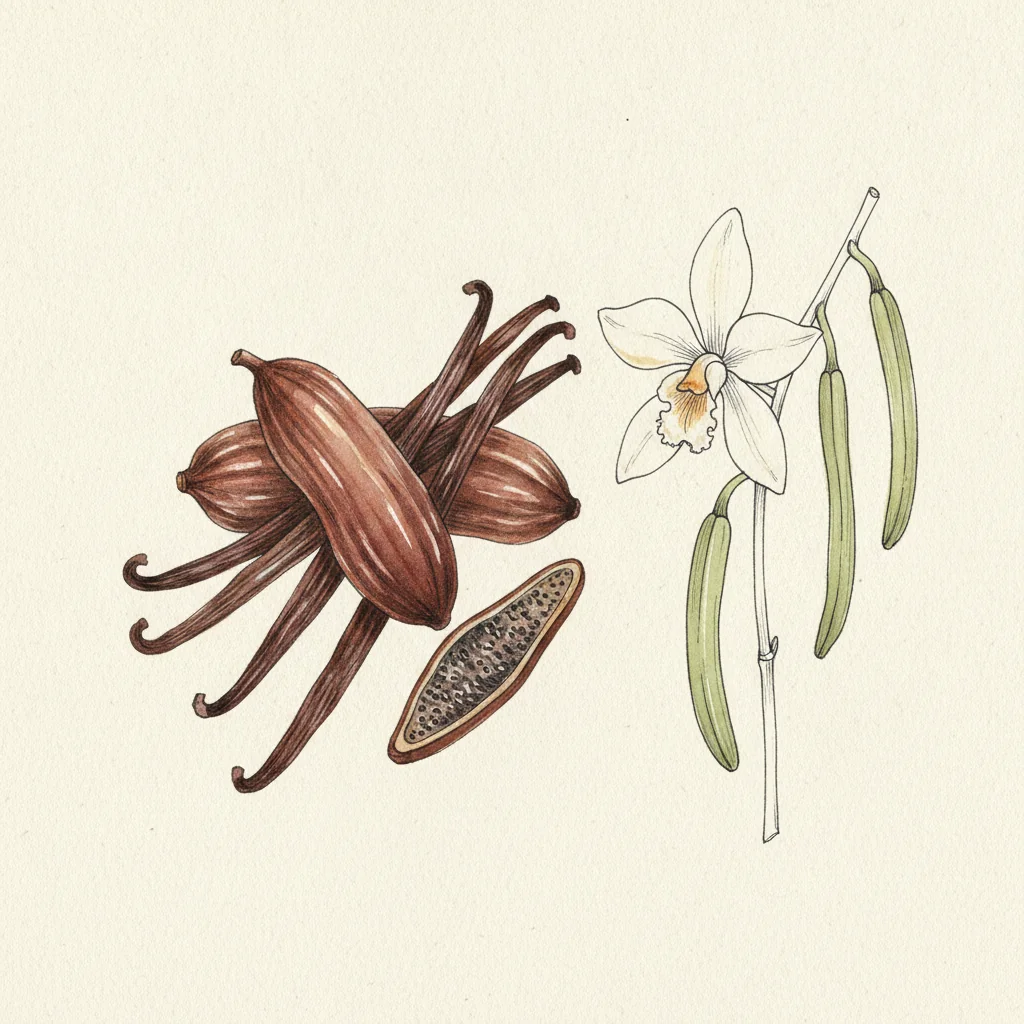
Tahitian Vanilla Beans, plump Grade A pods with a floral, anise profile (Taha'a & Raiatea, French Polynesia)
In brief — Tahitian vanilla isn't a richer Bourbon, it's a different botanical species, and it tastes like it: floral, anise, prune, where Madagascar gives you custard. Grown on Taha'a, the "vanilla island," the plump Grade A pods carry more anisaldehyde and less vanillin, so they perfume rather than sweeten. About $6 to $9 a bean. Reach for it for cold fruit desserts and cured fish, not for the cookie dough. Its aromatic profile develops notes of almond blossom, anise, fresh prune, extended by soft licorice and candied cherry, for an intensity of 6/10. In the kitchen, it's best added scrape and add at the finish, or steep briefly off the heat to protect the floral notes and it pairs with poached fruit and exotic fruit salads, strawberry, mango and citrus desserts, panna cotta and cold creams. Recommended dosage: one bean per 2 cups (500 ml) of liquid; scrape the seeds in, the pod gives the rest. Expect from $4.00 to $9.00 per 1 bean (median $6.50).
Origin : Taha'a and Raiatea, Society Islands, French Polynesia
Vanilla tahitensis
« A spectacular floral-anise profile, made for cold fruit desserts and cocktails. Less vanillin than Bourbon, so it's a perfumer's bean more than a baker's. Pricey, but genuinely singular. Check the label says Tahitensis. »
Tahitian vanilla isn't a richer Bourbon, it's a different botanical species, and it tastes like it: floral, anise, prune, where Madagascar gives you custard. Grown on Taha'a, the "vanilla island," the plump Grade A pods carry more anisaldehyde and less vanillin, so they perfume rather than sweeten. About $6 to $9 a bean. Reach for it for cold fruit desserts and cured fish, not for the cookie dough.
Spice · Vanilla
Tahitian Vanilla
Taha'a and Raiatea, Society Islands, French Polynesia
almond blossom · anise · fresh prune
Aromatic profile
| Family | Vanilla tahitensis |
|---|---|
| Intensity | ●●●○○ (6/10) |
| Main notes | almond blossom · anise · fresh prune |
| Secondary notes | soft licorice · candied cherry · coconut |
| Mouthfeel | supple and perfumed, less fatty and less sugary than a Bourbon bean |
| Finish length | long, with a marked floral trail that lingers after the sweetness fades |
Culinary use
- When to add : scrape and add at the finish, or steep briefly off the heat to protect the floral notes
- Dosage : one bean per 2 cups (500 ml) of liquid; scrape the seeds in, the pod gives the rest
- Ideal pairings : poached fruit and exotic fruit salads, strawberry, mango and citrus desserts, panna cotta and cold creams, cocktails and rum infusions, cured salmon and raw scallops, beurre blanc for white fish
- Avoid with : long cooking above 175 °F / 176°F (80°C), which drives off the floral compounds, very dark, intense chocolate that buries the perfume, anything where you want the bold custard hit of Bourbon vanilla
The grain in detail
Tahitian vanilla is a separate species, not a premium grade of the Madagascar bean, and that genetics is the whole story. Vanilla tahitensis is a likely hybrid of Vanilla planifolia and Vanilla odorata, fixed in French Polynesia in the 19th century. Its aroma is led by anisaldehyde, which is exactly why it reads floral and anise rather than the deep custard-vanillin note you know from a Bourbon bean. Vanillin runs lower, around 1.5 to 2 percent, so it's less sweet on the tongue but far more perfumed in the air. The pod itself is shorter, broader and plumper than a Madagascar bean, with a smooth dark-brown skin and a moisture content often above 30 percent, which keeps it supple and means it stores better once opened. The flavor reads as almond blossom, anise, fresh prune and candied cherry, with soft licorice and a faint coconut behind it. Polynesian output is tiny, roughly 50 to 80 tons a year against Madagascar's couple of thousand, and Taha'a, the "vanilla island" of the Society Islands, is the heart of it, with Raiatea alongside. Pastry chefs reach for it because the floral side talks to fresh fruit, mango, strawberry, pineapple, citrus, and to cream desserts that aren't cooked hard. On the savory side it's a quiet trick for cured salmon, raw scallops and a beurre blanc on white fish. The move is to split, scrape and add it at the finish, or steep it briefly off the heat: the perfume is volatile and a long simmer wastes it. When you buy, look for plump, glossy Grade A beans 6 to 8 inches long with no dry vanillin crust, and check the label says Tahitensis, not just "Tahitian-style."
History & origin
Vanilla reached Tahiti around 1848, brought by Admiral Hamelin from the Philippines by way of Mexico, and hybridized locally into a distinct species that the American botanist John Moore formally identified in 1933. The Polynesian trade nearly collapsed in the 1970s, then was rebuilt from the early 2000s by grower cooperatives on Taha'a. Production stays small-batch and hand-pollinated, grown in the understory or under shade cloth, which is part of why the bean costs what it does.
Provenance & authenticity
What sets the real thing apart — appellation, species and verification cues.
- Protected appellation
- GI (Vanille de Tahiti, French Polynesia)
- Register : French Polynesia GI / national
- Authority : French Polynesia (Pays)
- Species
- Vanilla tahitensis
- Grade / standard
- Vanilla x tahitensis, plump floral-anise pods
How to verify the real one
- Vanilla x tahitensis (distinct species - NOT planifolia)
- Societe/Tuamotu islands
- anisic/floral aroma marker (heliotropin)
- plump non-splitting pod
Indicative price
Reference format : 1 bean — from $4.00 to $9.00 (median : $6.50).
Storage
Airtight glass tube, away from light, at room temperature. Never the fridge. Its high moisture keeps it supple for 18 months without drying out.
Where to buy?
Where to buy it
Links checked on
| Merchant | Price | Action |
|---|---|---|
| Amazon US | — | Amazon US |
| Native Vanilla | — | Native Vanilla |
| Sous Chef UK | — | Sous Chef UK |
Prices may vary depending on current promotions on the merchant site.
Tags
- French Polynesia
- Taha'a
- Raiatea
- vanilla
- floral
- anise
- Vanilla tahitensis
- fine pastry
Frequently asked questions
- How do you store Tahitian Vanilla?
- Airtight glass tube, away from light, at room temperature. Never the fridge. Its high moisture keeps it supple for 18 months without drying out.
- What dosage for Tahitian Vanilla?
- one bean per 2 cups (500 ml) of liquid; scrape the seeds in, the pod gives the rest
- When should you add Tahitian Vanilla in cooking?
- It's best used scrape and add at the finish, or steep briefly off the heat to protect the floral notes.
- What should you avoid pairing Tahitian Vanilla with?
- Avoid with: long cooking above 175 °F / 176°F (80°C), which drives off the floral compounds, very dark, intense chocolate that buries the perfume, anything where you want the bold custard hit of Bourbon vanilla.
Go further
The dishes where this tahitian vanilla shines
Also a recommended alternative for
As a complementary pairing with
See every dish where this product is mentioned →
Other spices to discover
Featured in these gift sets
Page prepared according to our methodology. Purchase links marked sponsored and liable to earn a commission — details on our Affiliations page.