
Chimayó Red Chile, single-origin ground native chile (Chimayó, Río Arriba County, New Mexico, USA)
In brief — Real Chimayó is the catch here: fewer than 500 acres grow in this one northern New Mexico valley, so most powder labeled "Chimayó" on Amazon is New-Mexico-grown blend, not the native landrace. The true stuff is a single-origin red chile, sun-dried and stone-ground, with a deep cherry-and-earth flavor and a gentle 4-out-of-10 heat that builds instead of stinging. Expect to pay $18 to $20 for a real 8-to-12 oz bag from the valley. The cheap supermarket "Chimayó" is a different, blander animal. In the kitchen, it's best added bloom in warm fat or simmer into a sauce at the start of cooking; it is a base spice, not a finisher and it pairs with red chile sauce for enchiladas, carne adovada, posole and pork stews. Recommended dosage: 3 to 4 tablespoons of pure powder per quart of red chile sauce; 2 teaspoons to season a pound of meat for carne adovada. Expect from $15.00 to $22.00 per 8 oz bag (median $19.00).
Origin : Chimayó, Española Valley, Río Arriba County, New Mexico, USA
Capsicum annuum
« When it's the real valley landrace, it's gorgeous: cherry, red earth, a slow warmth that never bites. The catch is sourcing, since most "Chimayó" on the shelf is blend. Buy named, single-origin, or skip it. »
Real Chimayó is the catch here: fewer than 500 acres grow in this one northern New Mexico valley, so most powder labeled "Chimayó" on Amazon is New-Mexico-grown blend, not the native landrace. The true stuff is a single-origin red chile, sun-dried and stone-ground, with a deep cherry-and-earth flavor and a gentle 4-out-of-10 heat that builds instead of stinging. Expect to pay $18 to $20 for a real 8-to-12 oz bag from the valley. The cheap supermarket "Chimayó" is a different, blander animal.
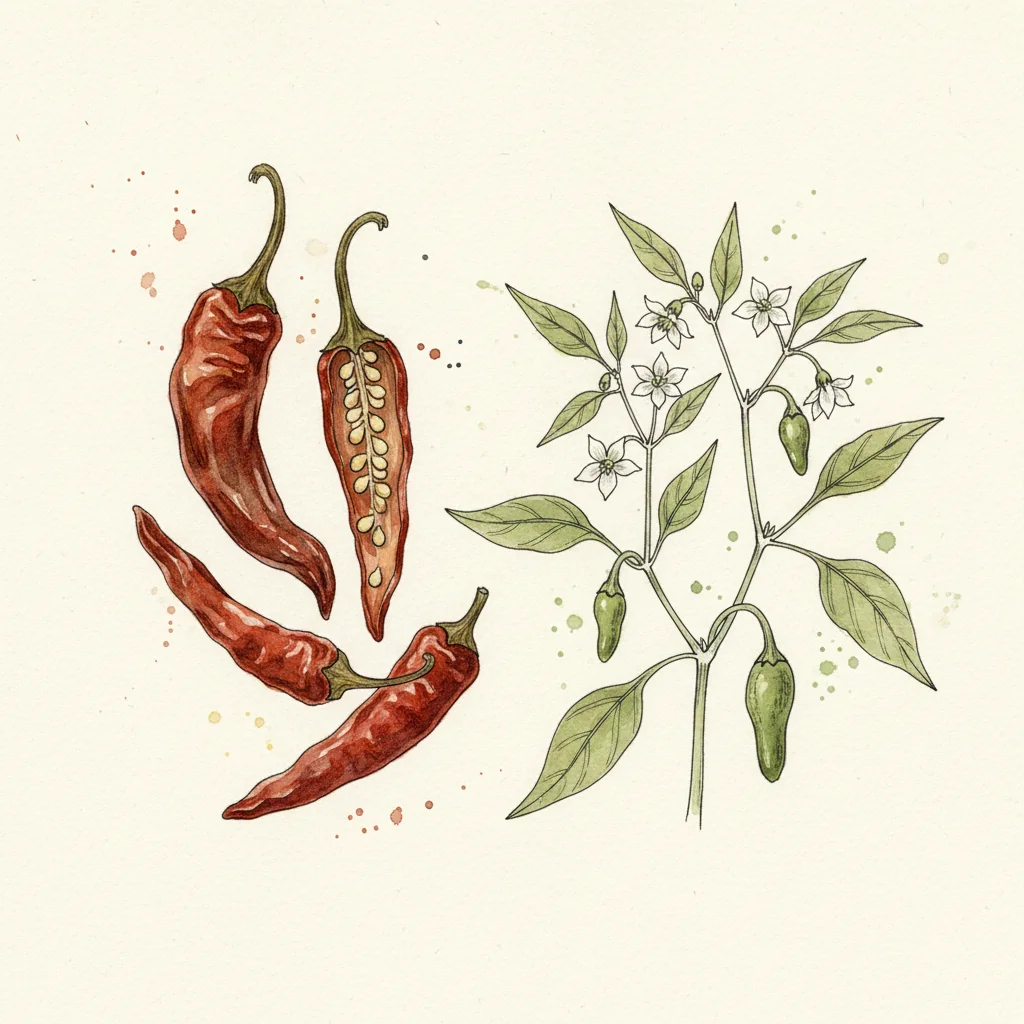
Spice · Chile
Chimayó Chile
Chimayó, Española Valley, Río Arriba County, New Mexico, USA
sun-dried cherry · earthy red soil · toasted raisin
Aromatic profile
| Family | Capsicum annuum |
|---|---|
| Intensity | ●●○○○ (4/10) |
| Main notes | sun-dried cherry · earthy red soil · toasted raisin |
| Secondary notes | dried apricot · warm leather · faint cocoa |
| Mouthfeel | a low, even warmth that builds slowly and never bites, more fruit than fire |
| Finish length | long, with a sweet dried-fruit fade that lingers past the heat |
Culinary use
- When to add : bloom in warm fat or simmer into a sauce at the start of cooking; it is a base spice, not a finisher
- Dosage : 3 to 4 tablespoons of pure powder per quart of red chile sauce; 2 teaspoons to season a pound of meat for carne adovada
- Ideal pairings : red chile sauce for enchiladas, carne adovada, posole and pork stews, tamale masa, beans and pinto frijoles, huevos rancheros
- Avoid with : dishes that need raw, sharp heat (reach for a fresh chile instead), delicate fish where the earthy weight overwhelms, bright vinaigrettes that want clean acidity
The grain in detail
Chimayó chile is a native landrace of Capsicum annuum grown in a single high-desert valley north of Santa Fe, at around 6,000 feet on iron-rich soil fed by the Santa Cruz acequias. Families here have saved and replanted the same seed line for generations, which is what makes it a landrace rather than a commercial cultivar. That continuity is the whole story: the pods are smaller, thinner-walled and less uniform than Hatch, and they carry a flavor that locals call floral and earthy, heavy on dried red fruit with a heat that sits around 4 out of 10. It builds slowly and stays warm rather than sharp. Here is the catch every honest source repeats: Chimayó plants no more than about 500 acres a year, against roughly 50,000 acres of Hatch, so the valley cannot remotely supply national demand. Most powder sold as "Chimayó" is grown elsewhere in New Mexico or the wider Southwest and ground to a similar color. It is not bad chile, it is just not the landrace. If provenance matters to you, buy from a named Chimayó-valley source and read the label for single-origin wording. The pods are traditionally dried whole on ristras or screens in the dry fall air, then stemmed, seeded and stone-ground. Buy it as pure ground chile, not "chili powder," which is a seasoning blend cut with cumin, oregano and salt. To use it, bloom the powder in warm fat or whisk it into stock to build a red chile sauce, the backbone of New Mexican enchiladas, carne adovada and posole. It is a cooking chile that gives color, body and a slow warmth, not a raw finishing heat. One warning worth printing: true valley chile runs roughly $68 to $100 a pound, so a genuine 8 oz bag at $18 to $20 is fair, and a one-pound bag for under $15 online is almost certainly the blend.
History & origin
Chile reached the upper Río Grande with Spanish colonists in the late 1500s, and the Chimayó seed line has been carried by the same farming families since the colonial era, passed down and replanted without crossing into modern hybrids. That unbroken seed-saving is why it survives as a true landrace. In 2024 NPR reported the crop is shrinking and aging as growers retire, which has pushed prices up and made counterfeit "Chimayó" powder more common. New Mexico State University and the Northern New Mexico chile growers have worked to preserve and certify the native seed so the name keeps meaning something.
Provenance & authenticity
What sets the real thing apart — appellation, species and verification cues.
- Species
- Capsicum annuum
Indicative price
Reference format : 8 oz bag — from $15.00 to $22.00 (median : $19.00).
Storage
Keep the ground chile in an airtight jar, away from light and heat. It holds its color and aroma for about 12 months; after that the fruit fades and the powder dulls toward brown.
Where to buy?
Where to buy it
Links checked on
| Merchant | Price | Action |
|---|---|---|
| Amazon US | — | Amazon US |
| Made in New Mexico | — | Made in New Mexico |
| Chimayo Chile Shop | — | Chimayo Chile Shop |
Prices may vary depending on current promotions on the merchant site.
Alternatives if unavailable
Tags
- New Mexico
- Chimayó
- Capsicum annuum
- landrace
- single-origin
- red chile
Frequently asked questions
- How do you store Chimayó Chile?
- Keep the ground chile in an airtight jar, away from light and heat. It holds its color and aroma for about 12 months; after that the fruit fades and the powder dulls toward brown.
- What dosage for Chimayó Chile?
- 3 to 4 tablespoons of pure powder per quart of red chile sauce; 2 teaspoons to season a pound of meat for carne adovada
- When should you add Chimayó Chile in cooking?
- It's best used bloom in warm fat or simmer into a sauce at the start of cooking; it is a base spice, not a finisher.
- What should you avoid pairing Chimayó Chile with?
- Avoid with: dishes that need raw, sharp heat (reach for a fresh chile instead), delicate fish where the earthy weight overwhelms, bright vinaigrettes that want clean acidity.
Go further
The dishes where this chimayó chile shines
Also a recommended alternative for
See every dish where this product is mentioned →
Other spices to discover
Featured in these gift sets
Page prepared according to our methodology. Purchase links marked sponsored and liable to earn a commission — details on our Affiliations page.