
Furikake, the Japanese rice seasoning of nori, toasted sesame, dried bonito and salt
In brief — Furikake is the dry Japanese rice seasoning of nori flakes, toasted white and black sesame, shaved bonito (katsuobushi) and salt. The mass-market version was born in 1959, when Marumiya in Kumamoto bagged the first commercial blend, Noritama. The flavor is briny and umami the moment it hits warm rice — and it's a finishing sprinkle, full stop: heat turns the nori bitter and flattens the bonito. The Oregon-made Jacobsen blend runs about $12 for a 1.73oz jar; a basic Japanese bottle is closer to $6. In the kitchen, it's best added showered over the plated dish at the last second, never cooked and it pairs with a bowl of plain white rice, onigiri rice balls, grilled salmon. Recommended dosage: one teaspoon per bowl of rice (about 300g), no more — furikake is concentrated and the salt adds up fast. Expect from $6.00 to $14.00 per around 50g jar (median $9.00).
Origin : Kumamoto Prefecture (industrial birthplace, Marumiya 1959) and nationwide, Japan
« A lot of flavor for almost no effort, and a finishing sprinkle only — heat turns the nori bitter. Skip the MSG-padded bottles; Jacobsen and Spicewalla earn the upgrade. Use it within six months before the sesame turns. »
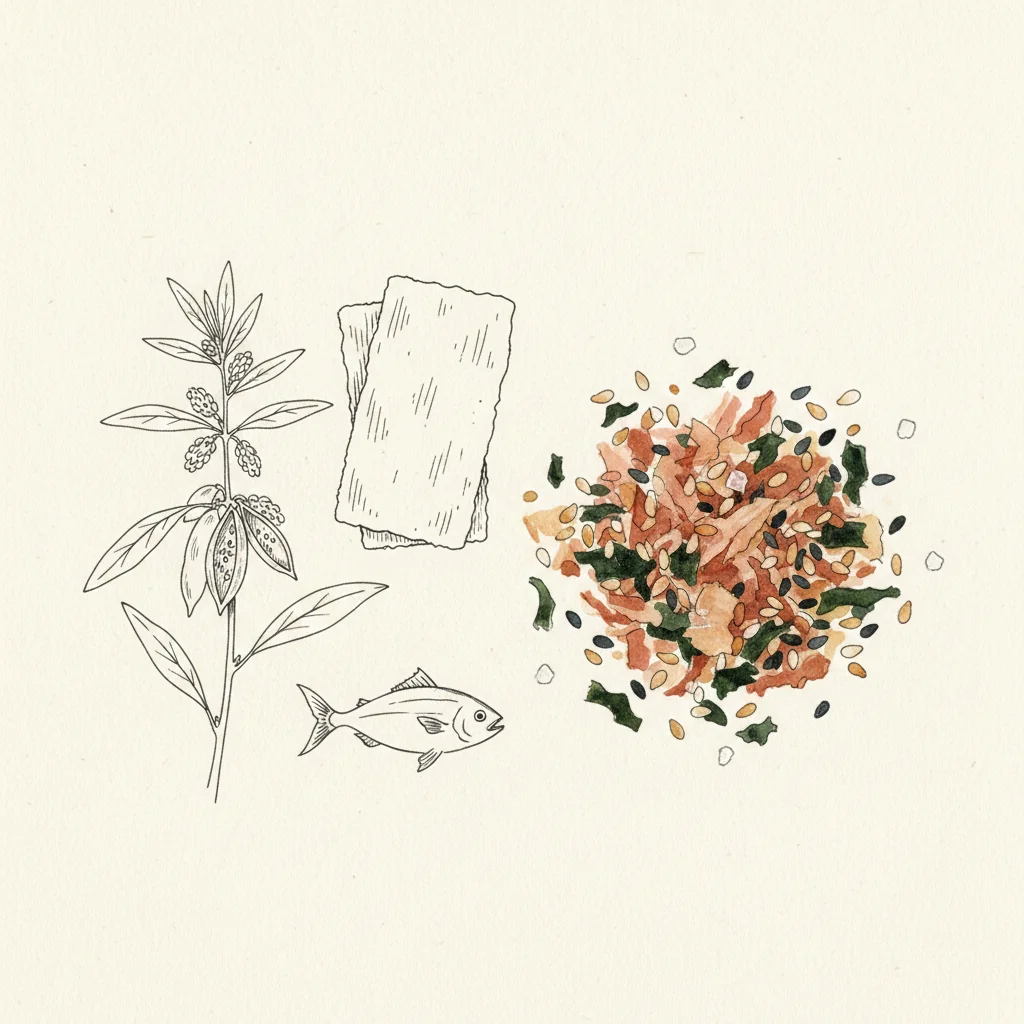
Furikake is the dry Japanese rice seasoning of nori flakes, toasted white and black sesame, shaved bonito (katsuobushi) and salt. The mass-market version was born in 1959, when Marumiya in Kumamoto bagged the first commercial blend, Noritama. The flavor is briny and umami the moment it hits warm rice — and it's a finishing sprinkle, full stop: heat turns the nori bitter and flattens the bonito. The Oregon-made Jacobsen blend runs about $12 for a 1.73oz jar; a basic Japanese bottle is closer to $6.
Spice · Blend
Furikake
Kumamoto Prefecture (industrial birthplace, Marumiya 1959) and nationwide, Japan
briny iodine from nori · deep bonito umami · toasted sesame
Aromatic profile
| Family | composed blend |
|---|---|
| Intensity | ●●●○○ (5/10) |
| Main notes | briny iodine from nori · deep bonito umami · toasted sesame |
| Secondary notes | light sweetness · toasted soy · dried egg |
| Mouthfeel | salty-umami with the crackle of sesame, no heat at all |
| Finish length | medium, an umami finish that lingers on the tongue |
Culinary use
- When to add : showered over the plated dish at the last second, never cooked
- Dosage : one teaspoon per bowl of rice (about 300g), no more — furikake is concentrated and the salt adds up fast
- Ideal pairings : a bowl of plain white rice, onigiri rice balls, grilled salmon, scrambled eggs, steamed vegetables, buttered popcorn
- Avoid with : already briny dishes like raw oysters, sweet preparations, anything that goes back under heat, which scorches the nori
The grain in detail
Furikake (ふりかけ, literally "to sprinkle over") is a dry condiment of dried fish, seaweed, sesame and salt built for one job: seasoning a bowl of plain white rice. Its industrial birth is precisely dated — in 1959 the Marumiya company in Kumamoto released Noritama, the first bagged furikake, built on nori and dried egg. The idea is older: in the 1920s an Okayama pharmacist, Suekichi Yoshimaru, ground a calcium-rich mix of fish bones, seaweed and sesame to fight malnutrition, and sold it as Gohan-no-Tomo, "friend of rice." The modern canonical blend layers roasted nori flakes (15 to 20 percent), toasted golden and black sesame (30 to 40 percent), shaved katsuobushi — smoked, dried bonito (15 to 25 percent) — salt (5 to 8 percent), a little sugar, and sometimes a touch of soy powder. Contemporary variants spin off the base: ume furikake (fermented plum), wasabi furikake, sake furikake (salmon), shiso furikake (perilla). The use is almost ritual: a bowl of white rice under a shower of furikake is a meal on its own, and an onigiri — the triangular rice ball — is often rolled in it before being wrapped in nori. It also finishes miso soup, ramen and grilled fish. Outside Japan it has landed on scrambled eggs, popcorn, avocado toast and steamed vegetables, where its salty-umami crackle does a lot of work for almost no effort. The one hard rule: furikake will not survive cooking. The nori scorches and turns bitter, the bonito loses its umami — so it goes on at the table, off the heat, never in the pan. And because the sesame is oily, it goes rancid; use it within six months of opening. On the shelf, read the label and favor blends that stay under about ten ingredients. The cheap industrial lots pad the list with MSG, dyes and flavor enhancers that flatten the profile — you're paying for filler, not for nori and bonito.
History & origin
The furikake idea traces to the 1920s, when the Okayama pharmacist Suekichi Yoshimaru ground a calcium-rich mix of fish bones, seaweed and sesame and sold it as Gohan-no-Tomo, "friend of rice." The modern industrial version arrived in 1959, when Marumiya in Kumamoto launched Noritama. Furikake became a daily fixture in Japanese homes through the 1970s and 1980s, and its international spread accelerated in the 2010s on the back of fusion cooking and Japanese pop culture. In the United States it has a parallel history through Hawaii, where furikake-dusted popcorn and snack mix are local staples.
Provenance & authenticity
What sets the real thing apart — appellation, species and verification cues.
- Grade / standard
- Seasoning blend (nori, sesame, bonito, salt)
How to verify the real one
- blend - nori/sesame/bonito flakes/salt
- Japanese origin (Marumiya origin 1959)
Indicative price
Reference format : around 50g jar — from $6.00 to $14.00 (median : $9.00).
Storage
Airtight, resealable, away from light. Because the sesame is oily, decant into an opaque glass jar after opening. Best within 6 months of opening, 12 months sealed.
Where to buy?
Where to buy it
Links checked on
| Merchant | Price | Action |
|---|---|---|
| Amazon US | — | Amazon US |
| Jacobsen Salt Co. | — | Jacobsen Salt Co. |
| Spicewalla | — | Spicewalla |
Prices may vary depending on current promotions on the merchant site.
Tags
- furikake
- Japan
- blend
- nori
- bonito
- sesame
- rice
- umami
- Marumiya
Frequently asked questions
- How do you store Furikake?
- Airtight, resealable, away from light. Because the sesame is oily, decant into an opaque glass jar after opening. Best within 6 months of opening, 12 months sealed.
- What dosage for Furikake?
- one teaspoon per bowl of rice (about 300g), no more — furikake is concentrated and the salt adds up fast
- When should you add Furikake in cooking?
- It's best used showered over the plated dish at the last second, never cooked.
- What should you avoid pairing Furikake with?
- Avoid with: already briny dishes like raw oysters, sweet preparations, anything that goes back under heat, which scorches the nori.
Go further
The dishes where this furikake shines
Also a recommended alternative for
See every dish where this product is mentioned →
Other spices to discover
Featured in these gift sets
Page prepared according to our methodology. Purchase links marked sponsored and liable to earn a commission — details on our Affiliations page.