
Persian Blue Salt (Semnan, Iran)
In brief — Persian Blue Salt is one of the rarest salts on earth, mined in the Iranian desert province of Semnan. Its pale-blue-to-indigo color isn't dye, it's natural sylvinite, a potassium mineral that bends light inside the crystal. The salinity is round with a faint metallic edge and a quiet umami close. This is a finishing salt for the precious end of the plate, foie gras, raw scallops, white truffle. Expect around $13 to $15 for a small 100 g jar. Its aromatic profile develops notes of round salinity, clean mineral, cold stone, extended by faint metallic edge and quiet umami finish, for an intensity of 7/10. In the kitchen, it's best added as a finishing touch, raw and it pairs with seared foie gras, raw scallops and crudo, beef carpaccio. Recommended dosage: a few whole crystals, or a light pass on a microplane, scattered over the plate at the last second. Expect from $10.00 to $16.00 per 100g (median $13.50).
Origin : Semnan province, central desert mines, Iran
« Stunning on the plate, more restrained on the tongue: round salinity, a faint metallic edge, a quiet umami close. Worth it as plating theater for foie gras or crudo, not as your everyday finishing salt. Buy genuinely blue, hard crystals. »
Persian Blue Salt is one of the rarest salts on earth, mined in the Iranian desert province of Semnan. Its pale-blue-to-indigo color isn't dye, it's natural sylvinite, a potassium mineral that bends light inside the crystal. The salinity is round with a faint metallic edge and a quiet umami close. This is a finishing salt for the precious end of the plate, foie gras, raw scallops, white truffle. Expect around $13 to $15 for a small 100 g jar.
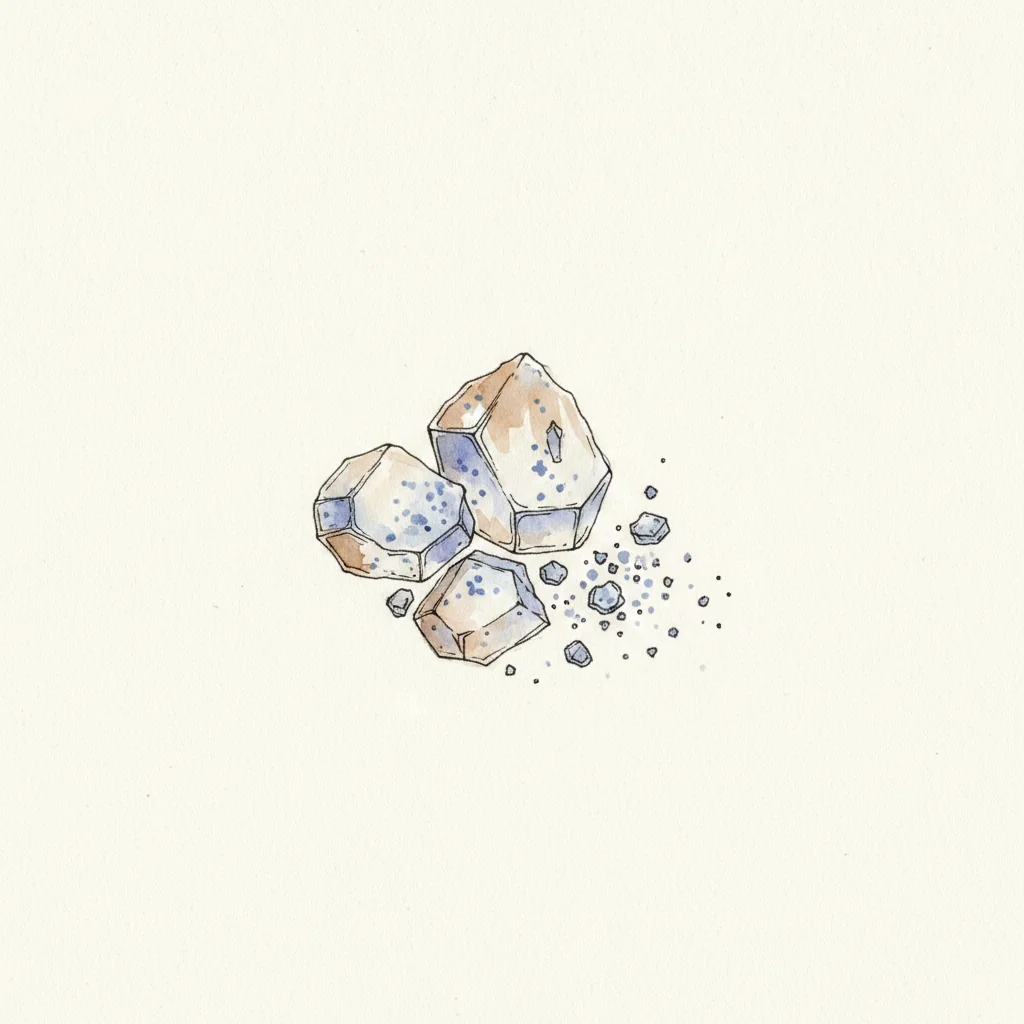
Salt · Rock salt
Persian Blue Salt
Semnan province, central desert mines, Iran
round salinity · clean mineral · cold stone
Aromatic profile
| Family | Halite (fossil sodium chloride with sylvinite inclusions) |
|---|---|
| Intensity | ●●●●○ (7/10) |
| Main notes | round salinity · clean mineral · cold stone |
| Secondary notes | faint metallic edge · quiet umami finish |
| Mouthfeel | hard translucent crystals that melt slowly, a soft salinity that stretches out rather than spiking |
| Finish length | long, a clean mineral persistence with no bitterness |
Culinary use
- When to add : finishing, raw
- Dosage : a few whole crystals, or a light pass on a microplane, scattered over the plate at the last second
- Ideal pairings : seared foie gras, raw scallops and crudo, beef carpaccio, shaved white truffle, soft-boiled eggs on toast, a few crystals on the rim of a Champagne flute
- Avoid with : long cooking (the blue color washes out), dishes that are already blue or dark on the plate, stocks and braises, where the color and the price are both wasted
The grain in detail
Persian Blue Salt is one of the rarest and strangest salts you can buy. It comes from a handful of fossil mines in Iran's Semnan province, in the central desert, worked since antiquity. The pale-blue to deep-indigo color is not an additive or a dye. It's caused by natural inclusions of sylvinite, a potassium chloride mineral that crystallized under geological pressure and refracts light inside the cubic salt structure, so the crystals throw a faint kaleidoscopic flash when you turn them toward the light. On the tongue the salinity is round and sustained, the mark of a pure fossil salt, with a light metallic note from the potassium and a discreet umami on the finish. The melt is slow, almost glassy. Here's why it lives strictly at the finish: this is not a cooking salt. Drop it into a hot pan or a stock and the blue washes out and the price evaporates with it. Use it raw, on the precious end of the plate, seared foie gras, barely-sliced raw scallops, beef carpaccio, shaved Alba white truffle, a soft-boiled egg on toast, or as a piece of theater, a few crystals dropped straight onto a Champagne flute. The look matters as much as the taste here: a scatter of blue crystals on a monochrome plate is a plating signature, not a seasoning. The rarity is real and it's why it's costly. The blue veins run thin in the mine, the crystals are hard and awkward to crush, and every batch is hand-sorted to keep only the genuinely blue stones. Annual output runs to a few tonnes, no more. The catch worth its own line: a lot of what's sold online is grayish or dyed. Buy crystals with a true blue cast, not a dull gray, and they should be hard, not crumbly.
History & origin
Blue salt has been worked in the Semnan mines since at least the Achaemenid era, the sixth century BC, when it was reserved for the Persian royal table. It stayed almost unknown in the West until the 2000s, when specialist importers of Iranian goods and a handful of Michelin-starred French and Japanese chefs began carrying it. Production is still entirely manual, capped by the geology and the hand-sorting, and a few Iranian families control most of the export, mainly to Europe, Japan and the Middle East.
Provenance & authenticity
What sets the real thing apart — appellation, species and verification cues.
- Grade / standard
- Rock salt with sylvinite (blue crystals)
How to verify the real one
- blue tint from natural sylvinite (potassium) inclusions - rare
- Semnan, Iran mines
Indicative price
Reference format : 100g — from $10.00 to $16.00 (median : $13.50).
Storage
An airtight, opaque jar, kept dry and away from humidity. It keeps indefinitely, a stable fossil salt that won't lose its color in the dark.
Where to buy?
Where to buy it
Links checked on
| Merchant | Price | Action |
|---|---|---|
| Amazon US | — | Amazon US |
| Persian Basket | — | Persian Basket |
| Sous Chef UK | — | Sous Chef UK |
Prices may vary depending on current promotions on the merchant site.
Alternatives if unavailable
Tags
- Iran
- Persia
- fossil salt
- blue
- rare
- finishing salt
- fine dining
Frequently asked questions
- How do you store Persian Blue Salt?
- An airtight, opaque jar, kept dry and away from humidity. It keeps indefinitely, a stable fossil salt that won't lose its color in the dark.
- What dosage for Persian Blue Salt?
- a few whole crystals, or a light pass on a microplane, scattered over the plate at the last second
- When should you add Persian Blue Salt in cooking?
- It's best used finishing, raw.
- What should you avoid pairing Persian Blue Salt with?
- Avoid with: long cooking (the blue color washes out), dishes that are already blue or dark on the plate, stocks and braises, where the color and the price are both wasted.
Go further
The dishes where this persian blue salt shines
See every dish where this product is mentioned →
Other salts to discover
Featured in these gift sets
Page prepared according to our methodology. Purchase links marked sponsored and liable to earn a commission — details on our Affiliations page.