
Pure Sweet Sorghum Syrup, kettle-boiled from cane juice in the Appalachian South (Tennessee, Kentucky, North Carolina)
In brief — Sorghum syrup is the Appalachian South's homegrown sweetener, and it is not molasses. It is the juice pressed from sweet sorghum cane, then kettle-boiled down to one amber syrup, no sugar refining involved. The flavor is caramel and warm spice cut with a tart, almost citrus edge that ordinary syrup never has. Real single-source sorghum runs about $12 to $22 for a 16 oz pint. In the kitchen, it's best added raw as a finish, or stirred in late in baking and glazing and it pairs with hot buttermilk biscuits and cornbread, stacked sorghum gingerbread and spice cakes, drizzled over butter-roasted sweet potatoes and winter squash. Recommended dosage: a tablespoon or two per portion as a finish; reduce other sugar when baking, it is less sweet and more acidic than sugar. Expect from $12.00 to $22.00 per 16 oz (1 pint) jar (median $18.00).
Origin : Appalachian South (Tennessee, Kentucky, North Carolina), United States
Sorghum bicolor
« Not molasses, and that's the point. Sorghum is whole boiled cane juice: caramel and spice with a tart citrus edge. Brilliant on biscuits and gingerbread, too sour for delicate desserts. Buy a named mill. »
Sorghum syrup is the Appalachian South's homegrown sweetener, and it is not molasses. It is the juice pressed from sweet sorghum cane, then kettle-boiled down to one amber syrup, no sugar refining involved. The flavor is caramel and warm spice cut with a tart, almost citrus edge that ordinary syrup never has. Real single-source sorghum runs about $12 to $22 for a 16 oz pint.
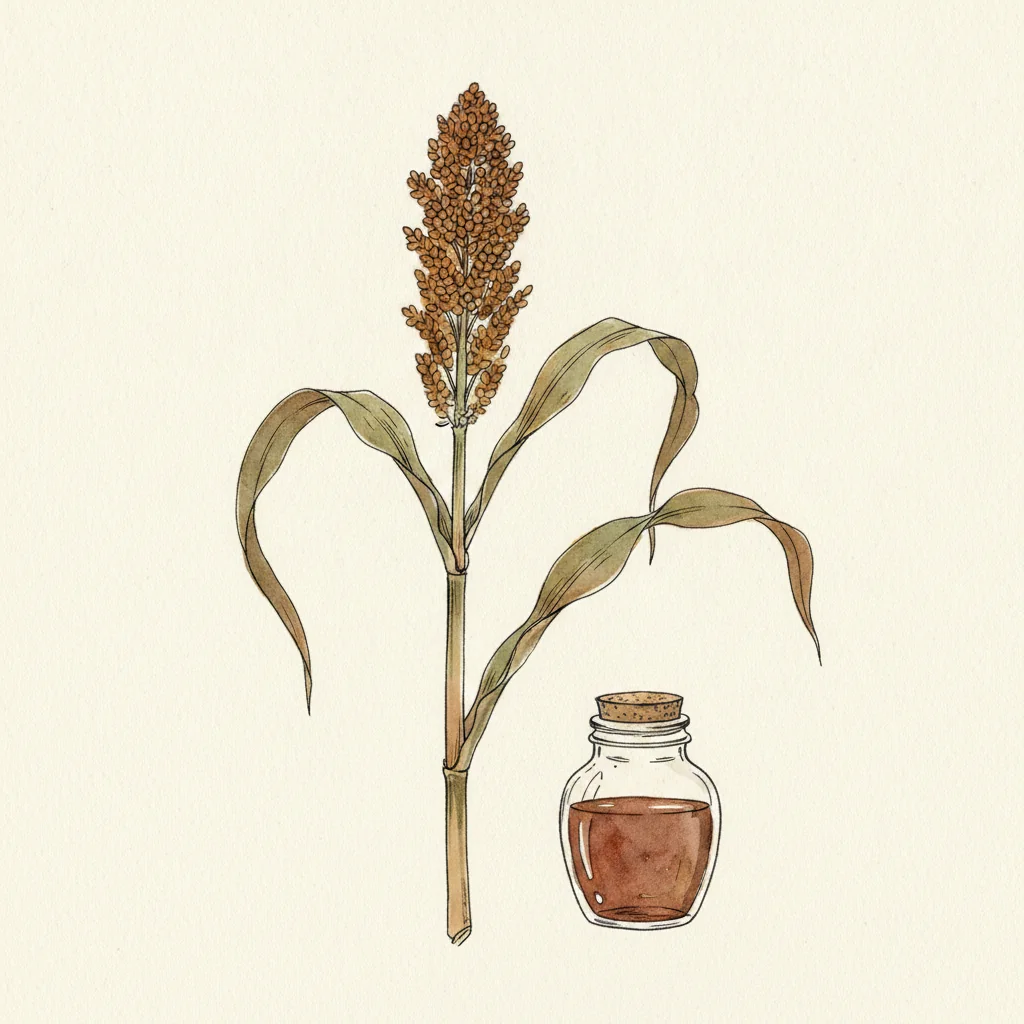
Honey · Plant syrup
Sorghum Syrup
Appalachian South (Tennessee, Kentucky, North Carolina), United States
deep caramel · warm baking spice · tart citrus edge
Aromatic profile
| Family | Sorghum bicolor (boiled cane juice) |
|---|---|
| Intensity | ●●●●○ (7/10) |
| Main notes | deep caramel · warm baking spice · tart citrus edge |
| Secondary notes | dark toast · mild bitterness · ripe fig |
| Mouthfeel | thick and pourable, a little thinner than blackstrap molasses, coats the spoon and never sets or crystallizes |
| Finish length | long, with a sour-sweet finish that pulls back before it turns cloying |
Culinary use
- When to add : raw as a finish, or stirred in late in baking and glazing
- Dosage : a tablespoon or two per portion as a finish; reduce other sugar when baking, it is less sweet and more acidic than sugar
- Ideal pairings : hot buttermilk biscuits and cornbread, stacked sorghum gingerbread and spice cakes, drizzled over butter-roasted sweet potatoes and winter squash, a BBQ or country-ham glaze in place of molasses, stirred into oatmeal, plain yogurt, or a bourbon cocktail
- Avoid with : delicate desserts where the tart, faintly bitter edge clashes, anything that just needs clean sweetness (use honey or simple syrup), a straight one-to-one swap for honey without tasting first, since it is sourer
The grain in detail
Sorghum syrup is made from Sorghum bicolor, a tall grass grown for its sweet, juicy stalks across the Appalachian South, chiefly Tennessee, Kentucky and the western Carolinas. The cane is cut in early fall, crushed to press out a green juice, and that juice is boiled down in long open pans until it thickens to a clear amber syrup. That is the entire product: no second sugar, no sulfur, nothing refined out. This is the first thing to get straight, because almost everyone calls it molasses and it is not. True molasses is a byproduct left over after sugar is crystallized out of sugarcane or beets; sorghum syrup is the whole boiled-down juice of a different plant, so it is brighter, sourer and more aromatic than blackstrap. The flavor is what earns it a place next to good honey: deep caramel and warm baking spice up front, then a tart, almost citrus edge on the finish, with a faint earthy bitterness that keeps it from ever cloying. It pours a touch thinner than blackstrap molasses and never crystallizes. Use it where you want molasses-style depth with more lift: on hot buttermilk biscuits and cornbread, in stacked gingerbread and spice cakes, brushed over butter-roasted sweet potatoes or a country ham, stirred into oatmeal, or shaken into a bourbon cocktail. Because it is sourer and less sweet than sugar, taste before you swap it one-for-one. Sorghum was a rural Appalachian staple from the 1850s on, when sweet sorghum cane spread across the country as a home sweetener that freed poor farms from expensive refined sugar; fall syrup-making was a community event like a hog killing. Production has since shrunk to a few hundred small mills, which is why a real single-source pint costs what it does. There is no federal appellation protecting the name, and the catch is exactly that: jars labeled 'sorghum' are sometimes blended or are actually cane molasses. Your defense is the source. Buy from a named mill like Muddy Pond in Tennessee or Oberholtzer's in Kentucky, expect about $12 to $22 for a 16 oz pint, and treat suspiciously cheap supermarket 'sorghum' as suspect.
History & origin
Sweet sorghum reached the United States in the 1850s, and by 1857 some 20,000 acres were planted from Minnesota to Georgia as growers chased a homegrown sugar crop. The cane never yielded reliable crystals, so once cheap beet and cane sugar arrived, commercial sorghum collapsed, surviving mainly as a home and community sweetener on small farms across the Appalachian South. There, fall syrup-making at the local mill became a seasonal ritual, and sorghum-and-biscuits a regional breakfast. The tradition nearly died out in the late twentieth century as makers aged out, but a craft-food revival has kept named Tennessee and Kentucky mills running, several of them family-operated for generations.
Provenance & authenticity
What sets the real thing apart — appellation, species and verification cues.
- Species
- Sorghum bicolor
Indicative price
Reference format : 16 oz (1 pint) jar — from $12.00 to $22.00 (median : $18.00).
Storage
Glass jar at room temperature, lid tight, away from direct light. Does not crystallize; if it thickens in the cold, warm the jar gently in a water bath. Keeps for years.
Where to buy?
Where to buy it
Links checked on
| Merchant | Price | Action |
|---|---|---|
| Amazon US | — | Amazon US |
| Muddy Pond Sorghum | — | Muddy Pond Sorghum |
| J.Q. Dickinson Appalachian Mercantile | — | J.Q. Dickinson Appalachian Mercantile |
Prices may vary depending on current promotions on the merchant site.
Alternatives if unavailable
Tags
- syrup
- sorghum
- Appalachian
- Tennessee
- Kentucky
- Sorghum-bicolor
- not-molasses
Frequently asked questions
- How do you store Sorghum Syrup?
- Glass jar at room temperature, lid tight, away from direct light. Does not crystallize; if it thickens in the cold, warm the jar gently in a water bath. Keeps for years.
- What dosage for Sorghum Syrup?
- a tablespoon or two per portion as a finish; reduce other sugar when baking, it is less sweet and more acidic than sugar
- When should you add Sorghum Syrup in cooking?
- It's best used raw as a finish, or stirred in late in baking and glazing.
- What should you avoid pairing Sorghum Syrup with?
- Avoid with: delicate desserts where the tart, faintly bitter edge clashes, anything that just needs clean sweetness (use honey or simple syrup), a straight one-to-one swap for honey without tasting first, since it is sourer.
Go further
Other oils, vinegars & honeys to discover
Page prepared according to our methodology. Purchase links marked sponsored and liable to earn a commission — details on our Affiliations page.