
Chestnut Honey — dark, tannic monofloral honey from Castanea sativa, made across the Cévennes, Corsica and the Italian chestnut belt
In brief — This is the one honey that tastes savory. Dark, almost treacle-brown, with a frank bitterness and a tannic grip no other honey has — roasted chestnut, dark caramel, a whisper of leather. The Italian chestnut belt (Tuscany, Piedmont) and southern France (Cévennes, Corsica) make the best of it; the Corsican lots even carry a PDO. If you came looking for sweet, look elsewhere. This is a cheese-board and roast-duck honey, full stop. Its aromatic profile develops notes of wood tannin, noble bitterness, roasted chestnut, extended by dark caramel and soft leather, for an intensity of 8/10. In the kitchen, it's best added raw, or as a fast glaze brushed on at the end and it pairs with blue cheeses (Roquefort, Gorgonzola), aged goat cheese, seared duck breast. Recommended dosage: 1 teaspoon to 1 tablespoon a portion — it is loud, so start small. Expect from $12.00 to $22.00 per 8.8 oz (250 g) jar (median $15.00).
Origin : Italian chestnut belt (Tuscany, Piedmont) and southern France (Cévennes, Corsica), Italy / France (PDO (Mele di Corsica — Miel de Corse, for the Corsican lots))
Castanea sativa
« Our default cooking honey: tannic, woody, frankly bitter, unbeatable on blue cheese and seared duck. The Italian and Corsican lots are dependable and fairly priced. It loses half a point only because the bitterness genuinely isn't for everyone. »
This is the one honey that tastes savory. Dark, almost treacle-brown, with a frank bitterness and a tannic grip no other honey has — roasted chestnut, dark caramel, a whisper of leather. The Italian chestnut belt (Tuscany, Piedmont) and southern France (Cévennes, Corsica) make the best of it; the Corsican lots even carry a PDO. If you came looking for sweet, look elsewhere. This is a cheese-board and roast-duck honey, full stop.
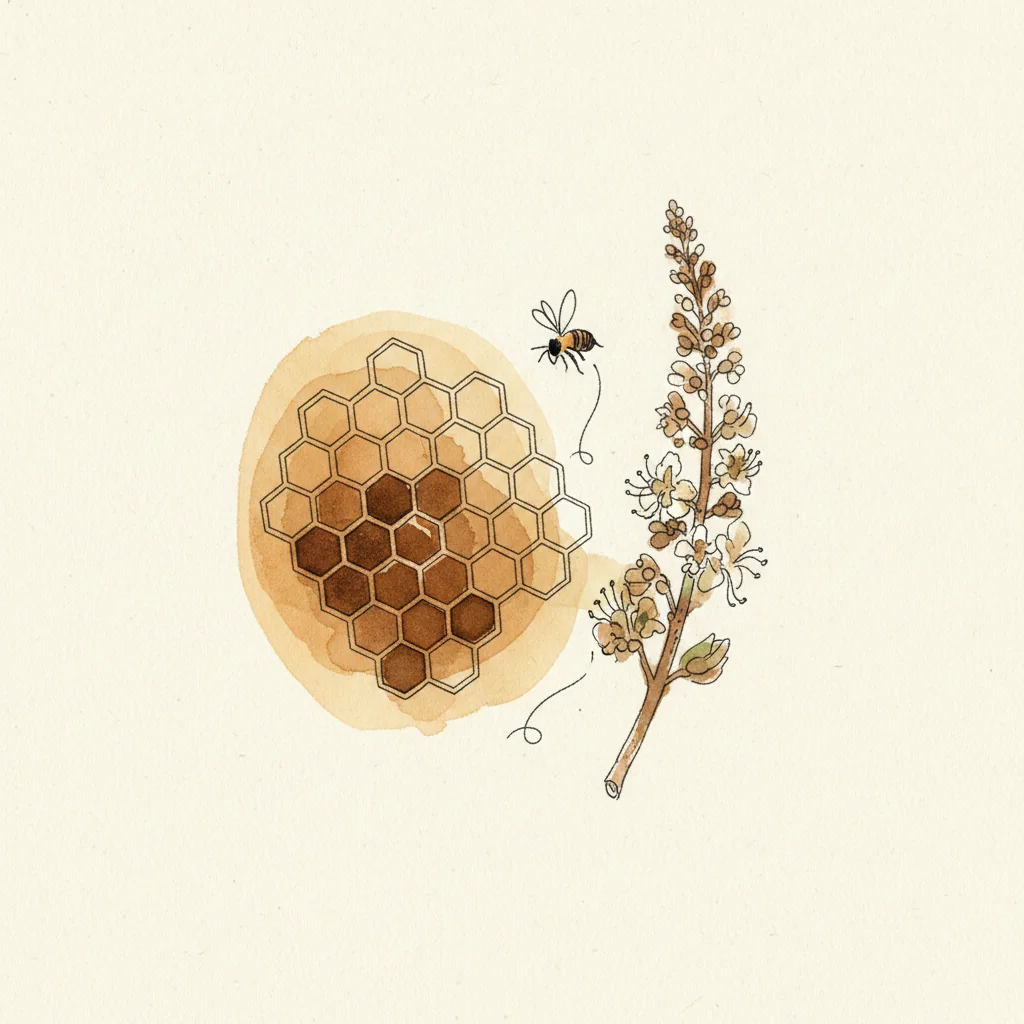
Honey · Monofloral honey
Chestnut Honey
Italian chestnut belt (Tuscany, Piedmont) and southern France (Cévennes, Corsica), Italy / France (PDO (Mele di Corsica — Miel de Corse, for the Corsican lots))
wood tannin · noble bitterness · roasted chestnut
Aromatic profile
| Family | Castanea sativa |
|---|---|
| Intensity | ●●●●○ (8/10) |
| Main notes | wood tannin · noble bitterness · roasted chestnut |
| Secondary notes | dark caramel · soft leather · licorice |
| Mouthfeel | runny to moderately thick, savory rather than sweet, with a genuine tannic grip |
| Finish length | long, finishing woody and frankly bitter |
Culinary use
- When to add : raw, or as a fast glaze brushed on at the end
- Dosage : 1 teaspoon to 1 tablespoon a portion — it is loud, so start small
- Ideal pairings : blue cheeses (Roquefort, Gorgonzola), aged goat cheese, seared duck breast, full-fat yogurt and ricotta, dark rye bread with salted butter
- Avoid with : dishes where you expect plain sweetness — the bitterness will ambush them, delicate floral or citrus pairings it simply flattens, anything you'd want a mild breakfast honey for
The grain in detail
Chestnut honey is harvested from late June into mid-July, when Castanea sativa flowers across the chestnut forests of southern Europe. Italy is the heartland — Tuscany's Garfagnana, Piedmont, the Asiago plateau — and France matches it from the Cévennes (Lozère, Gard), the Ardèche and Corsica. To be sold as monofloral it needs chestnut nectar above roughly 70 percent of the analyzed pollen, the threshold serious beekeepers hold to. The color runs deep amber to red-brown, sometimes near-black in the most concentrated lots, and it crystallizes slowly or not at all: a high fructose-to-glucose ratio keeps it pourable for months, even years, which sets it apart from almost every other honey on the shelf. What makes it a chef's honey is the flavor. It is the only honey that reads tannic — wood tannin, a marked, noble bitterness, roasted chestnut, soft leather, dark caramel and a faint licorice tail. That bitterness throws people who expect a sweet breakfast honey, but it is exactly why it earns a place on the cheese board: it argues with the salt in a Roquefort or Gorgonzola instead of fawning over it, holds its own against aged goat cheese, and brushed on as a fast glaze it gives a seared duck breast a savory, almost caramelized edge. Corsica won a PDO in 2000 — Mele di Corsica, Miel de Corse — that recognizes ten honey profiles including a distinct chestnut-grove one, with on-island production, cold extraction and pollen analysis written into the rules. In the US, the names to look for are Italian importers like Mieli Thun, Giannetti Artisans (Garfagnana, Tuscany) and Rigoni di Asiago, or French producers such as Manoir des Abeilles; in the UK, Seggiano's raw Tuscan lot and the French-packed Napoleon are the easy picks. Buy small from a real beekeeper where you can, check for that typical dark color, and treat slow or absent crystallization as a good sign, not a fault.
History & origin
The sweet chestnut (Castanea sativa) has grown across southern Europe since Roman times and propped up mountain economies for centuries — the Cévennes called it the bread tree. Chestnut honey is a historic product of those forests, gathered by peasant beekeepers who moved their hives under the trees at flowering. Italy's chestnut belt has long made the benchmark lots; Corsica's PDO was recognized in 2000 and revised in 2014.
Provenance & authenticity
What sets the real thing apart — appellation, species and verification cues.
- Species
- Castanea sativa
- Grade / standard
- Monofloral chestnut honey
How to verify the real one
- monofloral chestnut (pollen analysis)
- dark amber, tannic/bitter finish
- slow to crystallise
- NOTE: only Corsican chestnut honey is PDO (Miel de Corse - Mele di Corsica, AOC 1998/AOP 2000); Cevennes/Ardeche/Limousin chestnut honey is NOT PDO
Indicative price
Reference format : 8.8 oz (250 g) jar — from $12.00 to $22.00 (median : $15.00).
Storage
Glass jar, room temperature, out of the light. It crystallizes very slowly and can stay runny for years — that's a feature, not spoilage. Keeps essentially indefinitely.
Where to buy?
Where to buy it
Links checked on
| Merchant | Price | Action |
|---|---|---|
| Amazon US (Manoir des Abeilles, France) | — | Amazon US (Manoir des Abeilles, France) |
| Giannetti Artisans (Garfagnana, Tuscany) | — | Giannetti Artisans (Garfagnana, Tuscany) |
| Sous Chef UK (Napoleon, France) | — | Sous Chef UK (Napoleon, France) |
Prices may vary depending on current promotions on the merchant site.
Alternatives if unavailable
Tags
- Italy
- France
- Tuscany
- Corsica
- Cevennes
- Castanea sativa
- monofloral
- PDO
Frequently asked questions
- How do you store Chestnut Honey?
- Glass jar, room temperature, out of the light. It crystallizes very slowly and can stay runny for years — that's a feature, not spoilage. Keeps essentially indefinitely.
- What dosage for Chestnut Honey?
- 1 teaspoon to 1 tablespoon a portion — it is loud, so start small
- When should you add Chestnut Honey in cooking?
- It's best used raw, or as a fast glaze brushed on at the end.
- What should you avoid pairing Chestnut Honey with?
- Avoid with: dishes where you expect plain sweetness — the bitterness will ambush them, delicate floral or citrus pairings it simply flattens, anything you'd want a mild breakfast honey for.
Go further
The dishes where this chestnut honey shines
Also a recommended alternative for
As a complementary pairing with
See every dish where this product is mentioned →
Other oils, vinegars & honeys to discover
Featured in these gift sets
Page prepared according to our methodology. Purchase links marked sponsored and liable to earn a commission — details on our Affiliations page.