
Raw Buckwheat Honey (Upstate New York & Minnesota, USA)
In brief — Buckwheat is the darkest, boldest honey on the American shelf, and the one most people meet by accident expecting clover. It pours like motor oil and tastes of molasses, malt and a savory barnyard funk that wrecks delicate desserts but sings on sharp cheddar, biscuits and barbecue. Upstate New York and Minnesota are the heartland. A 12 oz jar of the real raw stuff runs about $12 to $20. Its aromatic profile develops notes of dark molasses, malt, barnyard funk, extended by stewed prune and brown bread, for an intensity of 9/10. In the kitchen, it's best added raw, drizzled at the finish, or in a quick glaze off the heat and it pairs with sharp aged cheddar and blue cheese, buttermilk biscuits and cornbread, barbecue glazes on ribs and pulled pork. Recommended dosage: 1 teaspoon to 1 tablespoon per portion; start small, it dominates fast. Expect from $11.00 to $22.00 per 12 oz jar (median $15.00).
Origin : Upstate New York & Minnesota (also the Dakotas), United States
Fagopyrum esculentum
« The boldest honey on the US shelf, and a love-it-or-hate-it funk the panel split on. Buy raw, single-source, named-state; the blended supermarket jars sand off the molasses-and-malt edge that makes it worth owning. Worth it for cheese and barbecue. »
Buckwheat is the darkest, boldest honey on the American shelf, and the one most people meet by accident expecting clover. It pours like motor oil and tastes of molasses, malt and a savory barnyard funk that wrecks delicate desserts but sings on sharp cheddar, biscuits and barbecue. Upstate New York and Minnesota are the heartland. A 12 oz jar of the real raw stuff runs about $12 to $20.
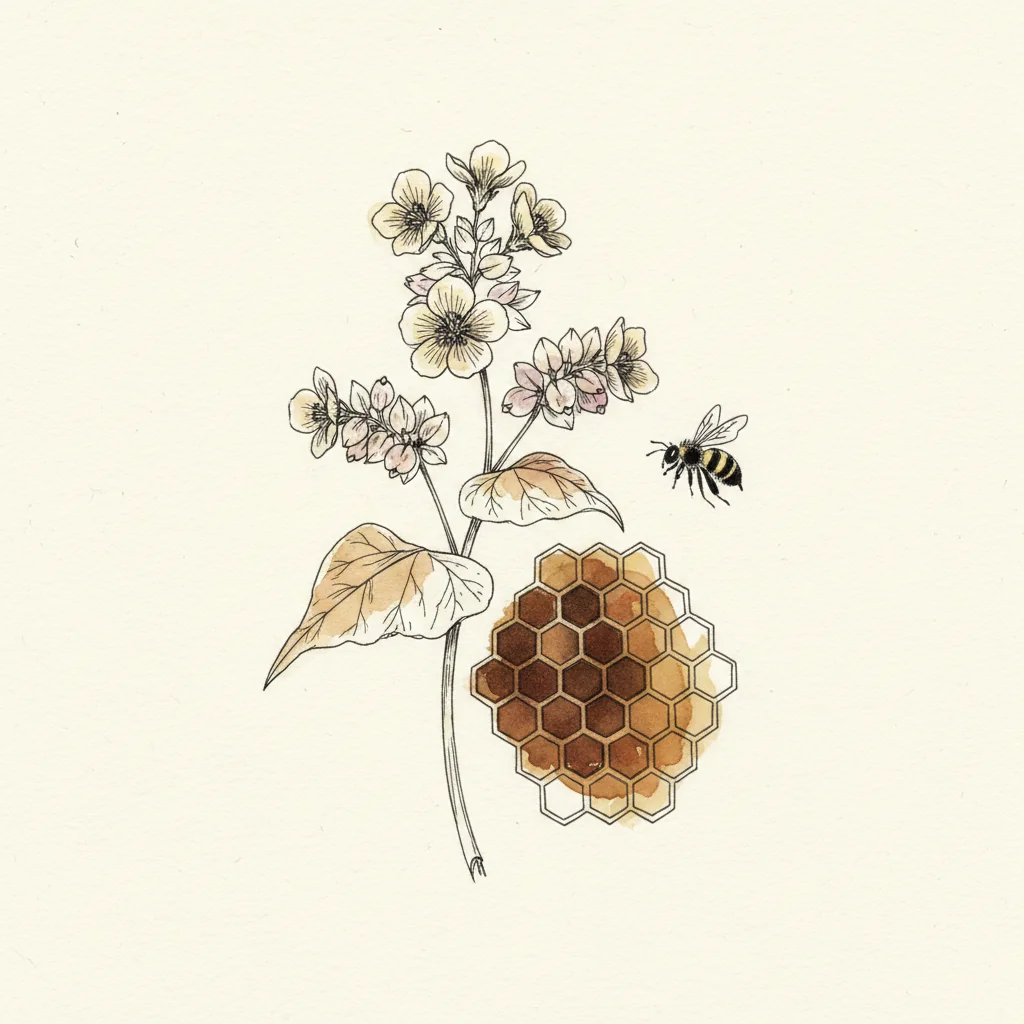
Honey · Monofloral honey
Buckwheat Honey
Upstate New York & Minnesota (also the Dakotas), United States
dark molasses · malt · barnyard funk
Aromatic profile
| Family | Fagopyrum esculentum (buckwheat blossom) |
|---|---|
| Intensity | ●●●●● (9/10) |
| Main notes | dark molasses · malt · barnyard funk |
| Secondary notes | stewed prune · brown bread · cocoa nib |
| Mouthfeel | thick, slow-pouring, coating, with a savory almost meaty edge unusual for honey |
| Finish length | long, a lingering malt-and-molasses finish that reads more like dark beer than flowers |
Culinary use
- When to add : raw, drizzled at the finish, or in a quick glaze off the heat
- Dosage : 1 teaspoon to 1 tablespoon per portion; start small, it dominates fast
- Ideal pairings : sharp aged cheddar and blue cheese, buttermilk biscuits and cornbread, barbecue glazes on ribs and pulled pork, buckwheat or whole-grain pancakes, plain whole-milk yogurt, a spoon stirred into black coffee or stout
- Avoid with : delicate teas and floral desserts (it bulldozes them), anything where you want a light, clean sweetness, high-heat baking where the funk turns flat and bitter
The grain in detail
Buckwheat honey is what happens when bees work the small white-and-pink blossoms of Fagopyrum esculentum, a fast-growing pseudo-cereal that is not a grass and not related to wheat at all. The flowers yield a famously dark nectar, and the honey that results is near-black, thick and slow to pour, sitting at the far opposite end of the spectrum from pale clover or acacia. The flavor is the headline: dark molasses, malt, brown bread and a savory, almost barnyard funk that newcomers either love on first taste or find startling. That funk is real and chemical, not a flaw. Buckwheat honey carries unusually high levels of aromatic and phenolic compounds, which is also why it tops most honeys for antioxidant content and why it shows up in old-fashioned cough remedies. In the United States the production heartland is the Northeast and Upper Midwest. Upstate New York has a long buckwheat-honey tradition tied to the grain's history as a cool-climate cover crop, and Minnesota and the Dakotas supply much of the raw, single-source buckwheat sold by small apiaries today. There is no PDO or PGI protection on American buckwheat honey, so the thing to read is the label, not a seal: look for raw, unfiltered, single-source, and ideally a named state, since a lot of supermarket buckwheat is blended or cut with cheaper honey to soften the funk. Crystallization runs slow to moderate; a jar may stay liquid for many months or set into a coarse, dark grain. Use it raw and at the end, where the aroma survives. It is built for strong partners: aged cheddar and blue cheese, buttermilk biscuits and cornbread, a brushed-on glaze for ribs or pulled pork, whole-grain pancakes, plain yogurt, and stirred straight into black coffee or a glass of stout. Keep it away from anything delicate, where it simply takes over.
History & origin
Buckwheat (Fagopyrum esculentum) was domesticated in Asia and reached North America with European settlers, becoming a major cool-climate crop across the Northeast in the 1800s, when it was milled for the buckwheat pancakes still on US breakfast tables. Acreage collapsed in the twentieth century as wheat and nitrogen fertilizer took over, and with it most buckwheat honey. The honey survived as a regional specialty in Upstate New York and, later, the Upper Midwest, where it is now harvested mainly by small family apiaries selling raw and unblended.
Provenance & authenticity
What sets the real thing apart — appellation, species and verification cues.
- Species
- Fagopyrum esculentum
Indicative price
Reference format : 12 oz jar — from $11.00 to $22.00 (median : $15.00).
Storage
Glass jar at room temperature, out of direct light. Crystallizes slowly to moderately into a coarse dark grain; warm the jar in a bowl of hot water to re-liquefy. Keeps for years.
Where to buy?
Where to buy it
Links checked on
Prices may vary depending on current promotions on the merchant site.
Alternatives if unavailable
Tags
- honey
- buckwheat
- monofloral
- Upstate New York
- Minnesota
- Fagopyrum esculentum
- raw honey
- USA
Frequently asked questions
- How do you store Buckwheat Honey?
- Glass jar at room temperature, out of direct light. Crystallizes slowly to moderately into a coarse dark grain; warm the jar in a bowl of hot water to re-liquefy. Keeps for years.
- What dosage for Buckwheat Honey?
- 1 teaspoon to 1 tablespoon per portion; start small, it dominates fast
- When should you add Buckwheat Honey in cooking?
- It's best used raw, drizzled at the finish, or in a quick glaze off the heat.
- What should you avoid pairing Buckwheat Honey with?
- Avoid with: delicate teas and floral desserts (it bulldozes them), anything where you want a light, clean sweetness, high-heat baking where the funk turns flat and bitter.
Go further
The dishes where this buckwheat honey shines
Also a recommended alternative for
As a complementary pairing with
See every dish where this product is mentioned →
Other oils, vinegars & honeys to discover
Featured in these gift sets
Page prepared according to our methodology. Purchase links marked sponsored and liable to earn a commission — details on our Affiliations page.