
Pink Peppercorns (Réunion Island, France)
In brief — Pink peppercorns aren't pepper at all. They're the dried fruit of a Brazilian pepper tree that ran wild on Réunion Island in the 1800s, so there's zero piperine and zero heat. What you get instead is a soft, sweet nose of juniper, pine resin and anise, and a bright rose color that turned gravlax and goat cheese pink for a generation of chefs. A small jar runs about $7. Buy it for the look and the perfume, not the bite. Its aromatic profile develops notes of sweet juniper, pine resin, anise, extended by candied citrus and dried flower, for an intensity of 4/10. In the kitchen, it's best added as a finishing touch and it pairs with salmon gravlax, fish carpaccio, fruit salad. Recommended dosage: a pinch crushed between the fingers over the finished plate, raw. Expect from $6.00 to $10.00 per 1.2 oz jar (median $7.50).
Origin : Réunion Island, western highlands, France
Schinus terebinthifolius
« Bought for the color, kept for the perfume: sweet juniper, resin, anise, never any heat. The Réunion grain beats the cheap Brazilian fill on aroma. Worth it on gravlax and goat cheese, pointless in a hot pan. »
Pink peppercorns aren't pepper at all. They're the dried fruit of a Brazilian pepper tree that ran wild on Réunion Island in the 1800s, so there's zero piperine and zero heat. What you get instead is a soft, sweet nose of juniper, pine resin and anise, and a bright rose color that turned gravlax and goat cheese pink for a generation of chefs. A small jar runs about $7. Buy it for the look and the perfume, not the bite.
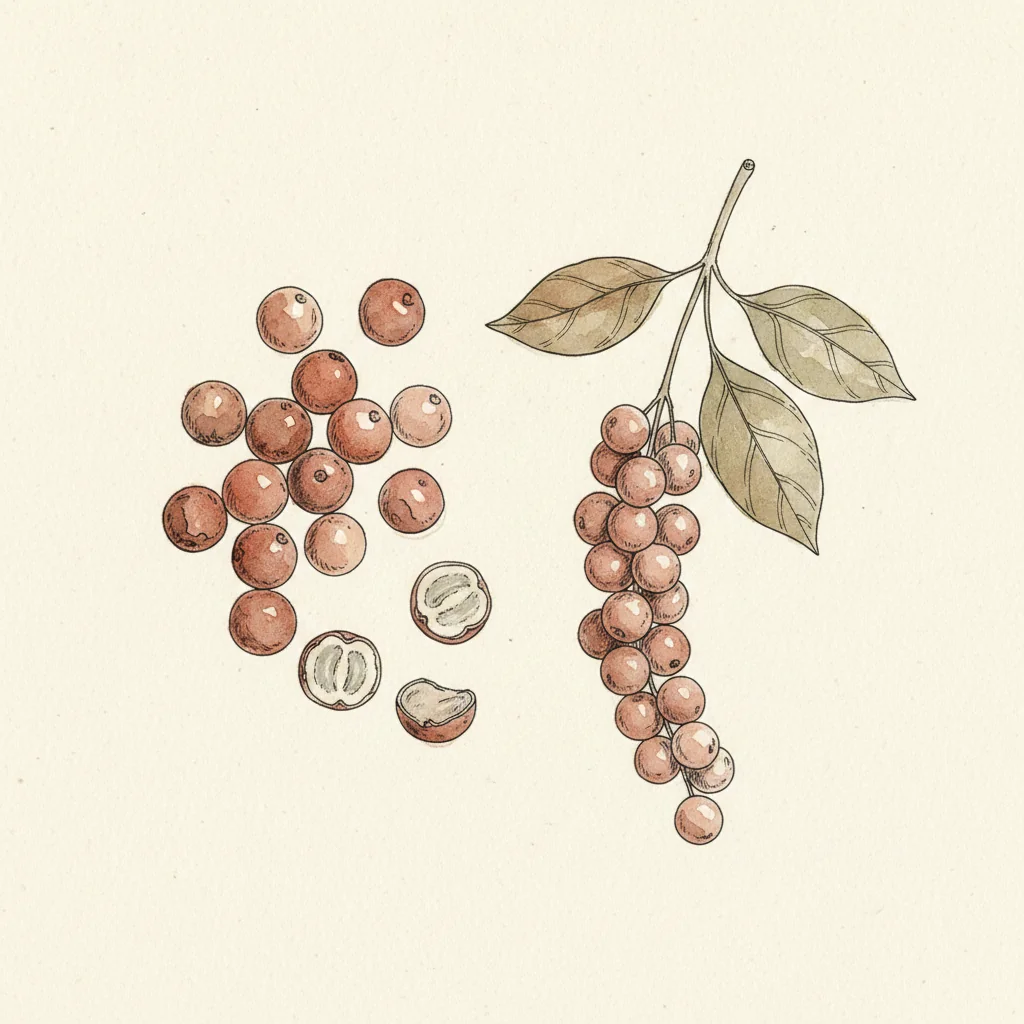
Pepper · Berry
Pink Peppercorns
Réunion Island, western highlands, France
sweet juniper · pine resin · anise
Aromatic profile
| Family | Schinus |
|---|---|
| Intensity | ●●○○○ (4/10) |
| Main notes | sweet juniper · pine resin · anise |
| Secondary notes | candied citrus · dried flower |
| Mouthfeel | almost sweet on the attack, a light resinous astringency on the finish, and no heat at all |
| Finish length | short to medium, with a resinous tail |
Culinary use
- When to add : finishing
- Dosage : a pinch crushed between the fingers over the finished plate, raw
- Ideal pairings : salmon gravlax, fish carpaccio, fruit salad, fresh cheeses, citrus vinaigrettes, goat cheese
- Avoid with : already heavily spiced dishes, long cooks (the perfume burns off), rare red meat
The grain in detail
Pink peppercorns (Schinus terebinthifolius) are the berries of the Brazilian pepper tree, a South American species that naturalized on Réunion Island, the old Île Bourbon, in the nineteenth century, where it spread so freely it counts as invasive. The berries are picked in clusters at full ripeness, bright red on the branch, then air-dried until they soften to that translucent rose. Botanically they have nothing to do with Piper nigrum: this is an Anacardiaceae, the same family as cashew, pistachio and mango. The grain is light and fragile, with a thin rose skin that crushes between your fingers. The nose is soft and layered: sweet juniper, pine resin, star anise, candied citrus, dried flower. On the palate the attack is almost sweet, followed by a faint resinous astringency. The thing to understand is that there's no heat: pink peppercorns carry no piperine, so they don't bite. That softness, plus the color, is exactly why modern Western kitchens adopted them in the 1980s nouvelle cuisine years. They're the visual signature of salmon gravlax, fish carpaccio, fresh cheeses and tropical fruit salads, and they earn their place on citrus vinaigrettes and goat cheese too. One real caution: because they share a botanical family with cashews, they can trigger reactions in people with tree-nut allergies. When you buy, look for a uniform bright rose and no stems. The Réunion supply chain stays small and hand-picked in the western highlands, with sun-drying, and it competes with cheaper Brazilian and Peruvian berries that are usually a step down.
History & origin
The Brazilian pepper tree was brought to Réunion in the nineteenth century as an ornamental before it naturalized at scale. For a long time the berries were treated as a weed; European chefs rediscovered them in the 1980s nouvelle cuisine wave, drawn by the color and the gentle sweetness. Today the harvest is run by a few Réunion cooperatives that export to Europe, where the island product competes with generally lower-grade Brazilian and Peruvian pink berries.
Provenance & authenticity
What sets the real thing apart — appellation, species and verification cues.
- Species
- Schinus terebinthifolius
How to verify the real one
- Schinus terebinthifolius (not a true peppercorn)
- Reunion (Ile Bourbon) origin
- fragile pink hollow berry
Indicative price
Reference format : 1.2 oz jar — from $6.00 to $10.00 (median : $7.50).
Storage
Airtight opaque jar; keeps 12 months with little loss. Crush to order.
Where to buy?
Where to buy it
Links checked on
| Merchant | Price | Action |
|---|---|---|
| Spicewalla | — | Spicewalla |
| Amazon US | — | Amazon US |
| Steenbergs UK | — | Steenbergs UK |
Prices may vary depending on current promotions on the merchant site.
Tags
- Réunion Island
- Bourbon
- Schinus
- berry
- salmon gravlax
- finishing
Frequently asked questions
- How do you store Pink Peppercorns?
- Airtight opaque jar; keeps 12 months with little loss. Crush to order.
- What dosage for Pink Peppercorns?
- a pinch crushed between the fingers over the finished plate, raw
- When should you add Pink Peppercorns in cooking?
- It's best used finishing.
- What should you avoid pairing Pink Peppercorns with?
- Avoid with: already heavily spiced dishes, long cooks (the perfume burns off), rare red meat.
Go further
The dishes where this pink peppercorns shines
Also a recommended alternative for
As a complementary pairing with
See every dish where this product is mentioned →
Other peppers to discover
Page prepared according to our methodology. Purchase links marked sponsored and liable to earn a commission — details on our Affiliations page.