
Wild Voatsiperifery Pepper (East-coast rainforest, Manakara, Madagascar)
In brief — Voatsiperifery is one of the only peppers still harvested entirely wild: a forest vine, Piper borbonense, that climbs Madagascar's east-coast rainforest. You spot the real thing by the tiny stem left on each berry. The flavor is woody and citrus-floral with a soft, resinous heat and a finish that runs nearly a minute. It's a finishing pepper for game and dark chocolate, around $11 for 20 grams. A splurge, but a singular one. Its aromatic profile develops notes of precious wood, fresh citrus, wild flowers, extended by pine resin and amber honey, for an intensity of 7/10. In the kitchen, it's best added as a finishing touch and it pairs with game and venison, seared duck breast, dark chocolate ganache. Recommended dosage: two or three berries crushed coarse in a mortar, added off the heat at the very end. Expect from $8.00 to $14.00 per 20g jar (median $11.00).
Origin : East-coast rainforest, Manakara and Mananjary districts, Madagascar
Piper borbonense
« A genuinely singular profile, resinous and woody with a finish that won't quit. The panel hesitated: gorgeous, but narrow, made for game and dark chocolate. The Malagasy supply chain stays fragile and the price swings with the harvest. »
Voatsiperifery is one of the only peppers still harvested entirely wild: a forest vine, Piper borbonense, that climbs Madagascar's east-coast rainforest. You spot the real thing by the tiny stem left on each berry. The flavor is woody and citrus-floral with a soft, resinous heat and a finish that runs nearly a minute. It's a finishing pepper for game and dark chocolate, around $11 for 20 grams. A splurge, but a singular one.
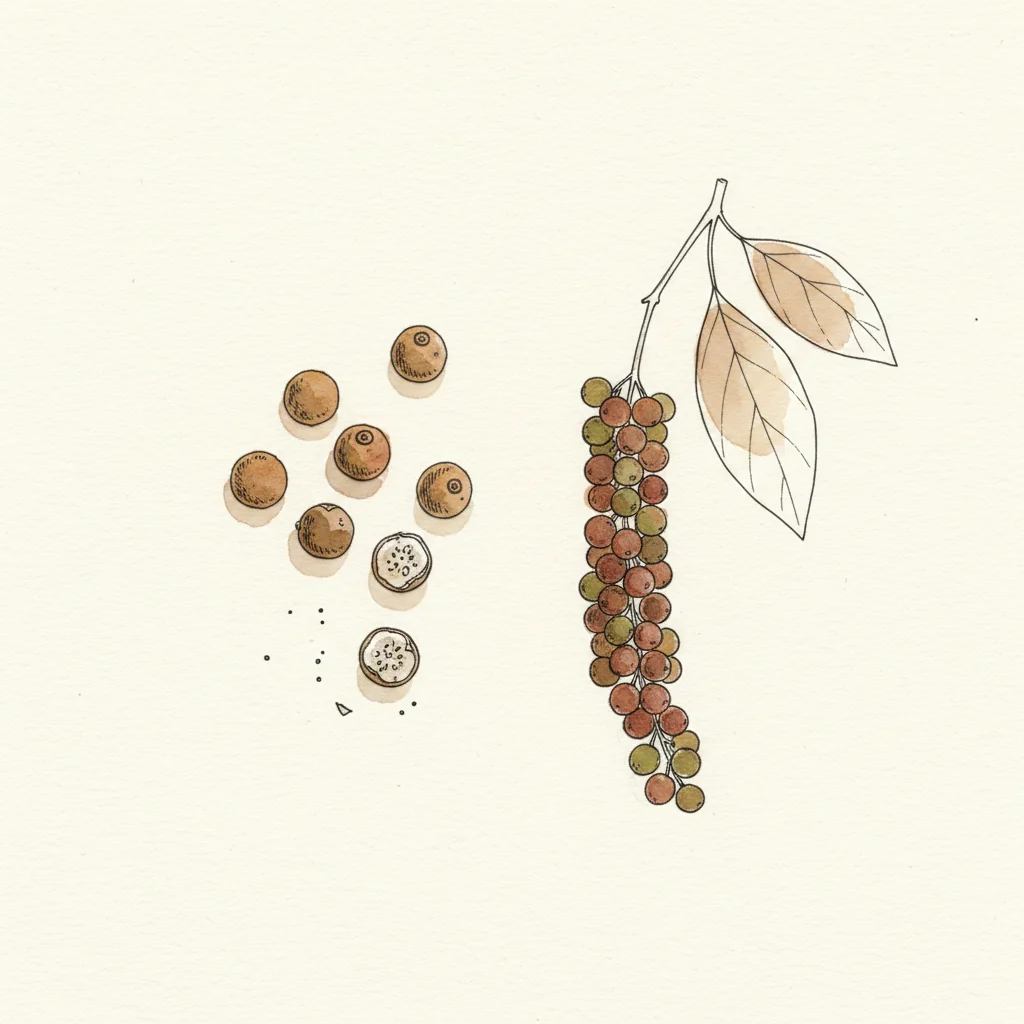
Pepper · Black pepper
Voatsiperifery Pepper
East-coast rainforest, Manakara and Mananjary districts, Madagascar
precious wood · fresh citrus · wild flowers
Aromatic profile
| Family | Piper borbonense |
|---|---|
| Intensity | ●●●●○ (7/10) |
| Main notes | precious wood · fresh citrus · wild flowers |
| Secondary notes | pine resin · amber honey |
| Mouthfeel | moderate, almost perfumed heat with a light resinous edge rather than a sharp bite |
| Finish length | very long, a woody finish that holds for the better part of a minute |
Culinary use
- When to add : finishing
- Dosage : two or three berries crushed coarse in a mortar, added off the heat at the very end
- Ideal pairings : game and venison, seared duck breast, dark chocolate ganache, roasted tropical fruit, grilled lobster, apple tarte tatin
- Avoid with : long braises and slow cooking (the volatile aromatics cook off), long marinades (the perfume fades before it works), anything already resinous, like a juniper cure (the notes collide)
The grain in detail
Voatsiperifery (say it voa-tsi-peri-feri, from the Malagasy voa, fruit, and tsiperifery, the local name for the vine) is one of the very few peppers still picked entirely in the wild. Piper borbonense, a distant cousin of cultivated black pepper, grows on its own in the primary rainforest of Madagascar's east coast, twisting up tall trees to twenty meters. There are no plantations, so harvesters climb for it, which is most of the reason it's rare and dear. The berries are sun-dried on mats, and you recognize the genuine article by the small stem left on each one, kept on purpose to prove the origin. The nose is anything but ordinary: precious wood, sandalwood and rosewood, fresh citrus and wild flowers, with a gentle pine resin underneath. On the tongue the heat is moderate, almost beside the point next to the aromatics, and the finish is exceptional, often holding past a minute. Here's why it belongs at the finish and not in the pot: those aromatic oils are volatile and cook off fast, so you add it raw or right at the end. It sings on game and venison, seared duck breast, grilled lobster, and just as well on dark chocolate ganache, apple tarte tatin and roasted tropical fruit. Crush two or three berries coarse in a mortar rather than running them through a mill, which preserves the oils. One warning worth its own line: a voatsiperifery with no stem, or one that's perfectly uniform in size, is rarely the real thing. The supply chain is fragile, and rainforest clearing is the standing threat to it.
History & origin
Known to the Betsimisaraka communities of the east coast for centuries, voatsiperifery stayed off international markets for most of that time, treated as a subsistence forage pepper rather than a cash crop. French chefs rediscovered it in the 2000s, with Olivier Roellinger among the early champions, and demand built from there. Cooperatives now organize the collection under rules meant to curb destructive, vine-killing harvesting, but pressure on the primary forest remains the defining problem for its future.
Provenance & authenticity
What sets the real thing apart — appellation, species and verification cues.
- Species
- Piper borbonense
How to verify the real one
- wild-harvested (not cultivated) from eastern Madagascar rainforest
- small tailed berries on stalk
- Piper borbonense - distinct from Piper nigrum
Indicative price
Reference format : 20g jar — from $8.00 to $14.00 (median : $11.00).
Storage
Airtight opaque jar, dry and out of the light. Keep the little stems intact and use within 18 months, since the resinous aromatics fade with age.
Where to buy?
Where to buy it
Links checked on
| Merchant | Price | Action |
|---|---|---|
| Amazon US | — | Amazon US |
| World Spice | — | World Spice |
| Sous Chef UK | — | Sous Chef UK |
Prices may vary depending on current promotions on the merchant site.
Alternatives if unavailable
Tags
- Madagascar
- wild-harvested
- Piper borbonense
- rare
- forest forage
- game
Frequently asked questions
- How do you store Voatsiperifery Pepper?
- Airtight opaque jar, dry and out of the light. Keep the little stems intact and use within 18 months, since the resinous aromatics fade with age.
- What dosage for Voatsiperifery Pepper?
- two or three berries crushed coarse in a mortar, added off the heat at the very end
- When should you add Voatsiperifery Pepper in cooking?
- It's best used finishing.
- What should you avoid pairing Voatsiperifery Pepper with?
- Avoid with: long braises and slow cooking (the volatile aromatics cook off), long marinades (the perfume fades before it works), anything already resinous, like a juniper cure (the notes collide).
Go further
The dishes where this voatsiperifery pepper shines
See every dish where this product is mentioned →
Other peppers to discover
Page prepared according to our methodology. Purchase links marked sponsored and liable to earn a commission — details on our Affiliations page.