
Tasmanian Pepperberry / Mountain Pepper (Tasmania, Australia)
In brief — Tasmanian pepperberry isn't a true pepper, but nothing else tastes like it: wild blueberry and black licorice up front, a stain of violet-black color, and a heat that arrives a beat late and then keeps climbing. Wild-harvested in Tasmania's cool rainforest, it signs game, blue cheese, and dark chocolate in a single crushed berry. A small jar runs about $12 to $15. Its aromatic profile develops notes of wild blueberry, black licorice, violet ink, extended by juniper and forest floor, for an intensity of 9/10. In the kitchen, it's best added as a finishing touch and it pairs with venison and game, seared duck breast, blue cheese. Recommended dosage: one or two berries, crushed; the intensity is several times that of black pepper, so go light. Expect from $11.00 to $18.00 per about 1.4-2 oz (40-57 g) jar of whole dried berries (median $14.00).
Origin : Tasmania, temperate rainforest understory, Australia
Tasmannia lanceolata
« A flavor with no rival: wild blueberry, licorice, then a heat that ambushes you late. The price stings and a little stains everything purple, but one berry genuinely sings on game and chocolate. »
Tasmanian pepperberry isn't a true pepper, but nothing else tastes like it: wild blueberry and black licorice up front, a stain of violet-black color, and a heat that arrives a beat late and then keeps climbing. Wild-harvested in Tasmania's cool rainforest, it signs game, blue cheese, and dark chocolate in a single crushed berry. A small jar runs about $12 to $15.
Pepper · Berry
Tasmanian Pepperberry
Tasmania, temperate rainforest understory, Australia
wild blueberry · black licorice · violet ink
Aromatic profile
| Family | Tasmannia (not a true pepper) |
|---|---|
| Intensity | ●●●●● (9/10) |
| Main notes | wild blueberry · black licorice · violet ink |
| Secondary notes | juniper · forest floor |
| Mouthfeel | delayed heat that builds for a few seconds, then floods in and lingers far longer than black pepper |
| Finish length | very long, with a licorice-sweet finish that stains the palate |
Culinary use
- When to add : finishing
- Dosage : one or two berries, crushed; the intensity is several times that of black pepper, so go light
- Ideal pairings : venison and game, seared duck breast, blue cheese, dark chocolate ganache, roasted beets, fresh goat cheese on toast
- Avoid with : delicate white fish (it bulldozes them), pale or clear sauces (the berry bleeds purple), bright acidic salads
The grain in detail
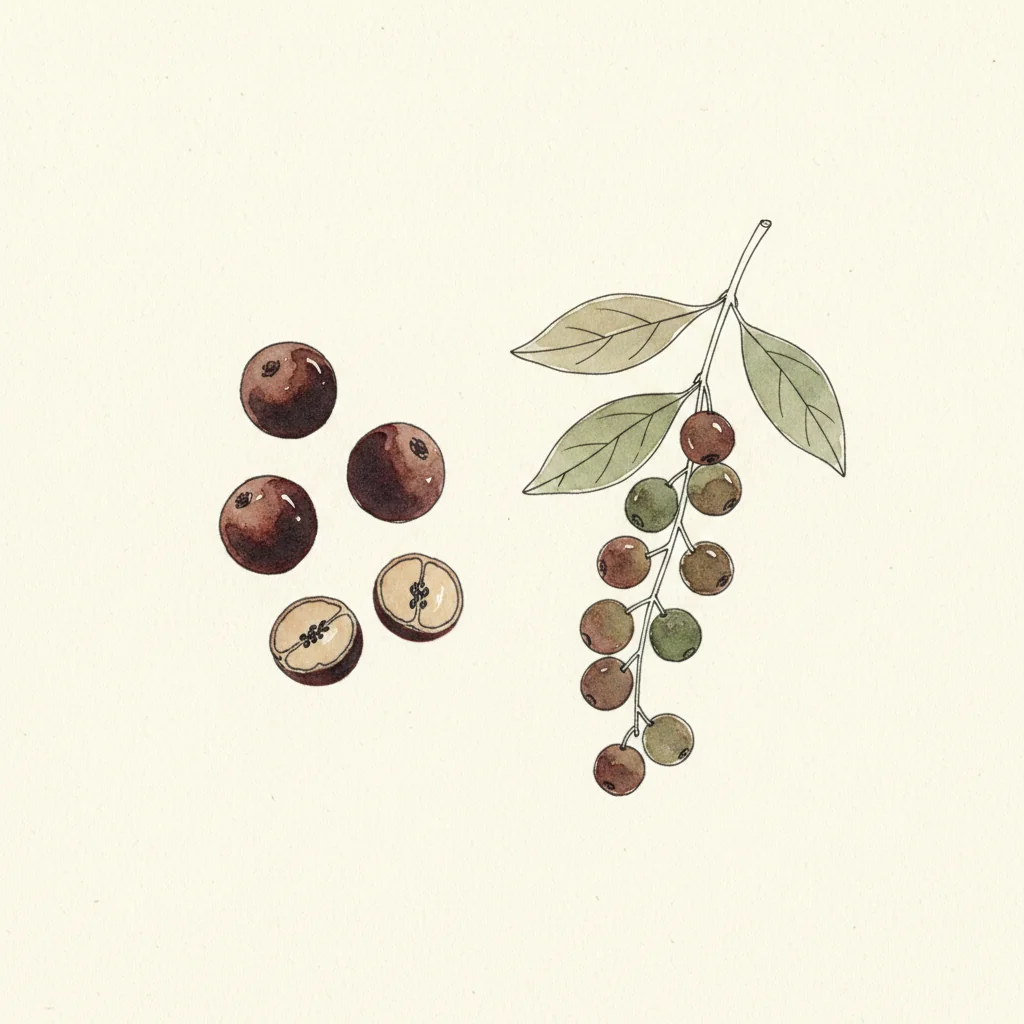
Tasmanian pepperberry is the dried fruit of Tasmannia lanceolata, a shrub native to the cool temperate rainforest of Tasmania, where it grows in the shade of giant eucalypts. The berries ripen from red to a deep purple-black and are mostly still wild-harvested by hand in autumn. Dried whole, they hold a near-black skin with violet highlights and bleed a purple pigment that will tint a sauce or a cream. The aroma hits immediately and throws you: wild blueberry, black licorice, violet ink, juniper, damp forest floor. No other spice combines berry fruit with resinous wood like this. But the real signature is the timing of the heat. For the first second or two you get sweet, almost fruity softness, and then a late explosion of warmth that lingers longer than ordinary black pepper. The heat comes from polygodial, a compound completely unlike the piperine in true pepper, which is exactly why the kinetics feel so strange. One berry is enough to sign a plate: roast venison, seared duck breast, a wedge of Roquefort, a dark-chocolate ganache, roasted beets, even goat cheese on toast. The supply chain is small and almost entirely artisanal, with wild foraging still the norm despite a few cultivation trials. Note that pepperberry is also sold as a leaf and as a milled powder, which are milder and easier to dose. Use the whole berry with a light hand: crush one, taste, then decide whether you need a second.
History & origin
Tasmania's Palawa Aboriginal peoples used the berry and leaf for thousands of years, in food and in medicine. It only reached Western tables late in the 20th century, carried by the Australian bush-food movement and championed by chefs like Peter Gilmore at Quay in Sydney. Wild harvest still dominates, though a handful of growers are now trialing cultivation to keep up with demand from European and Japanese buyers. It is regularly cited as roughly several times hotter than black pepper, which is why it is dosed by the single berry.
Provenance & authenticity
What sets the real thing apart — appellation, species and verification cues.
- Species
- Tasmannia lanceolata
How to verify the real one
- Tasmannia lanceolata (not a Piper)
- Tasmania cool-temperate forest origin
- intense magenta/purple stain
Indicative price
Reference format : about 1.4-2 oz (40-57 g) jar of whole dried berries — from $11.00 to $18.00 (median : $14.00).
Storage
Opaque airtight jar, away from light. Holds its punch about 18 months; light fades both the violet color and the aroma.
Where to buy?
Where to buy it
Links checked on
| Merchant | Price | Action |
|---|---|---|
| Amazon US | — | Amazon US |
| Steenbergs UK | — | Steenbergs UK |
Prices may vary depending on current promotions on the merchant site.
Alternatives if unavailable
Tags
- Australia
- Tasmania
- Tasmannia
- pepperberry
- mountain pepper
- bush food
Frequently asked questions
- How do you store Tasmanian Pepperberry?
- Opaque airtight jar, away from light. Holds its punch about 18 months; light fades both the violet color and the aroma.
- What dosage for Tasmanian Pepperberry?
- one or two berries, crushed; the intensity is several times that of black pepper, so go light
- When should you add Tasmanian Pepperberry in cooking?
- It's best used finishing.
- What should you avoid pairing Tasmanian Pepperberry with?
- Avoid with: delicate white fish (it bulldozes them), pale or clear sauces (the berry bleeds purple), bright acidic salads.
Go further
The dishes where this tasmanian pepperberry shines
Also a recommended alternative for
See every dish where this product is mentioned →
Other peppers to discover
Featured in these gift sets
Page prepared according to our methodology. Purchase links marked sponsored and liable to earn a commission — details on our Affiliations page.