
Pillar guide
American & Monofloral Honeys: Tupelo to Manuka
The honest guide to buying single-origin honey in the US: tupelo, sourwood, buckwheat, chestnut, acacia and manuka. Real flavor profiles, real prices, the fraud to dodge, and exactly which jar to buy for the cheese board, the biscuit, and the medicine cabinet.
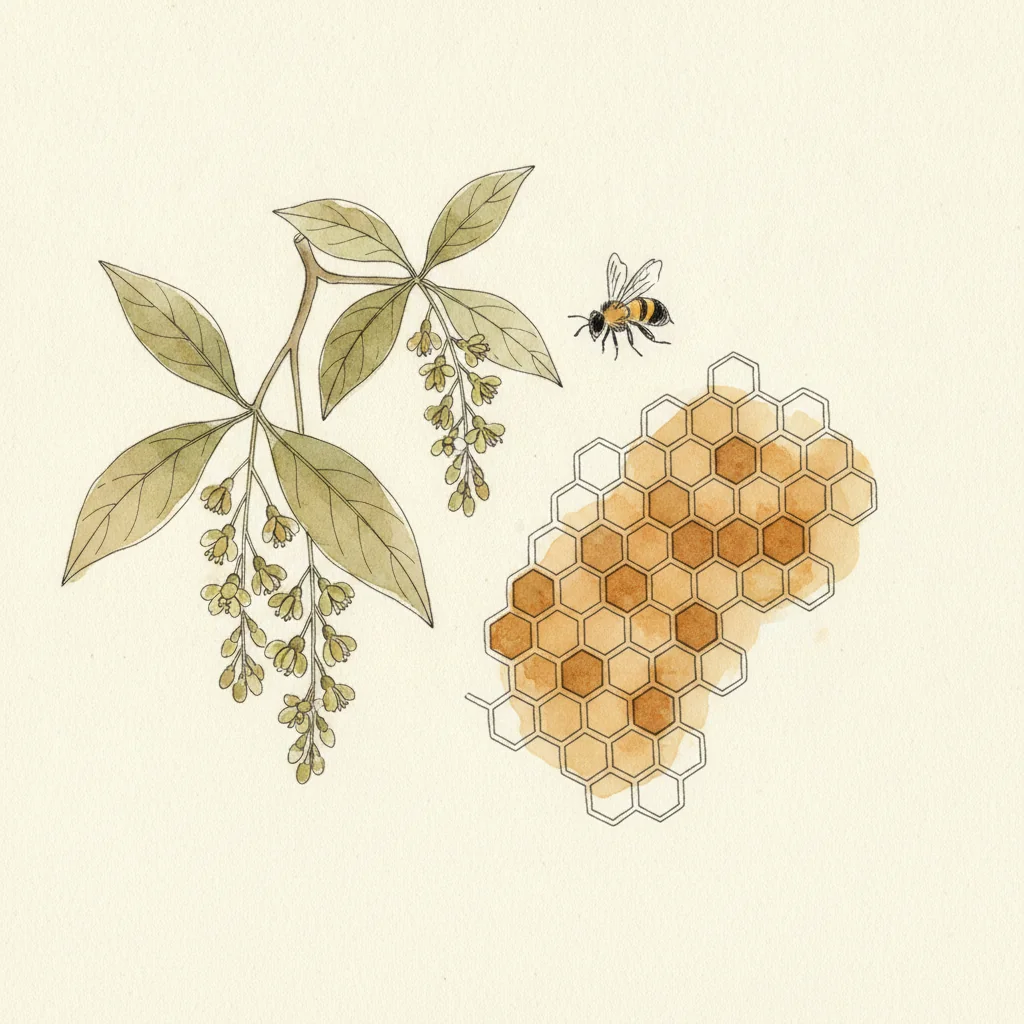
Forget the squeeze bear. The honey that's worth real money is single-origin and single-floral, and which one you buy depends entirely on what you're doing with it. Want sweetness with manners on a goat-cheese crostini? Acacia, about $14–$20 a jar, stays glassy-clear and never argues. Building a cheese board around a Roquefort? You want the tannic bite of chestnut honey, around $15 for 250 g. Chasing the rarest American jar there is? That's tupelo (about $20, refuses to crystallize) or sourwood ($14–$22, tastes like gingerbread). Want a barbecue glaze with backbone, or something for the cough-and-cold shelf? Buckwheat ($12–$20) and manuka ($30–$90) respectively. Six honeys, six jobs. Here's how to tell them apart and which to actually buy.
In this guide
- What "monofloral" actually means
- The six honeys, by job
- How to choose (and dodge the fraud)
- How to use it
- What to skip
- FAQ
What "monofloral" actually means
A monofloral honey comes mostly from the nectar of a single plant — typically above 45 percent, with serious producers holding chestnut and similar varietals to 70 percent or more of the analyzed pollen. Bees don't read maps, so beekeepers get there one of two ways: they truck or barge the hives onto a single bloom at the right two or three weeks, or they keep bees where one species dominates the landscape outright, the way chestnut forests do in the Cévennes.
That short bloom window is the whole reason these honeys cost what they do. Tupelo flowers for barely three weeks in April. Sourwood for two or three in July. Acacia and chestnut about the same. Miss the weather and a beekeeper pulls an empty crop, which is why a wet July in the Appalachians can wipe out the sourwood harvest entirely. You are paying for scarcity and labor, not marketing — when the honey is real.
Here's the catch that runs through everything below: the United States has almost no appellation protection for honey. There's no PDO on tupelo, sourwood, buckwheat or American-sold acacia. The lone exception in this lineup is Corsican chestnut, covered by the Mele di Corsica — Miel de Corse PDO since 2000. Everywhere else, your only defense against a "tupelo blend" cut with clover is the name of a real producer on the label. Honey is one of the most adulterated foods on Earth, and the premium varietals are exactly where the fraud lives.
The six honeys, by job
Acacia — the one that doesn't talk back
Acacia honey (about $14–$20 a 16 oz jar) is the palest, mildest honey on the shelf, and that's the point. It doesn't come from true acacia at all but from black locust, Robinia pseudoacacia, a North American tree that took over the Hungarian plain centuries ago and now blooms white across the Carpathian Basin every May.
Profile: soft floral sweetness, a whisper of vanilla, clean sugar, zero bitterness. It pours thin and reads water-clear.
Why it stays liquid: acacia nectar is unusually high in fructose and low in glucose, so it resists crystallization and stays glassy for years where most honeys set hard. That clarity is a chemistry signature, not a processing trick.
Use it for: fresh goat cheese and burrata, Greek yogurt and granola, sweetening green and herbal teas without clouding the flavor, a neutral note in vinaigrettes and cocktails. Skip it against a strong blue — it gets buried, and you've wasted a good jar on a fight it can't win.
Chestnut — the savory one
Chestnut honey (around $15 for an 8.8 oz / 250 g jar) is the only honey that reads savory. It's dark, near-treacle brown, and carries a frank, tannic bitterness no other honey has. The Italian chestnut belt — Tuscany's Garfagnana, Piedmont, the Asiago plateau — sets the benchmark, with southern France (Cévennes, Corsica) right alongside. The Corsican lots carry that PDO.
Profile: wood tannin, noble bitterness, roasted chestnut, dark caramel, soft leather, a faint licorice tail. It finishes woody and frankly bitter, and that's the feature.
Use it for: the cheese board, full stop. It argues with the salt in a Roquefort or Gorgonzola instead of fawning over it, holds its own against aged goat cheese, and brushed on as a fast glaze it gives a seared duck breast a caramelized, savory edge. If you came looking for a sweet breakfast honey, this is not it. US shoppers should look for Italian importers like Mieli Thun, Giannetti Artisans or Rigoni di Asiago.
Buckwheat — the dark, loud American workhorse
Buckwheat honey (about $12–$20 a 12 oz jar) pours like motor oil and tastes of molasses. It's the boldest honey on the American shelf and the one most people meet by accident, expecting clover and getting hit with malt and funk instead. Upstate New York and Minnesota are the heartland, tied to buckwheat's old life as a cool-climate cover crop.
Profile: dark molasses, malt, brown bread, and a savory, almost barnyard funk. That funk is chemical, not a flaw — buckwheat carries unusually high phenolic and aromatic compounds, which is also why it tops most honeys for antioxidant content and shows up in old-fashioned cough remedies.
Use it for: strong partners only. Sharp aged cheddar and blue cheese, buttermilk biscuits and cornbread, a brushed-on glaze for ribs or pulled pork, whole-grain pancakes, and stirred straight into black coffee or a stout. Keep it far from delicate teas and floral desserts — it bulldozes them.
Tupelo — the honey that refuses to crystallize
Tupelo honey (about $20 a 12 oz jar) comes from one tree in one swamp: white tupelo, Nyssa ogeche, growing in the flooded bottomlands of the Apalachicola River basin in Florida's Panhandle, around Wewahitchka. The bloom lasts barely three weeks in mid-April, so beekeepers float their hives out on barges to keep the bees off competing nectar. That narrow window is the price tag.
Profile: buttery and floral, with a clear note of fresh pear and a soft caramel finish — far less cloying than table honey. Pale gold with a faint green cast.
Why it stays liquid: like acacia, tupelo runs higher in fructose than glucose, so it stays pourable for years instead of setting hard. That property is also the fraud bait, since cheaper honey gets relabeled "tupelo" to ride the name.
Use it for: raw, off the heat — on a warm buttermilk biscuit, over sharp cheddar or a wedge of blue, stirred into yogurt, or melted into hot tea where it never clumps. Buy from a named Florida producer; the Lanier, Smiley and Savannah Bee names are the trusted ones, and look for "white tupelo," not "tupelo blend." The L.L. Lanier family has worked this honey near Wewahitchka since 1898.
Sourwood — the gingerbread honey beekeepers hide for themselves
Sourwood honey (about $14–$22 a 16 oz jar) is the one serious Southern beekeepers chase and most cooks never taste. It comes from Oxydendrum arboreum, a slender understory tree that blooms for two or three weeks in July across the Southern Appalachians of North Carolina, Georgia and Tennessee. A wet July washes the nectar out; a dry one keeps the bees grounded. Either way it's a vintage product that varies year to year.
Profile: buttery caramel up front, then warm baking-spice notes — gingerbread, cinnamon, a whisper of anise — finishing on ripe stone fruit. Lighter-bodied than chestnut or buckwheat, slow to crystallize, never bitter.
Use it for: raw and cold, where the aromatics survive. Warm biscuits and cornbread, sharp cheddar or fresh goat cheese, Greek yogurt and oatmeal, and honestly straight off the spoon. Genuine Appalachian sourwood has twice taken top honors at Apimondia, the international beekeeping congress — buy from a named mountain apiary and treat anything suspiciously cheap as suspect.
Manuka — the one you buy for the lab number, not the flavor
Manuka honey ($30–$90 for a 250 g jar at UMF 10+) is the New Zealand monofloral you buy for its methylglyoxal, not its taste. MGO forms from the dihydroxyacetone naturally present in Leptospermum scoparium nectar, and the more of it, the higher the measurable antibacterial activity — and the price.
Read the number. Two systems run side by side. UMF (Unique Manuka Factor) grades several markers at once; MGO is the direct reading in mg/kg. Rough map: UMF 10+ ≈ MGO 263, UMF 15+ ≈ MGO 514, UMF 20+ ≈ MGO 829. For a daily spoonful or any kitchen use, UMF 10+ / MGO 263+ is plenty; the UMF 20+ jars run $80–$150 and are for the medicine cabinet.
Profile: dense, nearly thick at room temperature — cooked honey, eucalyptus, licorice, menthol and iodine over a noble bitterness you don't expect from honey.
Use it for: raw, by the spoon, stirred into warm (never boiling) tea, over Greek yogurt, on salted-butter toast. Since 2018 New Zealand has required a mandatory five-marker test before any honey can be exported as manuka, so the certified marker on the jar now matters more than the brand on it.
How to choose (and dodge the fraud)
The name is your appellation. With only Corsican chestnut PDO-protected in this lineup, the producer's name does the work a seal would. For US honeys, that means a named Florida tupelo house, a named Appalachian sourwood apiary, a named Upstate New York or Minnesota buckwheat keeper. "Tupelo blend" or unsourced "sourwood" at a suspiciously low price is the fraud signal.
For manuka, demand UMF or MGO. Without one of those lab-tested markers, you're statistically buying blended honey at a single-origin price. The number is the only thing worth the premium.
Use the crystallization test. Tupelo and acacia run high in fructose and should stay liquid for years — if your "tupelo" sets hard in three months, be suspicious. Chestnut crystallizes very slowly, sometimes never; slow or absent crystallization there is a good sign, not spoilage. Buckwheat sets slowly to moderately into a coarse dark grain, which is normal. Sourwood crystallizes slowly. None of these should be artificially kept liquid by pasteurization — look for "raw" and "unfiltered."
Honest market prices (June 2026, US): acacia $14–$20 (16 oz); chestnut $12–$22 (8.8 oz / 250 g); buckwheat $11–$22 (12 oz); tupelo $13–$29 (12 oz); sourwood $14–$22 (16 oz); manuka $30–$90 (250 g at UMF 10+), climbing to $80–$150 for UMF 20+. A single-origin varietal selling for a few dollars is industrial blend wearing a fancy label.
Buy glass, store dark. Honey oxidizes in light. A tinted-glass or opaque jar in a cupboard keeps the aromatics you paid for.
How to use it
Raw, off the heat, almost always. Every honey here loses its volatile aromatics and enzymes above about 104°F (40°C). The whole reason you bought single-origin is the aroma — cook it into a 350°F bake and you've paid varietal money for plain sweetness you could've squeezed from a bear. Finish with it; don't bake with it.
Match the honey to the strength of the dish. Delicate food wants acacia or tupelo. Loud food — blue cheese, barbecue, dark bread — wants buckwheat or chestnut. Sourwood splits the difference with its spiced complexity. Manuka is a spoon-and-tea honey, not a cooking honey.
Doses are small. A teaspoon to a tablespoon per portion across the board. Buckwheat and chestnut dominate fast, so start at the low end and taste.
If you must heat, use the cheap stuff. A honey-soy glaze caramelizing on ribs is real cooking — but it destroys most of the aromatic compounds, so reach for a basic clover honey and save the chestnut for the cheese board. A manuka in a marinade is the worst offense: heat breaks down the MGO you paid $40 for. Keep manuka for warm-not-boiling uses only.
Storage. Sealed jar, out of the light, 65–72°F. Honey is saturated in sugar and doesn't spoil chemically — edible honey has been pulled from 3,000-year-old Egyptian tombs — but it loses aroma past 18–24 months. If a jar sets and you want it runny, warm it in a water bath under 104°F, never the microwave.
What to skip
Uncertified "manuka." No UMF, no MGO, no deal. You're paying $30 for honey worth a fraction of that.
Manuka as a cure-all. The antibacterial activity is real and lab-measured — it's used in licensed wound dressings — but that's topical and clinical. The broader wellness claims are unproven, and heating it for a recipe destroys the active compound entirely.
"Tupelo blend" and bargain sourwood. Both names get borrowed by cheaper honey precisely because they command a premium. No named producer, no buy.
Pasteurized supermarket honey. Many shelf honeys are heated to 158°F+ to stay liquid and pretty, which leaves an inert, flat product. Look for "raw," "unpasteurized," "unfiltered."
Honey for babies under one year. Risk of infant botulism from Clostridium botulinum spores. Standard pediatric advice: no honey before twelve months, any variety, no exceptions.
Honey in boiling tea. At 212°F you kill the enzymes and volatiles. Add it once the cup has dropped to drinking temperature.
FAQ
Is manuka honey worth the price?
Only if you want its lab-tested antibacterial activity or its singular medicinal-eucalyptus profile. A UMF 10+ / MGO 263+ jar at $30–$40 has a real, measurable effect. For purely culinary use — toast, marinades, the cheese board — a French chestnut honey gives you more character for a fifth of the price. Skip uncertified jars entirely.
What's the difference between buckwheat and chestnut honey?
Both are dark and bold, but they diverge on the finish. Buckwheat is sweet-savory molasses and malt with a barnyard funk — built for barbecue, biscuits and aged cheddar. Chestnut is genuinely tannic and bitter, more savory than sweet, the cheese-board honey that stands up to a Roquefort. Buckwheat dominates by sheer weight; chestnut by bitterness.
Which American honey is the rarest?
Tupelo and sourwood trade the title. Both come from a single tree blooming for two or three weeks, and a bad-weather year can wipe out the crop entirely. Tupelo is the harder to source — one swamp basin in the Florida Panhandle — while sourwood is a Southern Appalachian vintage that beekeepers often keep back for themselves.
Why doesn't tupelo (or acacia) crystallize?
Chemistry. Both run higher in fructose than glucose, and it's glucose that drives crystallization. That high-fructose balance keeps them pourable for years. It's also why "tupelo" is a favorite fraud target — staying liquid is the easy property to fake with a cheap blend, so buy on producer name, not on clarity alone.
How long does an open jar of honey keep?
Indefinitely, chemically — it's saturated in sugar and doesn't spoil. But it loses its aroma past 18–24 months and its enzymes sooner, so the single-origin notes you paid for fade. Store in a sealed, opaque jar at 65–72°F, out of the light. Crystallization is normal; re-liquefy in a water bath under 104°F, never the microwave.
Can you cook with medicinal-grade manuka?
You can, but it's a waste. The MGO that justifies the price degrades above about 104°F, so a UMF 20+ jar stirred into a hot marinade destroys the one thing you paid for. Keep medicinal manuka for warm-not-boiling uses — tea off the boil, yogurt, toast. For actual cooking, a basic honey at a fraction of the cost does the same job.
The bottom line
Six honeys, six jobs. Acacia for sweetness without backbone, chestnut and buckwheat for the cheese board and the barbecue, tupelo and sourwood for the rare single-origin spoonful, manuka for the lab number on the lid. Reasonable spend across the lineup runs $60–$120 — buy raw, buy from a named producer, and store it dark.
The catch: honey is one of the most adulterated foods on the planet. A 2023 European Joint Research Centre study tested 320 imported lots and flagged roughly 46 percent as suspected of adulteration — sugar-syrup cutting, false origin labels, fake monoflorals. The fraud clusters on imported honey and uncertified manuka. The US has almost no appellation defense, so your protection is the producer's name on the jar: a named Florida tupelo house, a named Appalachian sourwood apiary, a UMF or MGO marker on the manuka. No name, no number — assume it's a blend.
Chef's note: taste your honey neat before you build anything around it. One teaspoon on the tongue at room temperature, let it melt for ten seconds, and read the attack, the middle and the finish. An honest monofloral shows its signature in about three seconds — tannic bitterness for chestnut, molasses-and-malt for buckwheat, pear-and-caramel for tupelo, gingerbread spice for sourwood, eucalyptus-iodine for manuka. An industrial blend opens flat-sweet with no shape. Run the same test six months after opening to see how far the aroma has faded.
Tasting note:
- notes:
clean vanilla(acacia) ·wood tannin(chestnut) ·dark molasses funk(buckwheat) ·pear-caramel(tupelo) ·gingerbread spice(sourwood) ·eucalyptus-iodine(manuka) - value: $60–$120 to cover the lineup, $14–$90 a jar depending on the honey. Cheap supermarket "varietals" are blends — pay for the named producer or don't bother. No honey for babies under twelve months.
Methodology: these recommendations follow our methodology. Purchase links are marked sponsored and earn us a commission at no extra cost to you — see our affiliate policy.
Products cited in this guide
-
Honey · Varietal honey
Tupelo Honey
Apalachicola River basin, Florida (Wewahitchka, Gulf County), United States
-
Honey · Monofloral honey
Sourwood Honey
Southern Appalachians (North Carolina, Georgia, Tennessee), United States
-
Honey · Monofloral honey
Buckwheat Honey
Upstate New York & Minnesota (also the Dakotas), United States