Pillar guide
A World Atlas of Salt: Rock, Sea and Mineral — the complete guide
The reference guide to specialty salt: Himalayan pink, Persian blue, Hawaiian red Alaea and black lava, kala namak, sel gris de Guérande PGI and Diamond Crystal kosher. Origins, real uses, honest US prices, and the marketing traps to skip.
One salt won't cut it, and you don't need twelve. Here's the honest split: Diamond Crystal kosher is the salt you cook with, the one you season by feel into pasta water, brines and meat before the sear. Sel gris de Guérande PGI is the damp, mineral coarse salt for the same jobs when you want depth. Everything else on this page is a finishing salt, used raw, off the heat, at the last second: Persian blue for the rare, kaleidoscopic flourish; Hawaiian red Alaea and black lava Hiwa Kai for color and a soft mineral edge; kala namak when you want that hard-boiled-egg sulfur note. And Himalayan pink — the most over-marketed of the lot — earns its keep as a sear block and a pretty rim, nothing more. Here's how a serious kitchen actually divides them up.
In this guide
- How salt is made: three families
- The salts worth knowing
- How to choose
- How to use
- What to skip
- Frequently asked questions
How salt is made: three families
Specialty salt sorts into three technical families, and the family tells you almost everything about how to use it.
Surface sea salts. Seawater is concentrated in shallow pans and the sun does the rest; the crystals are skimmed or raked by hand. Sel gris de Guérande belongs here — raked from the clay floor of the pans on the Loire-Atlantique coast, hand-harvested since the 9th century, PGI-protected today. Maldon, Halen Môn and the fleurs de sel are its cousins. These salts carry real mineral character and, in the damp ones, a little built-in moisture.
Rock (mined) salts. Fossil seabeds, dug out of the ground. Himalayan pink comes from the Khewra mine in Pakistan's Salt Range — not India, not the Himalayas proper — worked since the 1500s; its pink is just fossilized iron oxide. Persian blue comes from the Semnan desert mines in Iran, and its color is the strangest thing in the salt world: natural sylvinite, a potassium mineral that bends light inside the crystal. Kala namak starts as fossil rock salt too, a close cousin of Himalayan pink, before it's transformed.
Worked salts. A base salt plus a process. Hawaiian red Alaea is Pacific sea salt blended during crystallization with iron-rich red volcanic clay from Kauai. Black lava Hiwa Kai is Pacific sea salt cut with activated coconut-shell charcoal — the black is charcoal, not volcanic mineral, whatever the label implies. And kala namak is kiln-fired with charcoal and botanicals until it picks up its sulfur note. The process is the product here.
The salts worth knowing
The two workhorses: Diamond Crystal and sel gris
Diamond Crystal kosher salt (about $11 for a 3 lb box) is the cook's salt, full stop. It's made by the Alberger process, which produces light, hollow, pyramid-like flakes rather than dense cubes. Those flakes crush between your fingers, cling to food, and dissolve fast — and they're hard to over-salt with, which is exactly why it's the American test-kitchen default. Additive-free, in production since 1886. Use it to season meat before the sear, salt pasta and vegetable water, build brines and dry-brines, and mix doughs. This is the salt you season by feel; it is not a finishing salt and there's no point crushing it over a plate.
Sel gris de Guérande PGI (about $7 a kilo) is the other workhorse, the salt the paludiers actually live on. Where fleur de sel is skimmed as a thin veil off the surface, sel gris is raked from the clay floor of the pans, which is why it stays grey and a little damp. Clean, direct salinity, real mineral depth, faint marine iodine. Reach for it for stocks and court-bouillon, bread dough, lacto-fermentation, and a salt crust for whole fish. Like Diamond Crystal, it's a cooking salt — don't waste it as a finish.
Persian blue: the rare one
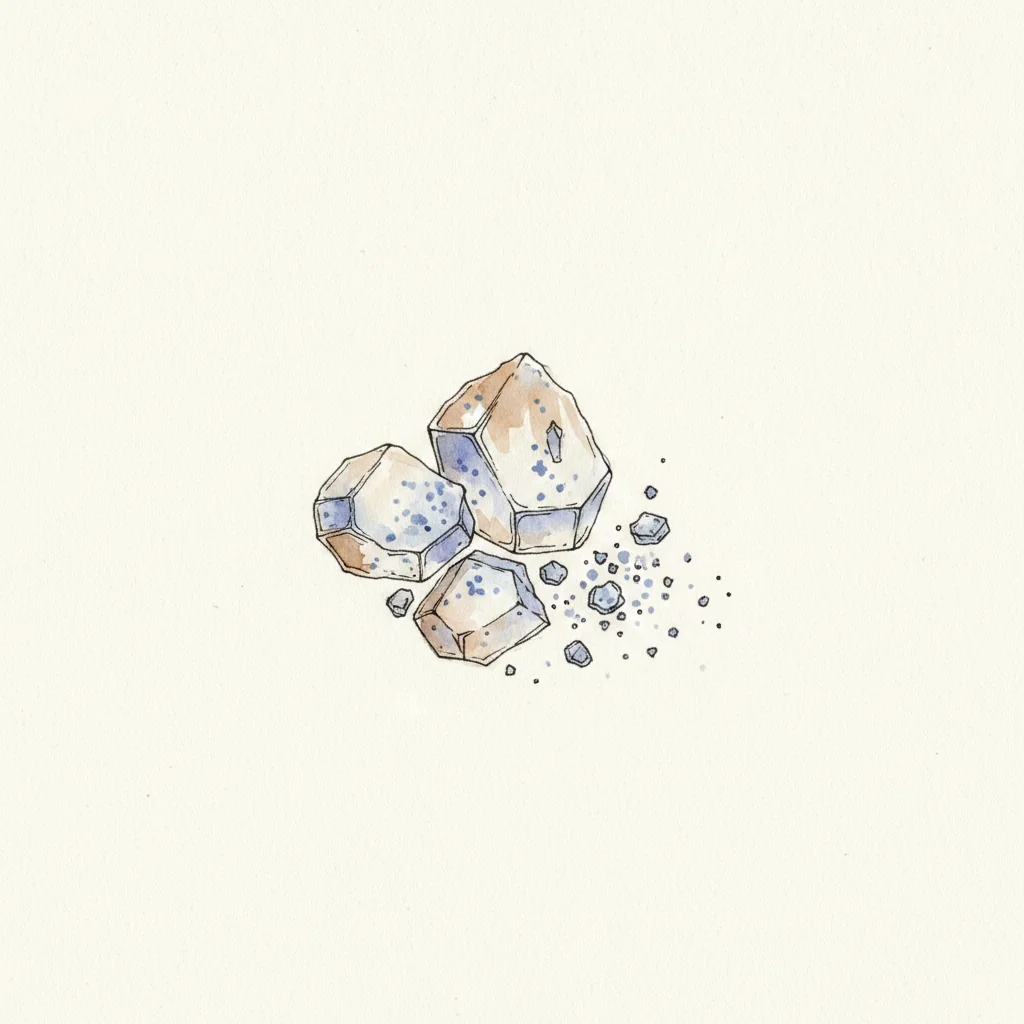
Persian blue salt (about $13.50 per 100 g) is the rarest salt on this page and one of the rarest you can buy anywhere. It comes from a handful of fossil mines in Iran's Semnan province, worked since at least the sixth century BC, when it was reserved for the Persian royal table. The pale-blue-to-indigo color is no additive: it's sylvinite trapped in the crystal, bending light. The salinity is round and clean with a cold-stone minerality and a quiet umami finish. Use it raw, in tiny amounts, where the look matters as much as the taste: seared foie gras, raw scallops and crudo, beef carpaccio, shaved white truffle, a soft-boiled egg on toast. Three crystals per bite, not a pinch — at this price, you're seasoning with tweezers.
Hawaiian red Alaea: poke and pork
Hawaiian red Alaea salt (about $10 for a 4 oz jar) takes its name from the Hawaiian alae, red earth. Sea water is evaporated, then the crystals are mixed with alaea, a baked volcanic clay loaded with iron oxide that turns them anywhere from pale rust to deep copper. Native Hawaiians have used it for over a thousand years, as food, as a preservative, and in blessings. The salinity is soft and round with an iron-mineral, faintly earthy edge — nothing like plain table salt. Scatter it raw over the plated dish: ahi poke bowls, kalua pork, grilled or roasted pineapple, seared salmon, a red cocktail rim on a margarita or paloma.
Black lava Hiwa Kai: the visual finish
Hawaiian black lava salt (Hiwa Kai) (about $8 per 100 g) is solar-evaporated Pacific sea salt blended with activated charcoal made from roasted coconut shells — which is what makes it glossy black, not any volcanic mineral. Production centers on Molokai. The salinity is round and clean with a faint smoke and a soft, velvety trace from the charcoal. You buy it for the contrast: jet-black crystals scattered over seared rare tuna, raw scallops, deviled and soft-boiled eggs, hummus and white bean dips, sushi and poke, even white panna cotta or salted caramel. Finishing only, off the heat — cooked into a dish, the visual payoff and the faint smoke both vanish.
Kala namak: the egg salt
Kala namak (about $8 for a 4 oz jar) isn't black despite the name — the crystals are a dark red-brown with violet glints. What makes it singular is the smell: a vivid hard-boiled-egg note that comes from kiln-firing fossil rock salt with charcoal and botanicals, a craft used in Ayurvedic medicine for over 2,000 years. It's the backbone of Indian chaat, and it's the secret weapon of vegan cooks who want eggy flavor without eggs. Use it raw or off the heat at the very end: fruit and savory chaat, tofu scramble, vegan mayo and chickpea omelet, yogurt raita, green mango, cucumber, hummus. Store the whole crystals, not powder — the sulfur aroma fades faster once it's ground.
Himalayan pink: the famous one
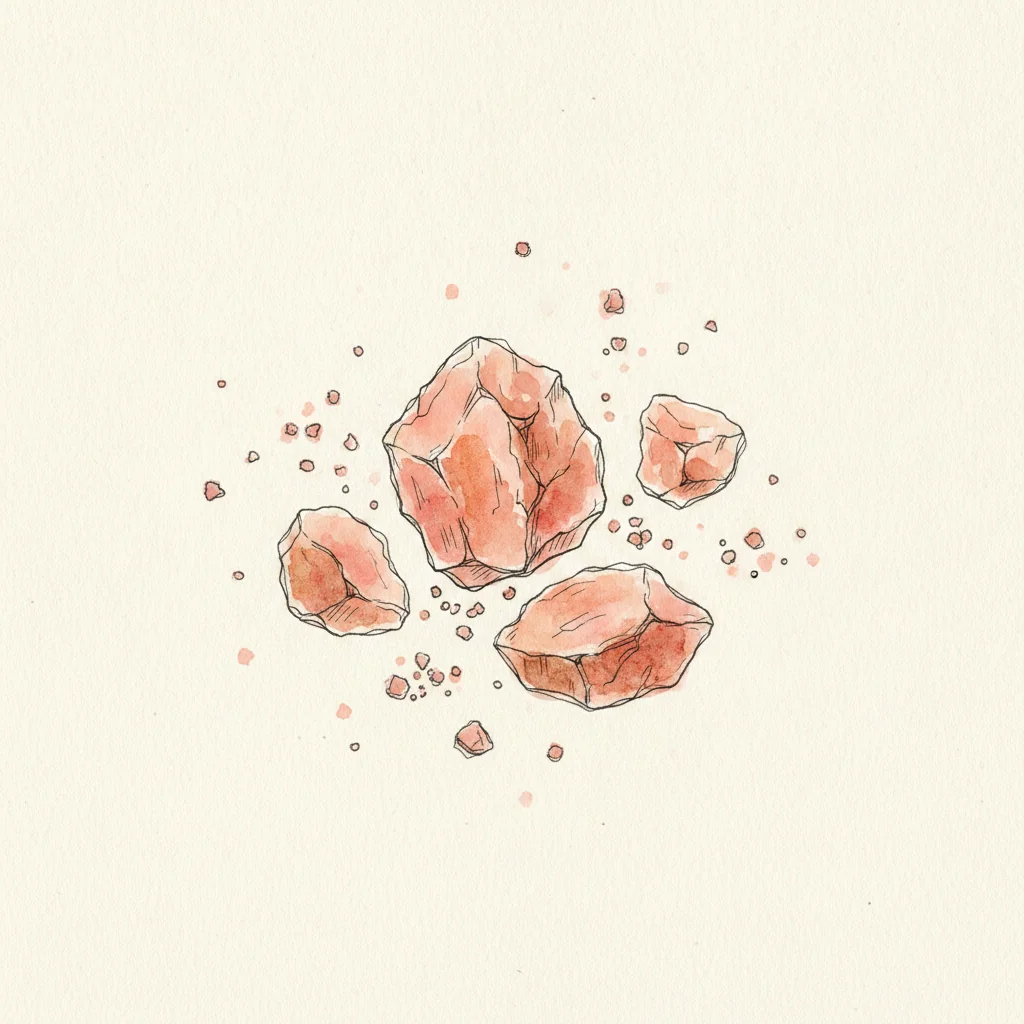
Himalayan pink salt (about $11 for a 2 lb fine-grain bag) is the most marketed salt of the last twenty years, and most of what you've heard about it is wrong. It's mined at Khewra in Pakistan — roughly 300 km from the mountains the name borrows — and the pink is fossilized iron oxide, not a sign of purity or trace-mineral magic. Khewra produces around 350,000 tonnes a year, one of the largest non-marine salt outputs on earth, and for most of its history it sold as basic industrial salt. The salinity is rounder than a sea salt, the minerality warm. Where it genuinely earns a place: a steak seared on a hot pink salt block, a carpaccio or tomato salad finished with the coarse grind, a margarita rim. Buy it for the look and the block, never for the "84 minerals."
How to choose
Match the family to the job. Cooking salt (Diamond Crystal, sel gris) goes in the water, the brine, the dough. Finishing salt (Persian blue, the Hawaiian pair, kala namak) goes on the plate, raw, last. Get this one split right and you've made 90% of the decision.
Look for protected origin where it exists. Sel gris de Guérande is PGI-protected and hand-harvested — that's a real, verifiable provenance, not a label flourish. For the mined and worked salts, there's no appellation; judge them on the producer and a clear single origin (Khewra, Semnan, Molokai, Kauai, Sindh).
Mind the grain. Fine grains dissolve into water and dough. Coarse damp crystals (sel gris) suit cooking and salt crusts. Hard fossil crystals (Persian blue, Himalayan) are slow-dissolving, so crush or grate them for a finish. Light hollow flakes (Diamond Crystal) are the easiest to season by feel.
Honest US market prices (June 2026): Diamond Crystal kosher about $10–14 a 3 lb box; sel gris de Guérande about $5–10 a kilo; Himalayan pink about $8–14 for a 2 lb bag; kala namak about $5–12 a 4 oz jar; black lava Hiwa Kai about $5–11 per 100 g; Hawaiian red Alaea about $8–12 a 4 oz jar; Persian blue about $10–16 per 100 g. Anyone charging far above these for the same grade is selling you the marketing.
Color isn't quality. Pink, blue, black and red salts are, first and foremost, a visual finish. A colored salt earns its price on origin or process, not on the hue alone — Persian blue (a true geological rarity) and Alaea (real volcanic clay) earn it; pink Himalayan mostly doesn't.
How to use
Cook with the cheap one, finish with the precious one. A specialty salt that's been boiled in pasta water has lost everything you paid for. Reach for Diamond Crystal or sel gris for any internal seasoning; save the colored and aromatic salts for the moment just before service.
Dose in crystals, not pinches, for finishing salt. With Persian blue, three crystals per bite — you should see them, not hunt for them. With Hiwa Kai or Alaea, a light scatter across the plated dish so the color reads. With kala namak, a few grains off the heat: it's potent, and too much turns sulfur into rotten egg.
Friendly supports:
- Seared foie gras, scallops, white truffle: Persian blue, a few crystals, raw.
- Ahi poke, kalua pork, grilled pineapple: Hawaiian red Alaea, scattered at the end.
- Seared rare tuna, deviled eggs, salted caramel: black lava Hiwa Kai, for the contrast.
- Tofu scramble, vegan omelet, fruit chaat: kala namak, off the heat.
- Salt-block steak, tomato salad, margarita rim: Himalayan pink.
- Pasta water, brines, dry-brining a roast: Diamond Crystal or sel gris.
Storage. Airtight, opaque jars away from humidity. Salt is a mineral, not an organic ingredient — the plain salts keep indefinitely. The worked and aromatic salts are the exception: kala namak holds its egg note about 18 months, and the Hawaiian charcoal and clay are stable for years. Keep a dedicated dry spoon per jar; one wet spoon and your finishing salt clumps into a crust.
Heads up on the grill word: if a recipe says "grill the steak," on a US page that's open flame. A salt that survives a sear can scorch under a broiler — finish under direct heat, then salt, never the reverse.
What to skip
Himalayan pink "for your health." This is wellness marketing, full stop. The famous "84 trace minerals" are present in quantities so small you'd have to eat a toxic amount of salt to get any nutritional effect. Khewra is a commodity mine running 350,000 tonnes a year; there's nothing rare or curative about it. Buy it for the salt block and the look — for a colored salt with a real story, spend on Alaea or Persian blue instead.
Finishing salt in the pot. Crush Persian blue into a braise and you've dissolved a $13.50-per-100g salt into invisibility — any coarse salt would have done the identical seasoning job. The same goes for Alaea and Hiwa Kai: the color and the mineral edge only register raw, on the plate.
Pre-ground colored salt in a shaker. For everyday cooking, fine. For Hiwa Kai and Persian blue, no — you're paying for crystals you'll never see, and ground kala namak loses its sulfur aroma fast.
A wet spoon in the jar. The fastest way to ruin a specialty salt. Moisture from a damp or metal spoon clumps the crystals and dulls the aromatics. One dedicated dry spoon per salt, and you double the useful life of the stock.
One salt for everything. The dense-cube table salt habit. It's fine for the water, but it brings nothing to a finish, and a colored salt brings nothing to the braise. The split — one cooking salt, one or two finishing salts — is the whole point.
Frequently asked questions
What's the difference between cooking salt and finishing salt?
Cooking salt (Diamond Crystal kosher, sel gris de Guérande) goes into water, brine and dough, where it dissolves and seasons from within — you want it cheap and easy to dose. Finishing salt (Persian blue, the Hawaiian salts, kala namak) goes on top of the plated dish, raw and last, for texture, color or aroma the heat would destroy. A serious kitchen keeps at least one of each.
Is Himalayan pink salt actually healthier than table salt?
No. It's sodium chloride like any other salt, with traces of iron oxide for the color. The "84 essential minerals" claim is marketing — those minerals are present in such tiny amounts that you'd need to eat a dangerous quantity of salt to get a meaningful dose. Buy it for the salt block, the carpaccio finish and the look, not for any health benefit.
What is kala namak and why does it smell like eggs?
Kala namak is Indian black salt — really a dark red-brown — made by kiln-firing fossil rock salt with charcoal and botanicals. That process gives it sulfur compounds that read as hard-boiled egg. It's the signature of Indian chaat and the go-to for vegan cooks simulating egg flavor in tofu scrambles and vegan mayo. Add it raw or off the heat at the very end, and store the whole crystals to keep the aroma.
Why is Persian blue salt so expensive?
Because it's genuinely rare. It comes from a small number of fossil mines in Iran's Semnan desert, and the blue is natural sylvinite — a potassium mineral that refracts light inside the crystal — not a dye. At about $13.50 per 100 g it's a finishing salt you measure in crystals: three on a slice of foie gras or a raw scallop, never cooked into a dish.
How long does specialty salt keep?
Plain salt is a stable mineral and keeps essentially forever — Himalayan pink, Persian blue, sel gris and Diamond Crystal won't spoil. The exceptions are the aromatic and worked salts: kala namak holds its egg note about 18 months, and smoked salts have a roughly 12–18-month aromatic life. Keep everything in airtight, opaque jars away from humidity, with a dedicated dry spoon.
In short
Seven salts, two jobs. One cooking salt you season by feel (Diamond Crystal, with sel gris for mineral depth), and a short bench of finishing salts for the plate: Persian blue for rarity, Alaea and Hiwa Kai for color, kala namak for eggy umami, Himalayan pink for the salt block and the look. A realistic year's spend for a curious kitchen runs $50–80 across four or five rotating salts. If you're stuck, the Oracle crosses your dish against your flavor profile and tells you the exact grain to buy.
The catch
Here's the one nobody selling salt will tell you: "Himalayan pink salt" is one of the most over-marketed products of the last two decades. The Khewra mine runs about 350,000 tonnes a year — most of it ends up as table salt, cooking blocks and decorative lamps. It's neither rare nor curative. If you want a colored salt that actually means something, buy Hawaiian red Alaea (real sea salt cut with real volcanic clay) or Persian blue (a true geological rarity), and skip the wellness pitch entirely.
Chef's note
The move that doubles your stock's life: pull salt from the jar with a dry wooden spoon, never a wet or metal one. Moisture from a damp spoon clumps finishing salt into a crust and dulls the aromatics. With kala namak it's worse — touched with a wet hand, the sulfur note flattens in weeks instead of holding eighteen months. One dedicated dry spoon per specialty jar costs nothing and buys you twice the useful shelf life.
Tasting note
- notes:
marine iodine · cold stone · iron earth · sulfur egg · soft smoke - value: $5–14 a jar across the colored and aromatic salts, $7–11 for the cooking workhorses. Spend on the cooking salt you'll actually use daily; treat the colored salts as cheap visual luxury — and skip the Himalayan-pink health upsell, which is the one thing here that isn't worth a cent.
Methodology: these recommendations follow our methodology. Purchase links are marked sponsored and earn us a commission at no extra cost to you — see our affiliations.